

Construction site fire extinguisher inspection cost in 2026 requires a written, site-specific quote that identifies the equipment and work included. Separate routine inspection and maintenance from recharging, hydrostatic testing, replacement equipment, and any visit charges before you approve the job.
- Construction site fire extinguisher inspection cost needs a defined scope; compare written quotes for the same equipment and work.
- NFPA 10 separates monthly visual inspections from annual maintenance; a quick check does not replace service.
- Firstlinefire provides fire extinguisher inspection and service for commercial and industrial customers across its six-state service area.
- List recharging, hydrostatic testing, and replacements separately so corrective work does not disappear inside the inspection total.
Why this matters
A quote for checking extinguishers is not the same as a quote for servicing them. If one contractor includes corrective work and another excludes it, their totals do not describe the same job.
Firstlinefire provides fire extinguisher inspection and service for commercial and industrial customers in Kentucky, Illinois, Indiana, Tennessee, Missouri, and Alabama. Firstlinefire is a fit for commercial and industrial teams that need fire extinguisher inspection and service within that service area. Confirm the construction-site scope before booking; the service description alone does not establish what a particular quote includes.
How much does fire extinguisher inspection cost at a construction site?
Use a written quote with separate lines for the visit, routine service, and corrective work. That gives you a usable construction-site budget instead of a figure that hides exclusions.
For your 2026 project, ask the contractor to identify the number of extinguishers covered, their types, their locations, and the records you receive. Request a clear approval process for any additional work found during service.
The word inspection often hides several different tasks. Use this breakdown when you compare proposals.
| Work | Best for | What it addresses | Limitation to check |
|---|---|---|---|
| Visual inspection | Routine site checks | Presence, accessibility, visible condition, and charge indication where fitted | Does not replace maintenance or internal testing |
| Maintenance | Scheduled equipment service | Examination and corrective work appropriate to the extinguisher | Confirm whether parts and recharging are included |
| Recharging | Restoring a serviceable rechargeable extinguisher after use or loss of charge | Extinguishing agent and pressurization | Does not make a damaged cylinder acceptable |
| Hydrostatic testing | Extinguishers due for cylinder pressure testing | Cylinder integrity under the applicable test procedure | Does not replace routine inspection or maintenance |
| Replacement | Equipment condemned or unsuitable for continued service | Providing an appropriate replacement extinguisher | Requires a separate equipment decision |
Ask whether the contractor uses annual inspection as shorthand for annual maintenance. The label on a proposal matters less than the actual work described beneath it.
A maintenance quote should also explain what happens when an extinguisher fails examination. You need a documented disposition, not just a new tag and an unexplained invoice line.
Routine inspection: check the equipment, not just the tag
A visual inspection checks whether an extinguisher is present, accessible, and visibly ready for use. Look for damage, missing components, blocked access, and an abnormal pressure indication when the extinguisher has a gauge.
NFPA 10, the portable fire extinguisher standard, calls for inspections at least monthly, with more frequent checks when circumstances require them. Construction sites change as work advances. Recheck access and placement after equipment moves, storage changes, or a new work area opens.
A monthly check is not annual maintenance. An employee's visual inspection does not establish that the cylinder has passed pressure testing or that internal maintenance is current.
For a 2026 inspection log, identify the extinguisher and record its actual location. A note that says only all extinguishers checked is harder to act on when a unit later goes missing.
Annual maintenance: specify the service and the record
NFPA 10 requires maintenance at intervals of no more than 1 year, as well as when an inspection or other condition indicates a need. Annual maintenance is a separate task from the monthly visual inspection.
Ask the service contractor what the maintenance line covers. Identify the equipment examined, the corrective work performed, and any equipment removed from service.
Do not assume every extinguisher needs the same procedure. Agent, construction, manufacturer instructions, and service history determine the applicable work.
Your maintenance record should let you match the technician's findings to a specific extinguisher. A location list and equipment identifier make that possible, especially when several subcontractors bring similar units onto the same job.
Internal maintenance and hydro testing: separate the due work
For rechargeable stored-pressure dry chemical extinguishers subject to a 12-year hydrostatic test interval, NFPA 10 generally requires internal maintenance every 6 years. Those intervals do not apply to every extinguisher type.
The 6-year internal maintenance interval and the 12-year hydrostatic test interval are different requirements. Internal maintenance examines the extinguisher's internal condition; hydrostatic testing evaluates cylinder integrity through the prescribed pressure test.
Ask the contractor to identify which units are due for which procedure. Use the extinguisher type, markings, and service records rather than assuming that every unit with the same appearance has the same due date.
For your 2026 service request, mark known due work separately from routine maintenance. That allows you to approve a defined scope and plan continued fire protection while equipment is being serviced.
Why construction site fire extinguisher inspection cost varies
The work requested determines what a quote covers. Give each contractor the same information so you can compare the same job.
- Equipment count. State how many extinguishers need inspection or maintenance. Separate the site's equipment from subcontractor-owned units.
- Extinguisher type. Identify the agent, rating, and cylinder type where available. Different extinguishers require different service procedures.
- Service history. Provide the last maintenance, internal maintenance, and hydrostatic test records. Due work changes the scope.
- Equipment condition. Report discharged units, damage, corrosion, missing parts, and abnormal gauge readings before the visit.
- Site access. Describe gates, check-in requirements, work areas, and where each unit can be reached. Ask how the contractor treats access restrictions in the quote.
- Included work. Confirm the treatment of documentation, corrective work, recharging, testing, and replacements. Do not infer inclusion from the word inspection.
These are scope questions, not a reason to accept an unexplained total. Require the contractor to state which items are included and which need additional authorization.
How do I get a comparable construction-site inspection quote?
Build one equipment list and send the same scope to every contractor. Compare like-for-like work before you compare totals.
- Equipment list. Record each extinguisher's identifier, type, rating, location, and owner. Include vehicle-mounted units only when you want them covered by this service request.
- Service history. Gather readable photographs of labels, tags, and test markings, plus existing service reports. Flag records you cannot match to a unit.
- Site access. Name the person who can open gates and escort the technician where required. Explain whether extinguishers are spread across floors, trailers, or separate work areas.
- Written scope. Request routine service and known due work as distinct items. Ask what documentation the contractor supplies and how corrective work is authorized.
- Approval limits. Identify who can approve additional work and how that approval is recorded. Agree on the process before the technician finds a problem.
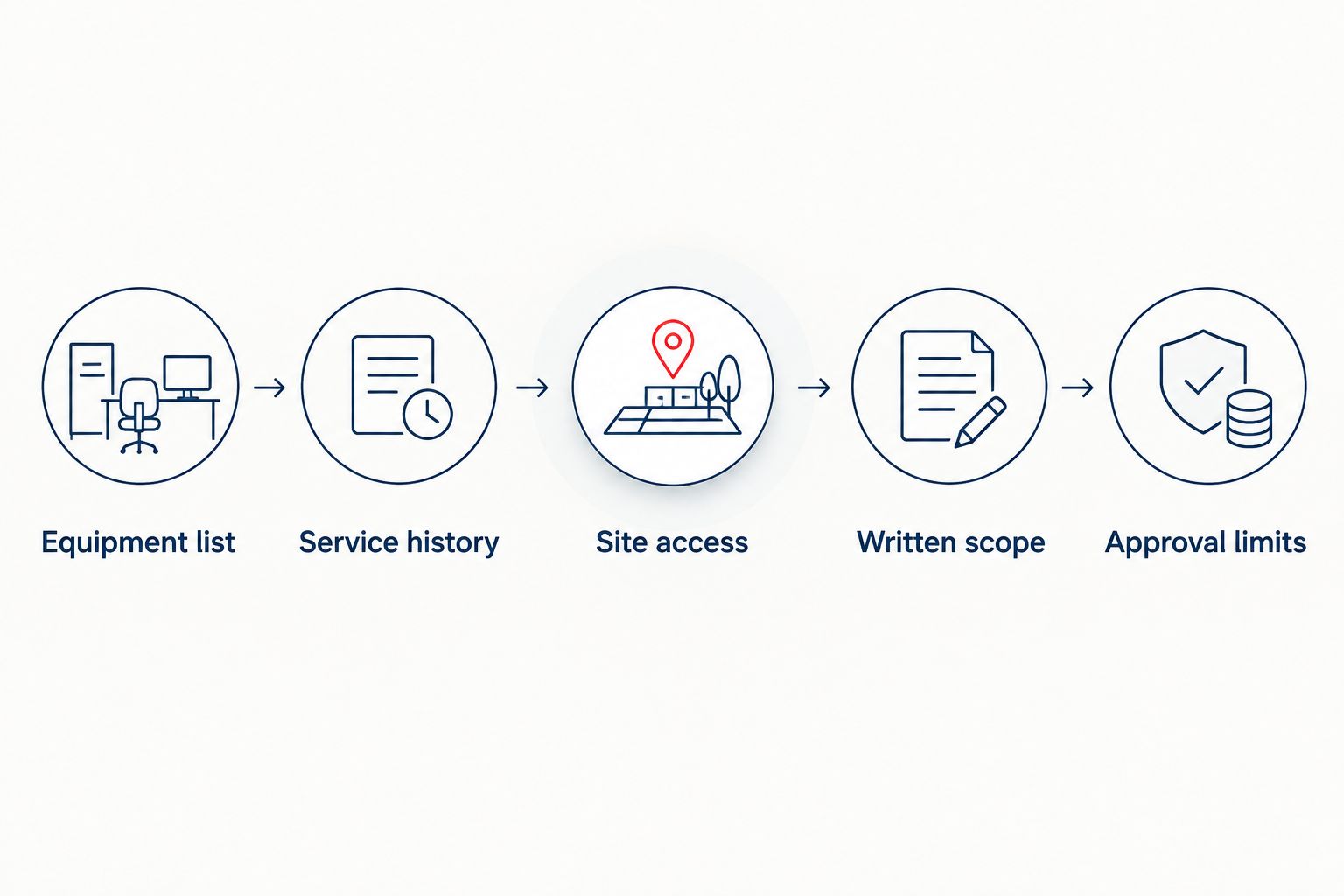
Keep ownership clear. A general contractor's equipment list should not silently absorb subcontractor equipment unless that is the agreed service scope.
Before the visit, ask who will arrange continued protection if equipment must leave its assigned location. Do not remove required extinguishers simply to make the technician's route easier.
Request extinguisher service
Discuss the site, equipment list, and inspection and maintenance scope with Firstlinefire.
What paperwork should I receive after the inspection?
Request a record that connects each finding to an identifiable extinguisher. You should be able to distinguish equipment that remains in service from equipment needing corrective work.
Keep the following information together:
- The equipment identifier and serviced location.
- The service date and work performed.
- Defects found and corrective action taken.
- Equipment removed from service and its disposition.
- Applicable maintenance and test information.
- Any work that remains open.
Use the extinguisher service records to OSHA compliance logs workflow to organize the handoff between service records and your site files. Keep the original service report rather than relying only on a summary entered elsewhere.
For a 2026 project file, assign someone to close unresolved findings. Receiving a report is not the same as correcting the problems listed in it.
Can our crew handle the monthly checks?
Your crew can perform routine visual inspections when the assigned person understands what to check and how to report defects. Monthly inspections under NFPA 10 do not replace maintenance at intervals of no more than 1 year.
Give the checker an equipment list and a clear escalation process. A missing extinguisher, blocked access, visible damage, or abnormal gauge reading needs action, not just an entry in a log.
Keep inspection responsibility separate from repair authority. Do not have an unqualified worker open, recharge, pressure-test, or improvise repairs to an extinguisher.
Does a current tag mean the construction site is compliant?
A current tag does not establish that extinguisher placement meets construction-site requirements. Under OSHA's construction rule, 29 CFR 1926.150, specified building areas require an extinguisher rated at least 2-A for each 3,000 square feet of protected area, or major fraction, with travel distance no greater than 100 feet.
Those figures address a specific provision, not every construction hazard. Flammable liquids, hot work, and other conditions require their own review under applicable rules.
Service condition and placement are separate checks. A maintained extinguisher behind locked access or far from the area it must protect does not solve the placement problem.
Should I approve recharging instead of replacement?
Approve recharging only after the service contractor determines that the rechargeable extinguisher is suitable for continued service. A discharged unit does not automatically need replacement, but damage or a failed required test changes that decision.
Ask for the reason behind the recommendation. Distinguish a rechargeable extinguisher needing agent from a nonrechargeable unit or a cylinder that must be condemned.
Do not let a replacement decision obscure the original defect. Record which unit was removed and confirm that the replacement is appropriate for its assigned hazard and location.
FAQ
How much does fire extinguisher inspection cost at a construction site in 2026?
Construction site fire extinguisher inspection cost requires a written quote for the specific equipment and service scope. Ask for routine service, visit charges, recharging, hydrostatic testing, and replacement equipment to be identified separately.
What's the difference between a monthly check and annual maintenance?
A monthly check is a visual inspection; annual maintenance is a separate examination and service task. NFPA 10 requires maintenance at intervals of no more than 1 year, and sooner when conditions require it.
Can I inspect construction-site extinguishers myself?
You can perform routine visual inspections when you understand the checks and reporting process. Do not treat that check as authorization to open, recharge, repair, or pressure-test the extinguisher.
Does every extinguisher need hydrostatic testing every 12 years?
No, the 12-year hydrostatic test interval applies to specified extinguisher types, not every extinguisher. Identify the cylinder and agent type and use the applicable NFPA 10 requirements and manufacturer instructions.
Is recharging included in an extinguisher inspection quote?
Recharging is included only when the written quote says so. Ask the contractor to separate routine service from corrective work and state how additional work is approved.
How far can workers travel to a construction-site extinguisher?
OSHA's construction rule sets a maximum travel distance of 100 feet for the extinguishers specified under its protected-building-area provision. Other hazards have additional requirements, so that distance is not a complete placement plan.
Does a new extinguisher tag mean the fire marshal will approve the site?
No, a service tag is not a fire marshal's approval. Equipment condition, access, placement, and other applicable fire-safety requirements remain separate matters.
One last thing
Recheck the location after service. An extinguisher returned to its old position can still be blocked by new materials or separated from the work area by a changed access route.
Add location verification to your 2026 service closeout. Match the equipment to the report, close unresolved defects, and check that workers can reach the extinguishers assigned to their area.


