

Budget annual fire extinguisher service across multiple locations by building a site-by-site equipment list, separating routine maintenance from due testing and corrective work, and requesting quotes against the same scope. Your 2026 budget should also account for any quoted travel, return visits, replacement equipment, and temporary coverage during service. Approve a portfolio total only after each location has a named owner and a documented service schedule.
- How to budget for annual fire extinguisher service multiple locations: start with verified inventories and separate scheduled work.
- OSHA distinguishes monthly visual inspections from annual maintenance; budget and assign responsibility for both.
- Track hydro testing and internal maintenance separately from routine annual service.
- Firstlinefire provides fire extinguisher service for commercial, industrial, marine, mining, and fleet customers.
How do you budget for annual fire extinguisher service across multiple sites?
Build the budget from the equipment and work due at each site—not from last year's total invoice. Use the same inventory fields, quote instructions, and approval rules across the portfolio. Then attach each location's forecast to your multi-site fire extinguisher inspection schedule.
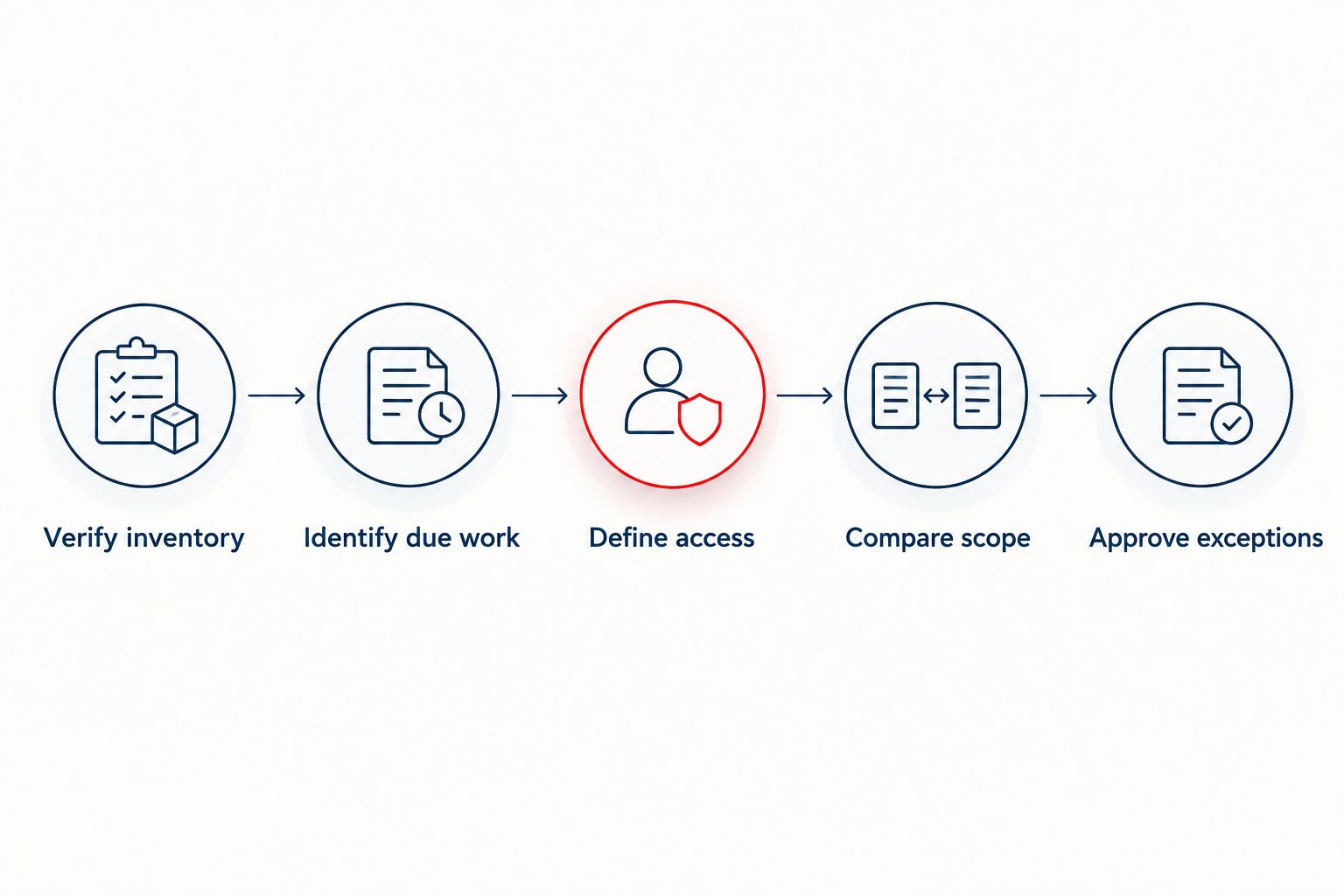
The sequence is simple: verify equipment, identify due work, define access, compare scope, and approve exceptions. Keep routine service and corrective work visible as separate lines. A single combined total hides what changed when the final invoice arrives.
Why this matters
An annual service budget covers more than a visit and a tag. Extinguishers have different service requirements, and equipment condition determines whether the technician also needs to recharge, repair, test, or replace a unit.
A portfolio average hides those differences. A location with testing due needs a different forecast from a location with only routine maintenance scheduled. Compare like-for-like work before deciding which site is spending too much.
For your 2026 plan, give finance a site total and an explanation of the work behind it. Give the site manager the equipment list and access instructions. Those documents should describe the same job.
Build the budget in a fixed sequence
Verify inventory
Start with a physical equipment list for every building, vessel, vehicle group, and job site included in the service scope. Reconcile that list with the previous service report. Do not carry forward equipment that has moved, been removed, or been replaced without updating its record.
Record these fields:
- Site name, address, and responsible manager.
- Extinguisher identifier and exact position.
- Agent type, capacity, and whether the unit is rechargeable.
- Manufacturing information and recorded service dates.
- Recorded hydrostatic test date and applicable next due date.
- Visible damage, discharge, missing equipment, or unresolved defects.
An extinguisher count is not a complete service scope. Equipment type and service history determine what work belongs in the forecast. Keep the location identifier consistent so finance can match the quote, report, and invoice without translating different site names.
Identify due work
Ask the service provider to distinguish annual maintenance from internal maintenance, hydrostatic testing, recharging, and replacement. Identify scheduled work before setting the annual total. Put unresolved defects from the previous report on the quote request rather than waiting for the next visit.
Do not treat an inspection tag as the full service history. Use equipment records to establish what was performed and when. Where records conflict, have the provider resolve the required work before you approve the forecast.
Define access
Give the provider the actual conditions at each location: operating hours, escort requirements, restricted areas, vehicle availability, and where equipment is stored. Identify who can open locked spaces and authorize corrective work. A visit booked without access instructions is not a complete service plan.
For mobile equipment, identify the vehicle or vessel and its expected availability. Ask the provider to state how missed equipment and return visits will be handled. Do not assume every extinguisher will be accessible just because the building is open.
Compare scope
Send each bidder the same inventory and due-work list. Require a site-level breakdown and written exclusions. Separate routine maintenance, scheduled testing, corrective work, and any quoted travel or return-visit charges.
Ask whether removal, transport, reinstallation, service records, and temporary coverage are included where relevant. These are scope questions, not promises that every provider includes them. Compare the answers before comparing the totals.
Approve exceptions
Name the person who can authorize unscheduled work at each location. Define which repairs need approval before completion and how the technician should report a unit that cannot remain in service. Keep the escalation contact available during the visit.
Close each job by matching the completed work to the approved scope. Update the inventory and next due dates before filing the invoice. Otherwise, the next budget starts with the same unresolved questions.
Separate the service intervals before forecasting
For a 2026 U.S. workplace budget, OSHA's portable extinguisher rule provides a useful starting point. Under 29 CFR 1910.157(e), portable extinguishers require monthly visual inspection and an annual maintenance check. The employer must record the annual maintenance date.
Monthly visual inspection does not replace annual maintenance. Assign the monthly task separately, whether your staff performs it or you contract for it. Confirm the site's applicable requirements with the service provider and the authority having jurisdiction.
OSHA also distinguishes longer-interval work. Under 29 CFR 1910.157(e)(4), stored-pressure dry chemical extinguishers requiring a 12-year hydrostatic test must be emptied and receive applicable maintenance every 6 years. Nonrefillable disposable dry chemical extinguishers are exempt from that particular requirement.
OSHA's Table L-1 lists a 12-year hydrostatic test interval for dry chemical extinguishers with mild steel, brazed brass, or aluminum shells. Other extinguisher types have different intervals. Do not apply that interval to the entire inventory.
Translate those requirements into separate budget fields: annual maintenance within the 12-month cycle, applicable 6-year maintenance, and applicable 12-year hydrostatic testing. Check the unit type, manufacturer instructions, and service history before assigning a due date. Fleet, marine, and mining equipment also needs review against the rules that apply to its operation.
Put each kind of work on its own budget line
Use the following structure for every site. It keeps the base service scope separate from equipment-specific work and makes exclusions visible.
| Budget line | Best for | What to capture | Limitation |
|---|---|---|---|
| Routine annual maintenance | Establishing the recurring baseline | Verified equipment count, maintenance scope, records | Does not describe every additional service task |
| Scheduled internal maintenance | Planning equipment-specific due work | Units due, required work, removal and return arrangements | Depends on correct equipment history |
| Hydrostatic testing | Forecasting pressure-test work | Units due, testing scope, transport and coverage arrangements | Not every unit shares the same interval |
| Corrective work | Resolving identified defects | Recharge, repair, replacement, and approval process | Final scope depends on equipment condition |
| Access and travel | Planning the visit itself | Quoted travel, escorts, restricted access, return visits | Contract terms determine what is included |
Keep known due work out of the contingency line. If testing is already scheduled, it belongs in the base forecast. Use a separate allowance for genuinely unplanned corrective work, with approval tied to the documented condition of the equipment.
Do not assign that allowance an arbitrary percentage. Build it from unresolved findings, equipment history, and the provider's written scope. Record the basis so finance can distinguish a planned expense from a general cushion.
Why annual fire extinguisher service budgets vary
The work at each location drives the forecast. Use these factors to explain differences between site totals:
- Equipment count and type. A headcount alone does not identify the maintenance tasks required for each extinguisher.
- Service dates. Internal maintenance and hydrostatic testing belong in the year they are due, not in every year's routine scope.
- Equipment condition. Discharged, damaged, or otherwise unserviceable units require a documented service decision.
- Access conditions. Locked rooms, escort requirements, and unavailable vehicles need explicit scheduling arrangements.
- Quoted visit terms. Travel, return visits, transport, and temporary coverage must be included or excluded in writing.
- Scope changes. Added locations, moved equipment, and changes in site use require an updated inventory and review.
For 2026, attach the relevant driver to each nonroutine budget line. A clear reason makes the forecast easier to approve and the invoice easier to check. It also prevents a site with testing due from being judged against a routine-maintenance-only site.
Should you use one company for every location?
Use one provider when the provider confirms the equipment scope and service coverage for every location. A single purchasing arrangement can give you common quote and reporting requirements. It does not remove the need for site-level records or approval controls.
Separate local providers can fit locations outside a common service area or sites with different service needs. The trade-off is more coordination: you must keep scope, records, and invoice descriptions consistent yourself. Neither arrangement fixes an inaccurate inventory.
Firstlinefire provides fire extinguisher sales, inspection and service, and hydro testing across Kentucky, Illinois, Indiana, Tennessee, Missouri, and Alabama. Firstlinefire fits commercial and industrial operators seeking fire extinguisher service in those states. Confirm each address, equipment type, and requested task before treating the portfolio as a single service scope.
Can you combine extinguisher service with other fire-protection work?
You can request coordinated scheduling, but keep each service scope separate. A portable extinguisher maintenance visit is not the same task as fire alarm work, hood system service, or vehicle suppression service. Each needs its own equipment list and applicable service requirements.
Firstlinefire also provides suppression systems, fire alarms, security, and safety training services. Review those needs alongside your extinguisher plan without assuming they are included in the extinguisher quote. Ask for written confirmation of the tasks covered at each site.
Use the Firstlinefire service inquiry to present the addresses, inventory, known due work, and access restrictions together. That gives the provider a defined job to review rather than an unsupported request for a portfolio-wide estimate.
Control the work between approval and invoicing
Your 2026 budget needs an approval process as well as a forecast. Give each site manager a copy of the authorized scope and tell the provider who approves changes. Do not leave the technician to find an authorized buyer after discovering an unserviceable unit.
Before the visit, confirm:
- Which equipment and locations are included.
- Which scheduled testing or internal maintenance is authorized.
- Who approves repairs, recharges, and replacements.
- How required protection will be maintained while units are removed.
- What report and equipment identifiers must accompany the invoice.
After service, reconcile completed work, exceptions, removed units, and replacement units. Record unresolved findings with an owner and a next action. An invoice marked paid does not close an outstanding equipment defect.
Track spending by site and by work category. When a total differs from the forecast, record whether the cause was inventory, due work, condition, access, or an approved scope change. Use that explanation when updating the next forecast rather than simply copying the final total.
FAQ
How do I budget for fire extinguisher service at multiple locations?
Build a verified inventory for each site, identify scheduled maintenance and testing, and request quotes against the same scope. Keep corrective work and any quoted visit charges separate from routine annual maintenance.
Does annual extinguisher service replace monthly checks?
No. OSHA's portable extinguisher rule distinguishes monthly visual inspections from annual maintenance checks. Assign responsibility for both tasks in your service plan.
Should I give every site the same extinguisher service budget?
No. Base each site's forecast on its equipment inventory, service history, due work, condition, and quoted visit terms. Equal budgets hide differences in the work required.
Do all fire extinguishers need hydrostatic testing every year?
No. Hydrostatic testing follows equipment-specific intervals rather than the annual maintenance cycle. OSHA's Table L-1 lists a 12-year interval for specified dry chemical extinguisher shell types, not for every extinguisher.
What should I include when asking for a multi-site service quote?
Include each address, equipment identifiers and types, recorded service dates, known defects, and access conditions. Ask the provider to distinguish routine maintenance, scheduled testing, corrective work, and exclusions.
Can one provider handle extinguisher service and other fire-protection work?
One provider can cover multiple service categories when its confirmed scope matches your needs. Keep extinguisher, alarm, and suppression work separately defined so a combined visit does not obscure required tasks.
How should I handle unexpected work during the service visit?
Use a named approval contact and require the provider to document the equipment condition and proposed action. Resolve how required protection will be maintained if a unit must be removed from service.
One last thing
Make the equipment identifier the link between your inventory, quote, service report, and invoice. Site totals tell you what you spent. Equipment records tell you what was done and what comes due next.
Before closing your 2026 service cycle, check that every removed or replaced extinguisher has a matching inventory update. Then carry the next due dates into the planning calendar. The strongest budget input is a closed service record—not a paid invoice alone.


