
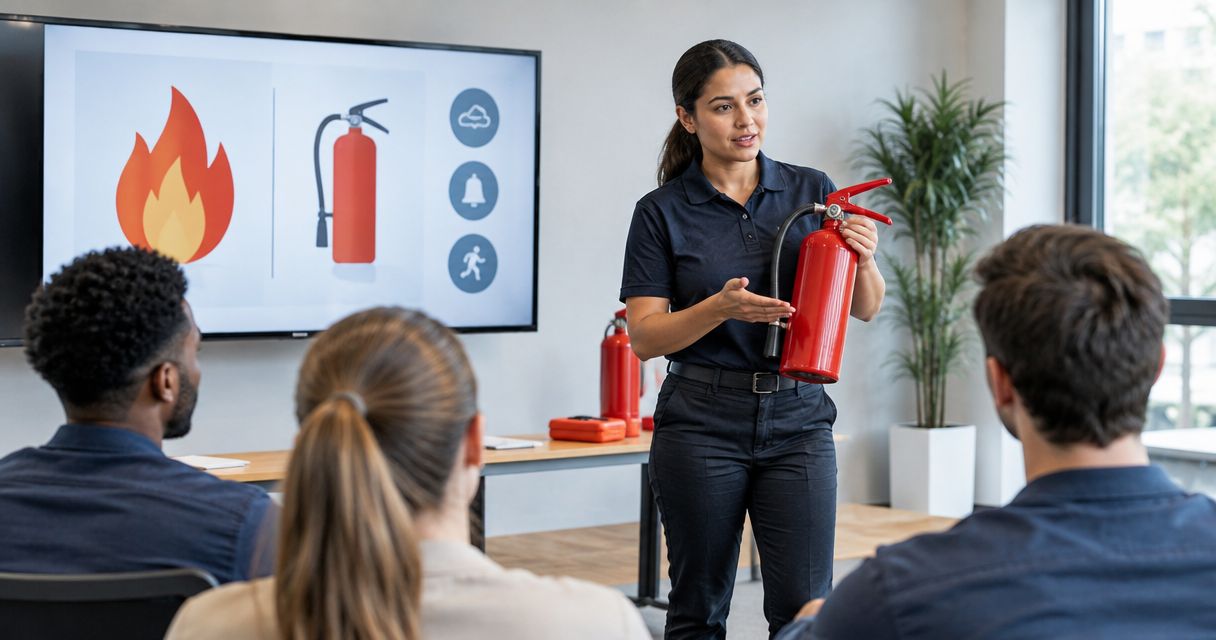
Fire safety training in 2026 is priced by class or session almost everywhere, not by counting heads — one flat quote covers a full shift whether that's 8 people or 40. What actually is fixed per employee is the OSHA training frequency, not the invoice: the law says how often each worker needs to sit through it, not what a vendor charges to run the class.
- Fire safety training cost per employee is almost never billed per head — vendors quote by class, group size and site.
- OSHA 29 CFR 1910.157(g) sets the real per-employee number: training at hire and at least annually after that.
- Group size, delivery format (onsite vs online), and hands-on discharge drills drive the quote more than headcount does.
- First-Line Fire Extinguisher Co. runs onsite training across Kentucky, Illinois, Indiana, Tennessee, Missouri and Alabama priced against your actual site, not a flat online rate.
Why this matters
A lot of safety managers go looking for "fire safety training cost per employee" expecting a rate card, then get quotes that look nothing alike because two vendors are pricing two different things — one is quoting a classroom session, the other a per-seat online module. That mismatch wastes budget cycles and delays training that OSHA already requires you to have on the books.
The fix isn't finding the "right" per-employee number online. It's understanding which cost driver actually applies to your site — group size, format, industry, and how many separate shifts need the same class — and getting quoted against those, not against a national average that doesn't reflect a coal prep plant any more than it reflects a small retail office.
How much does fire safety training cost per employee?
Most commercial fire safety training in 2026 is quoted as a flat session rate for the whole group trained, not a fee multiplied by employee count. A vendor sending someone onsite to run a class doesn't charge less for 12 employees and more for 20 — they charge for the visit, the trainer's time, and whether the class includes a live extinguisher discharge. That's different from online modules, which some vendors do license per seat because each employee logs in separately.
Here's how the formats stack up against each other:
| Training Format | Group Size | Best For |
|---|---|---|
| Onsite classroom | Full shift at once | Warehouses, manufacturing plants, offices |
| Live extinguisher discharge drill | Small groups, hands-on | Hands-on OSHA compliance, high-hazard sites |
| Online/self-paced module | Individual, flexible | Fleet drivers, remote or distributed crews |
| Train-the-trainer program | Select staff, then internal rollout | Multi-site operations with recurring turnover |
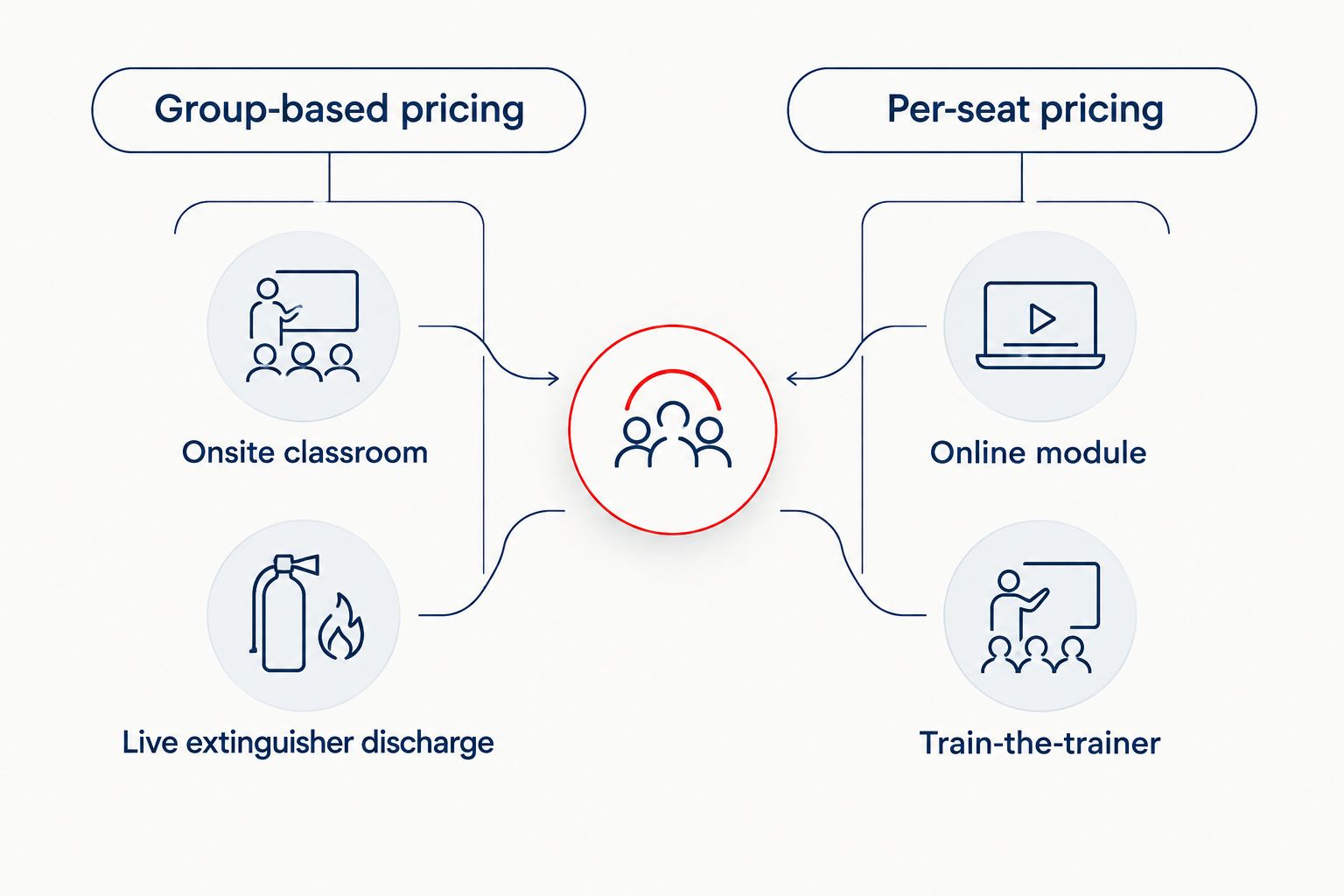
Onsite classroom training with a live discharge component tends to run longer per visit than a straight lecture, which is one reason it's usually quoted higher per session — but it also satisfies the hands-on portion some inspectors expect to see documented. Fire safety training for warehouse staff walks through what that hands-on component looks like for a distribution floor specifically.
Why fire safety training cost varies
- Group size and shift count — training three shifts at a manufacturing plant means three separate sessions, not one bill split three ways.
- Delivery format — onsite classroom and live discharge drills cost more per visit than a self-paced online module, but they cover more of what OSHA expects documented.
- Whether extinguishers are provided for the drill — some vendors bring dedicated training extinguishers; others expect you to supply units, which changes the scope of the visit.
- Industry-specific requirements — coal mining crews answer to MSHA on top of OSHA, and marine crews have Coast Guard expectations that add to what a session needs to cover.
- Travel distance — a multi-site operation spread across Kentucky, Illinois, Indiana, Tennessee, Missouri and Alabama pays differently for one central location versus five scattered ones.
- Refresher frequency — an annual refresher for an existing trained crew is a shorter session than new-hire onboarding training from scratch.
Coal mining crews are a clear example of an industry where the general OSHA number doesn't tell the whole story. Fire safety training for coal mining crews covers what MSHA adds on top of the baseline extinguisher training every employer needs.
“Training that isn't logged doesn't count in an inspection — a sign-in sheet and a date matter more than the class itself.”
Is fire extinguisher training required by OSHA?
Yes — OSHA 29 CFR 1910.157(g) requires employers who provide portable fire extinguishers for employee use to train each employee on their general use at the time of initial employment and at least annually after that. Employers who don't want employees fighting fires at all can skip this requirement, but only if they also have a written evacuation plan and no expectation that employees will use an extinguisher.
How often does fire safety training need to happen?
General extinguisher training needs to happen at least once a year under OSHA for any employer who keeps extinguishers available for employee use. High-hazard sites — coal mining, chemical processing, marine vessels — often run refreshers more often than the OSHA floor because their own regulatory bodies or insurance carriers require it.
Does online fire safety training satisfy OSHA requirements?
Online modules can cover the classroom portion of the OSHA requirement, but the standard is written around the employee understanding "general principles" of extinguisher use, and some employers still add a hands-on component to be sure that holds up under inspection. A vendor running onsite live discharge training documents that hands-on piece directly, which an online-only certificate doesn't.
Onsite extinguisher training and extinguisher servicing often get scheduled together, since a technician is already on site checking tags anyway. Fire extinguisher inspection cost breaks down what that annual inspection visit runs separately from training.
Get a training quote for your site
Priced against your headcount and shifts, not a flat online rate.
FAQ
How much does fire safety training cost per employee in 2026?
Fire safety training is priced by class or session in 2026, not by individual employee headcount, so the real per-employee figure is how often OSHA requires the training rather than a dollar amount per head. Get a quote based on your group size and site instead of a published flat rate.
Is fire extinguisher training required by OSHA?
Yes, OSHA 29 CFR 1910.157(g) requires employers who keep extinguishers available for employee use to train workers at hire and at least annually after that. Employers can opt out only with a written evacuation plan and no expectation employees will fight fires.
How often does fire safety training need to happen?
At least once a year for general extinguisher training under OSHA. Coal mining and other high-hazard sites often need more frequent refreshers under MSHA or their own safety programs.
Does online fire safety training meet OSHA requirements?
Online modules can satisfy the classroom portion of OSHA's general principles requirement, but many employers still add a hands-on live discharge session so the training holds up under inspection. The two formats are often priced differently for that reason.
What's the difference between fire warden training and general employee training?
General employee training covers basic extinguisher use for everyone on site, while fire warden training goes deeper into evacuation coordination and is usually given to a smaller group of designated staff. Fire warden sessions run longer and are quoted separately from the general class.
Do coal mining crews need separate fire safety training from MSHA?
Yes, coal mining operations answer to MSHA requirements in addition to the general OSHA extinguisher training standard. That adds scope to a training session compared to a standard commercial site.
Can one company train employees across multiple states?
Yes, providers that operate across state lines can run the same training program for a multi-site operation, though travel distance between sites affects how a multi-location quote is built.
Does fire safety training cover fire extinguisher inspection too?
No, training and inspection are typically separate line items even when scheduled on the same visit. Training covers employee use of the equipment; inspection covers whether the equipment itself is still serviceable.
One last thing
The class itself isn't what an inspector checks — the sign-in sheet and the date on it is. A crew that sat through a great session in 2026 with no paper trail looks, on paper, identical to a crew that never trained at all, so whatever vendor you use, confirm upfront that you get documentation you can hand over on demand, not just a certificate emailed once and forgotten.


