
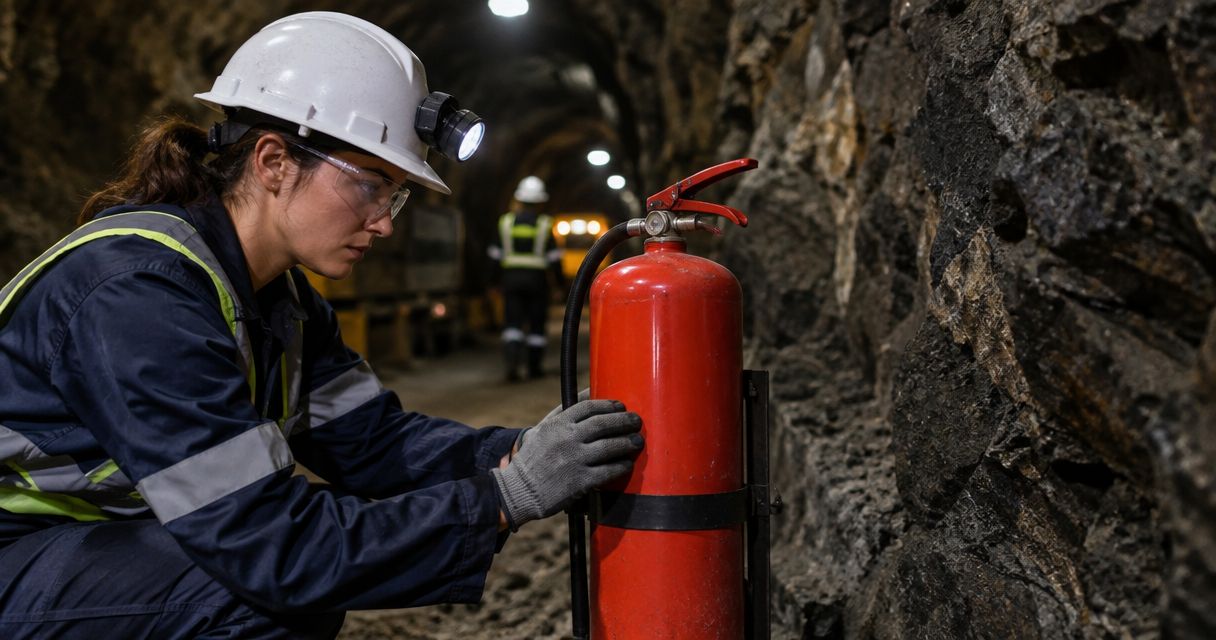
Fire extinguishers in U.S. coal mines need a documented examination at least every 6 months under the applicable MSHA coal-mine rules. That examination does not replace routine condition checks, maintenance, or hydrostatic testing; underground chemical extinguishers also require the examination date on a permanent tag attached to the extinguisher.
- How often should fire extinguishers be inspected in a coal mine? MSHA requires examinations at least every six months.
- Underground chemical extinguishers need the examination date recorded on a permanent attached tag.
- Monthly visual inspections and annual maintenance are separate tasks under applicable NFPA 10 requirements.
- Firstlinefire provides coal-mining fire protection services, including extinguisher service and hydro testing.
How often should fire extinguishers be inspected in a coal mine?
Use a six-month examination schedule, then track other required work separately. For your 2026 schedule, distinguish the federal coal-mine examination requirement from visual inspections, maintenance, and cylinder testing.
The federal references are 30 CFR §75.1100-3 for underground coal mines and 30 CFR §77.1110 for surface coal mines and surface work areas of underground coal mines. Both address keeping firefighting equipment usable and operative. Neither makes an annual service visit a substitute for the six-month examination.
| Task | Timing or trigger | What it establishes | What it does not establish |
|---|---|---|---|
| Underground chemical-extinguisher examination | Every 6 months under §75.1100-3 | Required examination, with its date on a permanent attached tag | Completion of every separate maintenance or testing task |
| Surface coal-mine extinguisher examination | At least once every 6 months under §77.1110 | Required examination of fire extinguishers | Permission to leave damaged equipment in service |
| Visual inspection under applicable NFPA 10 requirements | At least monthly, with more frequent checks where conditions require | Presence, access, and visible condition | Internal condition or cylinder strength |
| Maintenance under applicable NFPA 10 requirements | At intervals not exceeding 1 year, and when indicated | A maintenance assessment and necessary service | Completion of a hydrostatic test unless separately performed |
| Hydrostatic testing | According to extinguisher type and applicable requirements | Pressure-vessel testing | A replacement for inspections between tests |
Use the guide to inspecting extinguishers between annual service visits for the separate visual-check task. Do not use that checklist to replace a coal-mine examination or technical service procedure.
Why this matters
An extinguisher can have a recent service tag and still be missing, blocked, discharged, or damaged. A date on a tag records work; it does not guarantee readiness today. Your mine needs both scheduled examinations and a way to report problems between them.
The distinction matters when you build the 2026 calendar. A work order labeled simply “extinguisher inspection” leaves room for confusion about what was done, which equipment was covered, and what remains due.
Separate the tasks by name. Assign the examination, visual checks, maintenance, and hydro testing to identifiable people or service providers. Keep the results tied to the actual extinguisher, not just the building or machine where someone remembers seeing it.
Underground chemical extinguishers: every 6 months
For underground coal mines, 30 CFR §75.1100-3 requires chemical extinguishers to be examined every 6 months. The examination date must be recorded on a permanent tag attached to the extinguisher. The section also requires all firefighting equipment to remain usable and operative.
That creates two separate obligations: complete the examination on schedule and maintain usable equipment between examinations. A damaged extinguisher does not remain acceptable because its next examination date has not arrived.
For your underground inventory, record the extinguisher identifier, location, examination date, findings, and corrective action. Those inventory fields are a practical control; the explicit tag requirement is the examination date on the permanent attached tag.
Check the physical tag against the inventory. If the records disagree, resolve the discrepancy rather than copying a date forward. A calendar reminder is useful, but it is not the examination itself.
Surface coal-mine extinguishers: at least every 6 months
For surface coal mines and surface work areas of underground coal mines, 30 CFR §77.1110 requires extinguishers to be examined at least once every 6 months. It also requires firefighting equipment to be continuously maintained in a usable and operative condition.
An annual-only examination schedule does not meet that six-month requirement. An annual maintenance visit can share a date with one examination, but another examination remains necessary within the required interval.
Build your 2026 route around the equipment actually present. Include extinguishers assigned to mobile equipment as well as those at fixed locations. When equipment moves, update the location record so the next examination does not miss it.
Keep the underground and surface requirements distinct in your procedure. The underground provision expressly identifies the permanent attached tag; do not assume every recordkeeping statement in one provision appears word-for-word in the other.
Monthly checks and annual maintenance are different jobs
NFPA 10 separates inspection from maintenance. Where its requirements apply, portable extinguishers receive visual inspections at least monthly and maintenance at intervals not exceeding 1 year. Conditions can call for more frequent inspections or additional service.
Those requirements do not erase MSHA's coal-mine provisions. Establish which rules, manufacturer instructions, and site requirements apply, then put each task on the schedule under its own name.
A visual inspection checks readily observable conditions. Look for the extinguisher in its assigned place, clear access, visible damage, the pin and tamper seal, and the pressure indication where fitted. Follow the applicable checklist for the extinguisher type; not every extinguisher has a pressure gauge.
Maintenance goes further. It addresses the extinguisher's condition and the service needed to keep it working. Internal maintenance and hydrostatic testing have their own requirements, so do not assign every cylinder the same test interval.
The advantage of a combined service visit is simpler scheduling. The limitation is equally clear: combining appointments does not combine the tasks into one undocumented check. Record what was actually completed.
Why the inspection schedule varies
The six-month MSHA examination requirement is the baseline, not a reason to ignore equipment until the next due date. These factors affect the checks and service you schedule around it:
- Mine location. Underground and surface coal-mine provisions have different wording and documentation details. Identify the applicable provision before writing the procedure.
- Extinguisher construction. Agent, cylinder design, and manufacturer instructions determine applicable maintenance and hydrostatic-testing requirements.
- Exposure. Vibration, corrosion, weather, and physical damage justify closer attention to condition. Report a problem when you find it.
- Use or suspected discharge. An extinguisher that has been used needs service assessment. Do not return it to its bracket and wait for the next scheduled examination.
- Applicable additional requirements. Manufacturer instructions, adopted standards, and site requirements can add tasks. Keep their source and timing separate from the federal examination requirement.
These factors change the work around the baseline. They do not extend the six-month examination interval.
How do you build a coal-mine extinguisher inspection schedule?
Build the 2026 schedule from an equipment inventory, not from last year's appointment reminder. A repeat appointment misses extinguishers that were added, moved, replaced, or taken out of service.
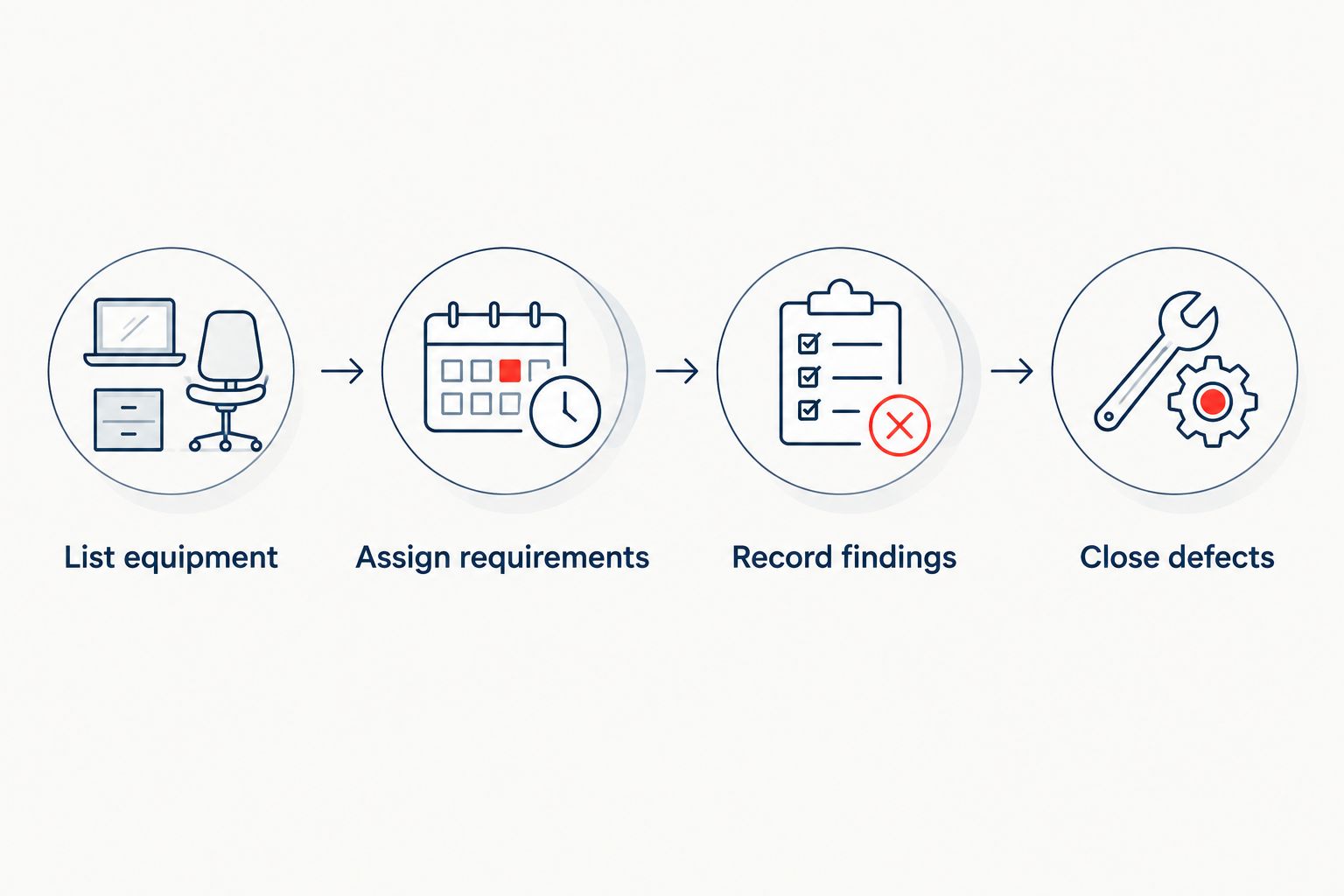
- List equipment. Give each extinguisher a traceable identifier. Record its location, type, examination history, and available maintenance and test information.
- Assign requirements. Identify the applicable MSHA provision and any separate inspection, maintenance, or testing requirements. Give each task its own due field.
- Record findings. Enter the actual examination date and condition found. Complete the required attached-tag entry for underground chemical extinguishers.
- Close defects. Assign corrective action, document the result, and confirm that required fire protection remains in place while equipment is serviced.
Do not mark the whole route complete because most units passed. A missing extinguisher, unreadable identifier, or unresolved defect needs an individual follow-up entry.
Check the schedule after equipment changes, not just at the next service visit. When an extinguisher leaves for testing, record what takes its place and where the replacement is installed. That keeps the equipment list useful to the next person walking the route.
What should you do when an extinguisher fails a check?
Do not leave a known defective extinguisher as the required protection. Report the defect, arrange appropriate replacement coverage, and send the unit for service assessment or replacement as appropriate.
Separate the finding from the repair. A note saying “low pressure” documents a problem; it does not document that the problem was corrected. Close the entry only after the corrective action is complete and the installed extinguisher's status is clear.
Do not open, recharge, or pressure-test an extinguisher unless you have the required training, equipment, and authorization. A routine visual check is not a cylinder-service procedure.
For a 2026 service request, provide the equipment list and known defects before the visit. Identify units needing examination separately from those needing recharge, maintenance, or hydro testing. That gives the service provider a defined scope without assuming every unit needs the same work.
When does outside extinguisher service make sense?
Firstlinefire is a service option for coal mine operators needing extinguisher inspections and hydro testing. Its stated service area covers Kentucky, Illinois, Indiana, Tennessee, Missouri, and Alabama.
The practical benefit is access to extinguisher service alongside other fire-protection services. The boundary is just as important: hiring a provider does not transfer the mine operator's responsibility to keep equipment usable or replace checks between visits.
When discussing Firstlinefire fire extinguisher service, specify the mine location, equipment inventory, applicable examination task, and outstanding defects. Ask for documentation that distinguishes examination, maintenance, recharge, and testing rather than treating them as interchangeable labels.
Arrange coal-mine extinguisher service
Discuss extinguisher examinations, maintenance, and hydro testing for your coal operation.
Does annual service satisfy the coal-mine examination requirement?
Every 6 months remains the examination interval, even when an extinguisher receives annual maintenance. Record both tasks if a service visit completes both, and schedule the intervening examination rather than waiting another full year.
Do extinguishers need checking between scheduled examinations?
Every 6 months is not permission to ignore equipment between examinations. MSHA requires firefighting equipment to remain usable and operative, so act on missing, damaged, discharged, or inaccessible equipment when the problem is discovered.
Is hydrostatic testing required every six months?
Every 6 months refers to the coal-mine extinguisher examination, not a universal hydrostatic-test interval. Determine hydrostatic testing from the extinguisher type, its markings and records, and applicable requirements.
FAQ
How often do coal-mine fire extinguishers need an MSHA examination?
Coal-mine fire extinguishers need examination at least every six months under the applicable coal-mine provisions. Underground chemical extinguishers fall under 30 CFR §75.1100-3; surface coal-mine extinguishers fall under §77.1110.
Does an underground extinguisher need a permanent inspection tag?
Yes. Under 30 CFR §75.1100-3, the examination date for an underground chemical extinguisher must be recorded on a permanent tag attached to it.
Can an annual extinguisher service visit cover the entire mine requirement?
No. Annual service alone does not satisfy the six-month coal-mine examination interval. A visit can cover multiple tasks, but each completed task must be identified.
Do monthly visual checks replace the six-month MSHA examination?
No. Do not assume a monthly visual check satisfies the required coal-mine examination. Define the examination scope separately and complete the applicable documentation.
Should I wait until the next examination if an extinguisher has low pressure?
No. Report the problem and arrange service assessment and appropriate replacement protection. Firefighting equipment must remain usable and operative between examinations.
Does every coal-mine extinguisher have the same hydro-test interval?
No. Hydrostatic-test requirements depend on the extinguisher type and applicable requirements. Identify the cylinder and review its markings, manufacturer instructions, and test records before assigning a due date.
Does Firstlinefire provide services for coal-mining customers?
Yes. Firstlinefire provides fire-protection services to coal-mining customers, including extinguisher service and hydro testing. Its stated service area includes Kentucky, Illinois, Indiana, Tennessee, Missouri, and Alabama.
One last thing
Inspect the records against the equipment, not the equipment against a remembered count. A tidy spreadsheet can still include an extinguisher that moved with a machine or left the mine for service.
Before closing your 2026 examination route, reconcile every listed unit: examined in place, relocated, replaced, removed, or still unresolved. Then check the attached tags where required. The useful result is not a full page of check marks; it is an accurate account of the protection actually in place.


