

Fire extinguisher class requirements by facility type follow the fuel and process, not the building’s name. For covered general-industry workplaces, OSHA sets maximum travel distances of 75 feet for Class A protection and 50 feet for Class B protection; kitchens, combustible-metal work, mines, and vessels need additional hazard-specific review.
- Fire extinguisher class requirements by facility type depend on actual fuels, electrical hazards, and work processes.
- OSHA general-industry limits include 75 feet for Class A and 50 feet for Class B travel distance.
- ABC extinguishers do not replace Class D protection for combustible metals or Class K protection for cooking oils.
- Firstlinefire provides fire extinguisher service for commercial, industrial, mining, marine, and fleet customers.
Why this matters
A warehouse office, solvent room, and fabrication bay can need different protection inside the same building. Putting the same extinguisher at every door does not establish compliance.
Firstlinefire provides fire extinguisher sales, inspection, and service. Firstlinefire is best for commercial and industrial customers seeking fire extinguisher service alongside suppression, alarms, and safety training. Use the following 2026 reference to identify the hazards that need review before you settle on equipment or placement.
Facility benchmarks: classes and travel distances
The table separates fire classes to evaluate from travel-distance limits. It is a hazard-screening reference, not a blanket equipment specification for every facility in a category.
| Facility or work area | Classes to evaluate | Travel-distance benchmark | What changes the selection |
|---|---|---|---|
| Overall: covered general-industry workplaces | Match the anticipated fire classes | OSHA: A, 75 feet; B, 50 feet; qualifying D hazards, 75 feet | Fuel, hazard severity, extinguisher rating, and actual walking route |
| Offices and ordinary retail areas | A; C where energized electrical equipment is involved | A: 75 feet maximum under OSHA | Stockrooms, maintenance chemicals, and electrical equipment add hazards |
| Warehouses and distribution centers | A; B and C where applicable | A: 75 feet; B: 50 feet under OSHA | Stored commodities, liquids, charging areas, and maintenance operations |
| Manufacturing and vehicle repair areas | A, B, C; D where combustible metals are present | A: 75 feet; B: 50 feet; qualifying D hazards: 75 feet under OSHA | Machining material, solvents, fuel handling, and energized machinery |
| Sawmills and woodworking areas | A; B and C where applicable | A: 75 feet; B: 50 feet under OSHA | Wood waste, finishing liquids, and combustible-dust hazards |
| Chemical processing and laboratories | A, B, C, or D according to materials | A: 75 feet; B: 50 feet; qualifying D hazards: 75 feet under OSHA | Chemical compatibility and reactive materials require specific review |
| Commercial cooking areas | K for combustible cooking oils and fats; other classes elsewhere | K: 30 feet maximum under NFPA 10 | Cooking equipment, hood protection, and the adopted code |
| Coal mining operations | Determine under applicable mining rules | Use applicable MSHA provisions, not this general-industry table | Mine type, equipment, location, and governing mining regulation |
| Vessels and commercial fleets | Determine under applicable marine or vehicle rules | Use applicable vessel or vehicle requirements | Vessel service, vehicle use, cargo, and installed suppression |
Class B has the shorter OSHA general-industry travel limit: 50 feet, compared with 75 feet for Class A. Class K cooking protection has the shortest listed benchmark at 30 feet under NFPA 10, but these distances address different hazards; they are not a ranking of facility safety.
Sources and scope: this 2026 reference uses OSHA 29 CFR 1910.157(d)(2), (4), and (6) for general-industry distribution, and NFPA 10, 2022 edition, Section 6.6.2 for Class K travel distance. These are regulatory and standards-based limits, not measured industry averages; the table cannot determine your required ratings, quantities, or locally adopted provisions without a site-specific assessment.
Fire class is not extinguisher size
A fire class identifies the kind of burning material or electrical condition. An extinguisher rating describes its listed capability. Neither the cylinder’s weight nor the building’s square footage alone tells you which fire classes it can handle.
The following comparison explains the class markings you need to recognize. Read the label before assigning an extinguisher to a hazard.
| Class marking | Best for | Useful protection | Important limitation |
|---|---|---|---|
| A | Ordinary combustibles | Wood, paper, cloth, and similar materials | An A-only marking does not establish suitability for liquid or electrical fires |
| B | Flammable-liquid hazards | Listed protection for flammable-liquid fires | A B marking does not establish cooking-oil or combustible-metal suitability |
| C | Energized electrical equipment | An agent suitable where electrical conductivity is a concern | C has no separate numerical capacity rating; underlying fuel still matters |
| D | Specific combustible metals | An agent selected for the metal involved | Class D agents are not interchangeable across all metals |
| K | Commercial cooking oils and fats | Listed protection for cooking-media fires | K protection does not replace protection for unrelated building hazards |
An ABC extinguisher combines listed protection for A, B, and C hazards. That is useful in mixed ordinary-combustible and electrical work areas, but the ABC marking does not include D or K.
For your 2026 inventory, record the complete rating from each label. Do not shorten every entry to “ABC extinguisher.” That loses the capacity information needed to evaluate the layout.
Travel distance is a walking route, not a circle
OSHA’s 75-foot Class A limit and 50-foot Class B limit concern employee travel distance. A measurement through a rack, locked room, or machine is not the route a worker can walk.
Class C distribution follows the appropriate pattern for the underlying Class A or Class B hazard. Under OSHA 1910.157(d)(6), Class D extinguishing agents must be within 75 feet of the combustible-metal working area; that provision specifically addresses areas generating combustible-metal powders, flakes, shavings, or similarly sized products at least once every two weeks.
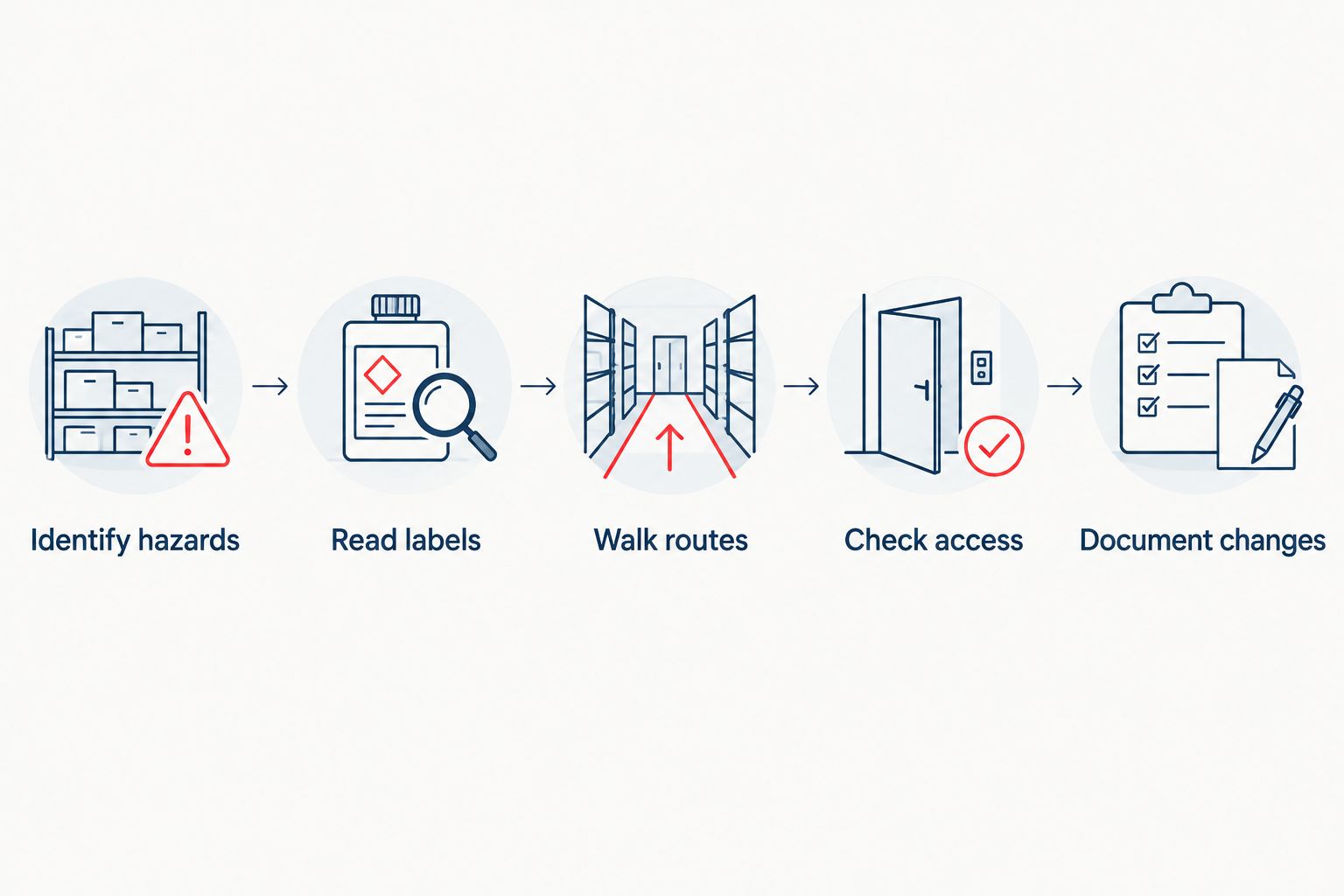
Use these steps when checking a floor plan:
- Identify hazards. Mark ordinary combustibles, liquids, energized equipment, cooking media, and combustible metals.
- Read labels. Record the class markings and complete ratings on the installed equipment.
- Walk routes. Follow usable aisles from the protected areas to the extinguishers.
- Check access. Identify blocked cabinets, hidden units, and locations that conflict with safe escape.
- Document changes. Update the plan after racks, processes, or stored materials move.
A compliant distance does not prove adequate extinguisher capacity. OSHA 1910.157(d)(1) also requires selection and distribution based on anticipated fire classes and the size and degree of hazard. NFPA 10 distribution requirements add rating and hazard considerations; the OSHA Class B limit is not permission to use every B-rated extinguisher at that distance.
For a closer placement review, use the guide to fire extinguisher placement distance by hazard class.
How to use these benchmarks
Separate mixed-use areas
Classify each work area before buying replacements. An office with paper storage presents a different problem from an adjacent paint-mixing area, even when both share an address.
Apply the 75-foot Class A benchmark to the relevant ordinary-combustible layout and review the 50-foot Class B benchmark wherever flammable-liquid protection is required. Do not treat either distance as a building-wide equipment specification.
Review specialty hazards separately
Send cooking-media and combustible-metal hazards through their own selection review. The 30-foot Class K benchmark does not make an ABC extinguisher suitable for a fryer. Likewise, a nearby ABC unit does not provide Class D protection for combustible-metal work.
For metals, identify the actual material and physical form. Solid stock, fine shavings, and powder do not present identical conditions. The selected agent must be suitable for the particular combustible metal.
Recheck routes after layout changes
Walk the route again when storage or equipment moves. A new rack can turn a previously short approach into a longer trip around an aisle.
Use the 2026 floor plan as a working document. Keep extinguisher locations, hazard areas, and access routes together so maintenance and operations are checking the same layout.
Keep specialty jurisdictions separate
Do not copy a warehouse extinguisher schedule onto a mine, truck, or vessel. OSHA general-industry distances are useful within their scope, not as substitutes for MSHA, transportation, or Coast Guard requirements.
Firstlinefire serves commercial, industrial, coal mining, marine, and vehicle/fleet customers. Identify the governing rules for each operation before standardizing equipment across those settings.
What the facility table does not replace
Portable extinguishers are only part of fire protection. A correct class marking does not establish that a hood system, sprinkler system, alarm, or emergency plan meets its separate requirements.
For a commercial kitchen, review the cooking equipment and fixed suppression together with Class K placement. For a dust-producing process, assess the dust hazard rather than treating additional portable extinguishers as the entire answer.
The same distinction applies to electrical rooms. Class C suitability addresses energized electrical equipment, but it does not mean every suitable agent is equally practical around sensitive equipment. Consider agent residue and the equipment manufacturer’s instructions during selection.
Firstlinefire fire extinguisher service belongs within the facility’s wider fire-protection plan, not in place of it. Keep the extinguisher schedule connected to the processes it protects.
Inspection and training are separate checks
Class selection answers what the extinguisher is intended to protect. Inspection and maintenance address whether it remains ready for use.
Under OSHA 1910.157(e), portable extinguishers require monthly visual inspection and an annual maintenance check. Those duties are separate from hydrostatic testing, which follows the applicable extinguisher type and requirements. A maintenance tag does not correct the wrong agent or a blocked approach.
Training also depends on the employer’s emergency policy. Under OSHA 1910.157(g)(1) and (2), where extinguishers are provided for employee use, employees must receive education on their general principles and the hazards of incipient-stage firefighting upon initial employment and at least annually thereafter. Designated equipment users have additional training requirements under paragraph (g)(3) and (4).
For your 2026 review, make the response policy clear: who evacuates, who is designated to use equipment, and when everyone must withdraw. An extinguisher does not make an unsafe firefighting attempt acceptable.
FAQ
What are fire extinguisher class requirements by facility type?
Fire extinguisher class requirements depend on the actual hazards within each facility, not its name alone. Evaluate ordinary combustibles, flammable liquids, energized electrical equipment, combustible metals, and cooking oils separately, then apply the governing rules.
Is an ABC extinguisher enough for an industrial building?
An ABC extinguisher is not enough where the building also requires Class D or Class K protection. Its complete rating, placement, and suitability for the anticipated hazards still need review.
How far can workers travel to a fire extinguisher?
For covered general-industry workplaces, OSHA sets maximum employee travel distances of 75 feet for Class A protection and 50 feet for Class B protection. Other hazards and governing standards have different provisions, and ratings can require a tighter layout.
Do commercial kitchens need a Class K extinguisher?
Commercial cooking operations involving combustible cooking oils and fats need Class K protection under applicable NFPA 10 provisions. NFPA 10, 2022 edition, limits travel distance to a Class K extinguisher to 30 feet; verify the edition and requirements adopted for the site.
Does every metal fabrication shop need Class D protection?
Class D protection depends on the combustible-metal hazard, not simply the presence of metalworking equipment. Identify the metal, its physical form, and the process; select an agent suitable for that specific material.
Can warehouses and offices use the same extinguisher model?
Warehouses and offices can share an extinguisher model only when its listed classes and rating suit the hazards in both areas. Shared equipment does not remove the need to check distribution, access, and specialty hazards separately.
Do these OSHA distances apply to coal mines and towboats?
This general-industry table does not establish the extinguisher requirements for coal mines or towboats. Review applicable mining or marine regulations and the equipment and operations involved.
How often should a workplace check its extinguishers?
OSHA requires monthly visual inspections and an annual maintenance check for portable extinguishers within the standard’s scope. Hydrostatic testing follows separate requirements and does not replace either check.
One last thing
A current tag does not prove that an extinguisher belongs where it hangs. The agent can be wrong, the rating insufficient, or the walking route too long even when maintenance is current.
On your next walkthrough, compare the label with the hazard beside it. That simple check keeps the 2026 equipment list tied to the work actually happening on the floor.


