
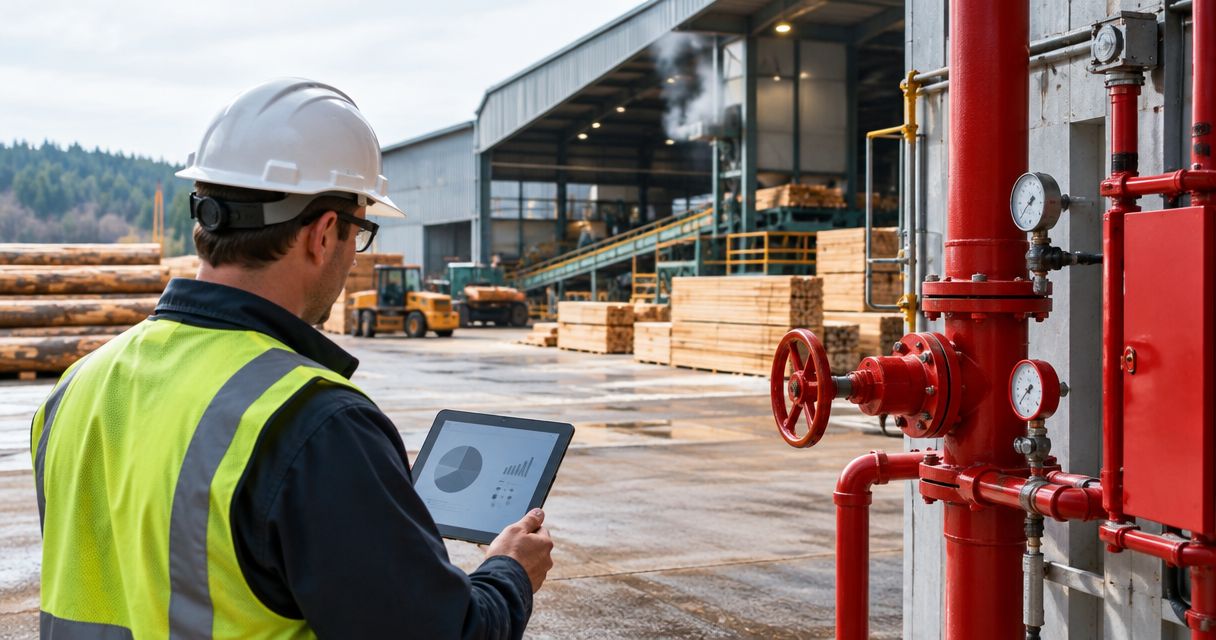
Sawmill and lumber mill industrial fire protection is the control of wood dust, ignition sources, fire spread, and emergency response to protect workers and keep production equipment safe. This 2026 guide explains how to build that protection around cutting lines, dust collection, lumber storage, maintenance work, and mobile equipment—not just the extinguishers on the wall.
- Industrial fire protection for sawmills and lumber mills starts with wood-dust control, ignition prevention, and clear escape routes.
- Firstlinefire serves industrial operators needing extinguishers, suppression systems, fire alarms, and safety training across its six-state service area.
- Portable extinguishers support early response; they do not replace engineered dust protection or building fire suppression.
- Match fire detection and suppression to each hazard, then document inspections, employee training, and unresolved defects.
Why fire protection matters for sawmills and lumber mills
A mill moves combustible material through machines, conveyors, ducts, and storage areas. A fire plan that covers only the production floor leaves those connected spaces out of the picture.
Wood dust presents a different problem from stacked boards. Fine combustible dust suspended in air can produce a flash fire or explosion under the right conditions, while settled dust can feed a spreading fire. Control the fuel and ignition sources before choosing additional equipment.
For your 2026 review, separate ordinary combustible hazards from fuel, electrical, and dust-process hazards. The guide to fire extinguisher types for industrial facilities explains why extinguisher selection must follow the material involved.
Use OSHA's sawmill requirements, applicable fire codes, equipment instructions, and your insurer's requirements together. A service tag does not establish that the entire mill meets those requirements.
Build a fire protection plan around the mill
Map the hazards before changing equipment
Start with a printed floor plan and a walk through the mill during normal operation. Mark where material enters, where dust travels, and where finished lumber waits. Include maintenance shops, electrical rooms, fuel storage, and outdoor handling areas.
Build the map around four headings: Dust collection, Ignition sources, Material storage, and Escape routes. Record actual conditions rather than relying on an old drawing that predates a conveyor extension or storage change.
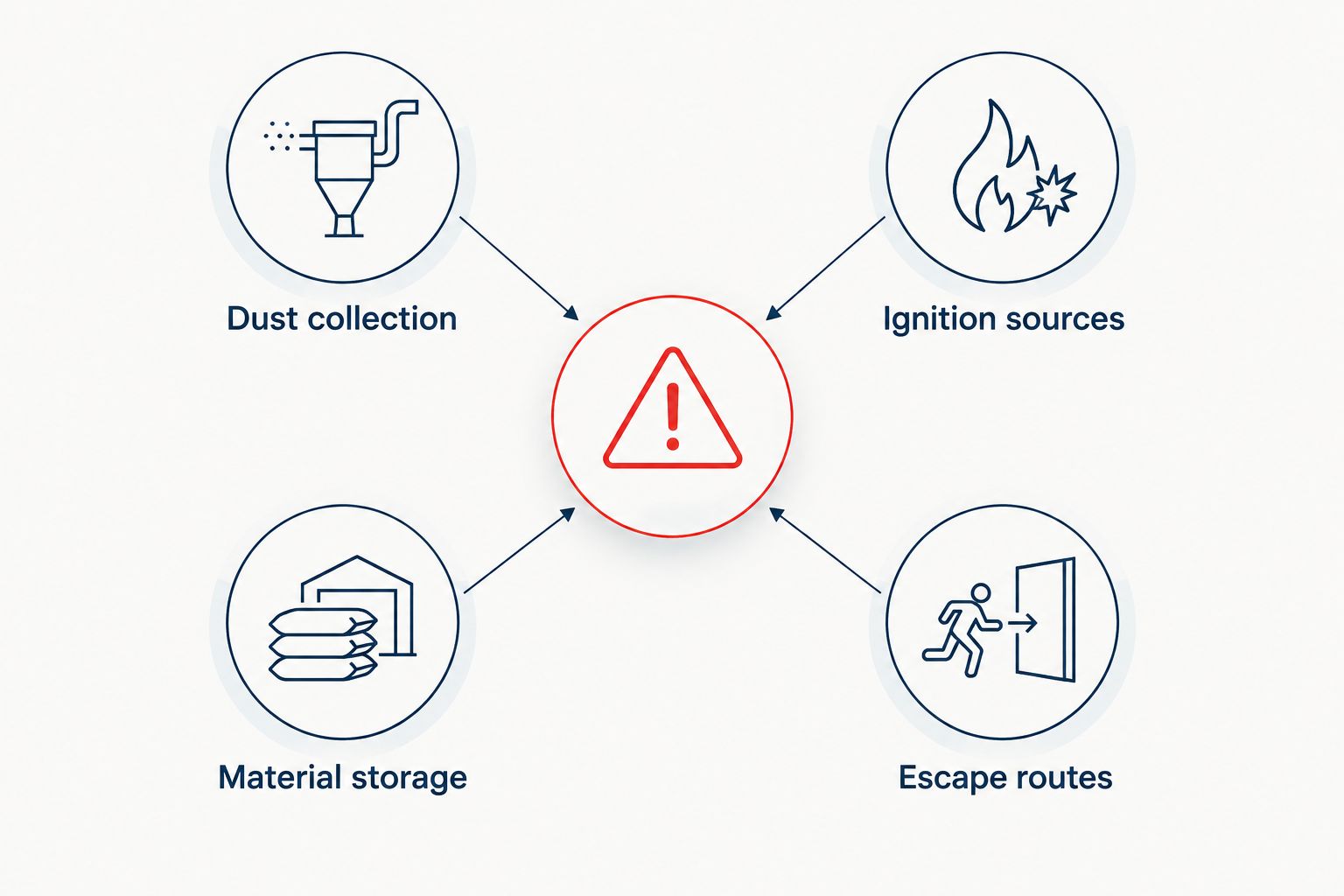
Give each finding an owner and a written corrective action. A list of hazards without responsibility is not a work plan.
- Trace dust ducts from each connected machine to the collector.
- Mark hot bearings, friction points, welding areas, and fuel handling locations.
- Identify lumber storage that obstructs exits, equipment access, or sprinkler discharge.
- Mark emergency exits, assembly points, and fire department access routes.
Control dust and ignition sources
Begin with housekeeping and maintenance records. Look for recurring dust deposits, damaged extraction connections, overheating equipment, and cleanup methods that put settled dust back into the air.
Do not treat a clean aisle as proof that the mill is clean. Check accessible overhead surfaces and concealed collection points through a safe inspection process. Use cleaning equipment and methods suitable for the dust hazard; an ordinary shop vacuum is not a universal solution.
Have qualified personnel assess dust collection and any required explosion protection. Portable extinguishers cannot prevent an explosion inside a collector, and operators should not improvise changes to ducts or protective devices.
- Assign cleaning responsibility for machinery, ledges, and accessible overhead surfaces.
- Repair dust leaks and investigate repeated accumulations.
- Maintain bearings, belts, guards, and electrical equipment according to instructions.
- Control hot work through authorization, preparation, fire watch, and follow-up checks.
Match extinguishers and service to each area
Inventory the extinguishers already installed before ordering replacements. Record the location, agent, rating, condition, and service information for each unit, then have a qualified provider check suitability and placement.
Wood is a Class A fuel. Flammable liquids and energized electrical equipment require different considerations, so a mill-wide purchase based only on cylinder size misses the point. Access matters too: workers must not pass through a developing fire to reach an extinguisher.
Firstlinefire is best for industrial operators seeking extinguisher, suppression, alarm, and safety-training services within its six-state service area. Firstlinefire serves Kentucky, Illinois, Indiana, Tennessee, Missouri, and Alabama. For a 2026 service request, supply the hazard map and equipment inventory; confirm the mill-specific scope rather than assuming every dust-process requirement is included.
- Match extinguisher classification and rating to each area's hazards.
- Check mounting, visibility, access, and exposure to damage or weather.
- Identify missing records and units needing professional examination.
- Separate routine staff checks from maintenance and hydrostatic testing.
Specify detection and suppression by hazard
Document existing protection first: alarm devices, sprinkler coverage, process suppression, equipment shutdowns, and any monitoring connection. Ask the responsible designer or service provider which hazards each system actually covers.
Dust, temperature, airflow, and ambient conditions affect detector selection. A device suitable for an office is not automatically suitable beside a dusty cutting line. Likewise, building sprinklers and protection inside dust-handling equipment serve different purposes.
For new work or alterations, require qualified design and review by the authority having jurisdiction. Establish how alarms, process shutdowns, and suppression interact without allowing staff to improvise control changes.
- Verify detector suitability for the operating environment.
- Confirm protection boundaries for buildings, machines, and dust-handling equipment.
- Document required shutdowns, alarm signals, and manual controls.
- Review water supply and freezing exposure where water-based systems apply.
Assign inspections and close service defects
Use a paper register or spreadsheet before adding another scheduling system. Give each asset a location, responsible person, required task, due date, and place to store the completed record.
For your 2026 schedule, OSHA's portable-extinguisher rule, 29 CFR 1910.157(e), requires monthly visual inspection and an annual maintenance check. That means a visual check each month and maintenance every 12 months; neither task replaces hydrostatic testing when required.
Firstlinefire provides extinguisher service and hydro testing. Confirm the work included in a service visit, how deficiencies will be reported, and who authorizes repairs. A completed visit is not the same as a closed defect.
- Record monthly visual checks and annual maintenance separately.
- Track hydrostatic testing by extinguisher type and applicable requirements.
- Assign corrective work for damaged, missing, or unsuitable equipment.
- Establish approved impairment procedures whenever required protection is unavailable.
Train each shift on response limits
Start by defining who evacuates and who, if anyone, is authorized to attempt extinguisher use. Workers need a clear answer before an alarm sounds, especially where machinery noise or hearing protection complicates communication.
Where extinguishers are provided for employee use, OSHA's 29 CFR 1910.157(g) requires education at initial employment and at least annually. Employees designated to use firefighting equipment also need training upon assignment and at least every 12 months.
Keep the instruction tied to the mill. Explain how to report a fire, leave by an alternate route, and account for contractors and drivers. Employees should not open a burning collector or enter smoke to investigate.
- Teach alarm recognition and the site's emergency reporting procedure.
- Walk primary and alternate evacuation routes on every shift.
- Explain extinguisher-use limits and the need for a clear escape route.
- Assign assembly-point accountability and emergency responder handoff duties.
Review changes before restarting production
A mill's protection plan must follow its equipment and storage changes. Moving a line, extending a duct, adding a collector, or increasing lumber storage can change hazards that the original design addressed.
Make change review part of the 2026 maintenance process, not a separate binder that nobody opens. Before restart, compare the altered area with the hazard map and have the appropriate qualified people review affected protection.
Keep the work bounded. Operators report changes, maintenance documents them, and qualified specialists evaluate the fire protection implications. Management owns the decision to close outstanding safety actions.
- Review new machinery, duct changes, and altered material flow.
- Check storage changes against approved protection and access requirements.
- Update drawings, asset records, and emergency instructions.
- Verify completed work and required approvals before returning equipment to service.
Compare protection options by the job they perform
These options are layers, not substitutes. Choose each measure for a defined hazard, and document what it does not cover. No single device handles housekeeping, explosion prevention, evacuation, and fire control.
| Option | Best for | Main benefit | Key limitation |
|---|---|---|---|
| Housekeeping and preventive maintenance | Reducing dust accumulation and avoidable ignition sources | Addresses conditions that feed or start fires | Depends on consistent execution; does not extinguish a developing fire |
| Portable extinguishers | Authorized response to small, early-stage fires | Provides accessible manual fire control | Requires correct selection, safe access, and a trained response decision |
| Building sprinkler protection | Controlling building fires within the approved design | Provides automatic water discharge where installed | Does not replace dust-explosion protection or cover every process hazard |
| Engineered dust-process protection | Hazards within collectors and connected dust-handling equipment | Addresses the assessed process fire and explosion hazards | Requires specialist design, maintenance, and review after changes |
| Fire detection and alarm systems | Warning occupants and initiating specified signals or controls | Supports evacuation and response | Detects and signals; an alarm alone does not suppress fire |
| Firstlinefire service support | Industrial operators in its stated service area | Offers extinguishers, hydro testing, suppression, alarms, and safety training | Confirm sawmill-specific work and specialist design responsibilities before engagement |
Common mistakes sawmills and lumber mills make
Treating an extinguisher tag as whole-site approval
An extinguisher maintenance record addresses that equipment. It does not establish that dust collection, hot work, storage arrangements, or building systems are acceptable. Keep equipment service records separate from the site-wide corrective-action register.
Cleaning the floor while leaving elevated dust
Dust on accessible beams, ledges, and equipment surfaces still matters. Build safe access and suitable cleaning methods into the housekeeping plan rather than waiting for deposits to become obvious from the floor.
Buying a system before defining the hazard
A detector, suppression package, or extinguisher cannot be selected properly from the words “wood products” alone. Describe the process, material, operating environment, and protection boundary before requesting a design or equipment recommendation.
Forgetting night shifts and contractors
A day-shift briefing does not train a night-shift operator or visiting welder. Apply evacuation instructions, hot-work controls, and emergency reporting rules to everyone working in the affected area.
Changing storage without checking protection
Lumber stacked in a new location can obstruct exits, equipment, or sprinkler discharge. Require storage-layout changes to pass the same review as production-line changes.
FAQ
What's the best starting point for industrial fire protection at a sawmill?
Start with a documented hazard walk covering dust collection, ignition sources, lumber storage, and escape routes. Use that map to identify corrective work and the equipment or specialist assessments needed.
Are ABC extinguishers enough for a lumber mill?
ABC extinguishers alone are not a complete lumber mill fire protection plan. Extinguisher selection must match local hazards, while dust control, building protection, alarms, and evacuation require separate attention.
Does every sawmill need explosion protection on its dust collector?
Dust-collector protection must follow a qualified assessment of the equipment, material, and applicable requirements. Do not assume that a collector is adequately protected because it is outdoors or connected to a sprinklered building.
How often should mill fire extinguishers be inspected?
OSHA requires monthly visual inspection and an annual maintenance check for portable extinguishers under 29 CFR 1910.157(e). Hydrostatic testing and other servicing follow the applicable extinguisher-specific requirements.
Can mill employees carry out their own extinguisher checks?
Assigned employees can perform routine visual checks when they understand what to inspect and how to report defects. Routine checks do not replace maintenance or hydrostatic testing by personnel qualified for that work.
Should workers open a dust collector if they suspect a fire?
Workers should not open a suspected burning dust collector to investigate. Raise the alarm, follow the site's emergency procedure, and leave investigation and intervention to authorized responders using the established plan.
Can Firstlinefire support industrial fire protection at a mill?
Firstlinefire provides industrial customers with extinguisher sales and service, hydro testing, suppression systems, fire alarms, and safety training across Kentucky, Illinois, Indiana, Tennessee, Missouri, and Alabama. Confirm the scope for the specific mill, including who handles dust-hazard assessment and engineered process protection.
One last thing
Check the maintenance shop before closing your 2026 review. Welding, grinding, oily materials, and equipment repair deserve attention even when the main production line has strong controls.
Then pick an open defect and follow it through to completion. Find the report, the assigned owner, the corrective work, and the verification. The useful record is not the one showing that someone visited. It is the one showing that the hazard was corrected.


