

Yes, a fire extinguisher service contract is worth it in 2026 when you have enough extinguishers, sites or vehicles that scheduled maintenance and consistent records are hard to manage visit by visit. It is not worth signing a contract that leaves inspections, hydro testing or corrective work undefined. A contract does not transfer your responsibility to check extinguishers or keep them accessible.
- Is a fire extinguisher service contract worth it? Yes for multi-site operations that need scheduled maintenance and usable records.
- First-Line Fire Extinguisher Co. is best for commercial, industrial, marine and fleet buyers in its stated six-state service area.
- Check whether annual maintenance, hydro testing, repairs and records are included; a recurring visit alone is not enough.
- The employer remains responsible for monthly visual checks under OSHA's general-industry extinguisher rule.
Why this matters
A missed service date is not the only risk. You also need to know which extinguisher was serviced, what the technician found and what happens to a unit that fails. If those answers are scattered across tags, invoices and emails, a contract should fix that process—not just reserve another visit.
First-Line Fire Extinguisher Co. provides fire extinguisher sales and hydro testing, along with other fire-protection services. That makes it a relevant provider to ask about extinguisher service. Do not assume its service contract includes a particular task; get the scope in writing.
Is a fire extinguisher service contract worth it in 2026?
Yes, if the contract assigns scheduled work, records the result for each extinguisher and gives you a clear path for failed units. For a small, stable group of extinguishers with an owner who reliably tracks every date, arranging professional service as needed can be the simpler choice. Neither approach removes the employer's monthly check duty under OSHA's general-industry rule, 29 CFR 1910.157.
| Approach | Best for | Main advantage | Main drawback |
|---|---|---|---|
| Service contract | Multiple sites, changing inventories or vehicles that need coordinated visits | Puts agreed service visits and reporting into a defined arrangement | Vague terms can leave corrective work and testing to separate approval |
| On-demand service | A small, stable inventory with a named person tracking due dates | Lets you request each professional visit separately | Your team must identify upcoming work and arrange every visit |
A contract is a scheduling and accountability tool, not proof that every extinguisher is compliant. On-demand service can work just as well when someone owns the register, performs the required checks and follows through on each deficiency. The deciding question is who notices the next due date and who closes the work order.
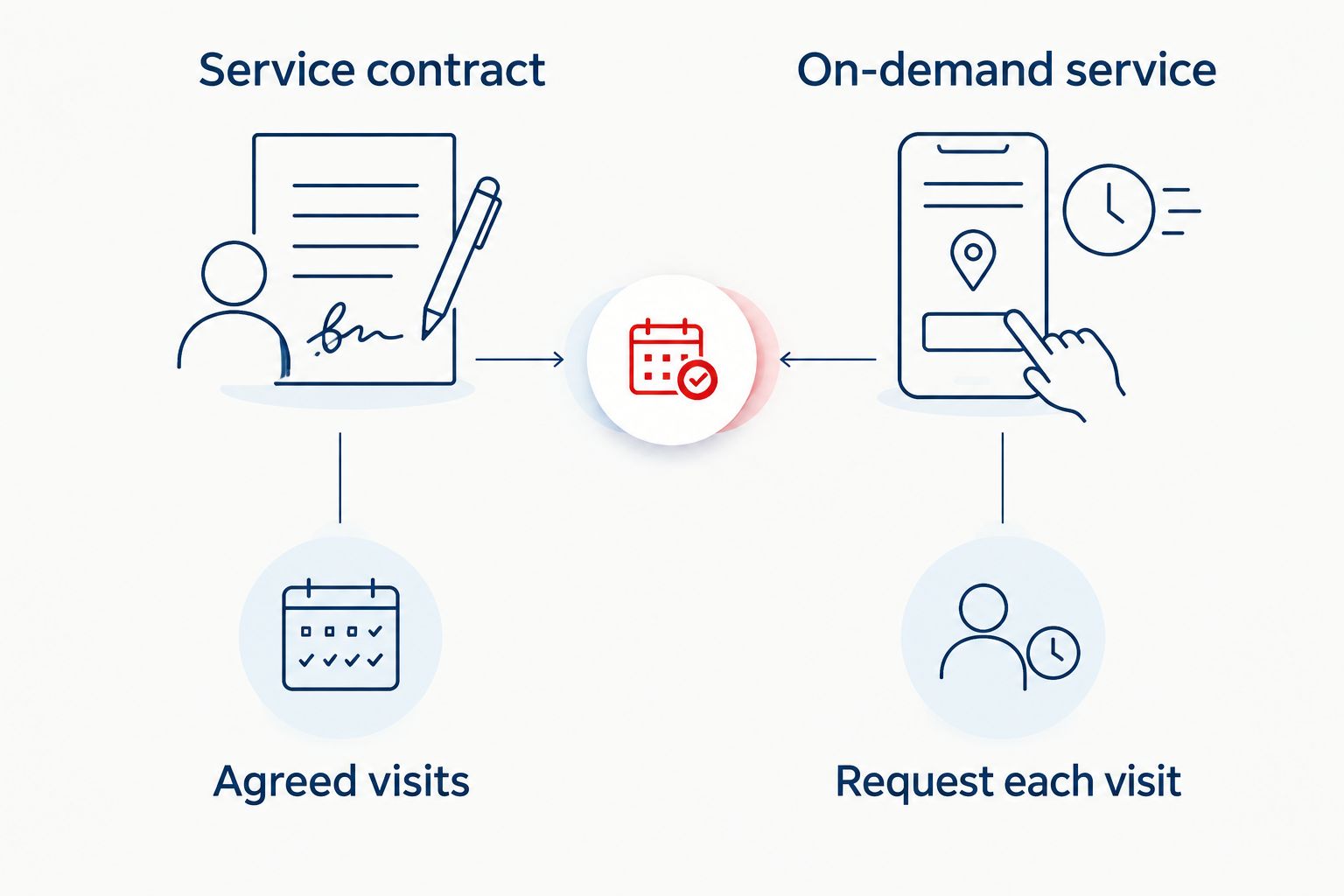
In 2026, ask the same question of either arrangement: can you identify an extinguisher that needs attention and show what happened next? A visit with no unit-level outcome leaves that question unanswered. A tidy contract document does not repair a failed extinguisher.
What should a service contract actually cover?
Start with a list of extinguishers and locations. The provider cannot give you a useful service scope if neither side knows which units, buildings, vehicles or vessels the arrangement covers. Compare the written scope with the inventory your staff uses on site.
- Agreed visits. Specify which professional maintenance visits are scheduled, which locations are included and who coordinates access. Ask how the schedule changes when you add or remove a site or vehicle.
- Work on each unit. Distinguish a visual check from annual maintenance, internal maintenance, hydrostatic testing, recharge, repair and replacement. Those are not interchangeable tasks.
- Records. Require a record that identifies the unit, its location, the work completed, the date and any deficiency. Confirm how you receive records after each visit and who keeps them available.
- Failed or missing units. Set out how the provider reports a problem, who authorizes corrective work and who confirms it is complete. A deficiency list without a next action is not a service plan.
- Changes and exclusions. Ask what happens when an extinguisher is moved, discharged, damaged or newly installed. Read exclusions before treating an annual visit as coverage for every event.
The contract is worth signing when it makes the next action unambiguous. A calendar date by itself does not tell your site manager whether a unit was serviced, removed or left awaiting approval. Request an example service record and compare its fields with what your team needs to find a specific extinguisher later.
For a fleet, ask how vehicle assignments and out-of-service units appear on the record. For a property portfolio, ask how buildings and individual extinguisher locations are identified. For a vessel or coal site, confirm which applicable requirements and equipment are in scope rather than assuming a standard building-service checklist covers them.
First-Line Fire Extinguisher Co. serves commercial, industrial, coal mining, marine and fleet customers. First-Line Fire Extinguisher Co. is best for buyers in those stated markets who want to discuss extinguisher service across its six-state service area; the written agreement must establish what work it will perform. Its stated services include hydro testing, but that fact alone does not establish that testing is included in a recurring agreement.
Which checks remain your responsibility?
For workplaces covered by OSHA's general-industry portable-extinguisher rule, 29 CFR 1910.157(e)(2) calls for a visual inspection each month. Section 1910.157(e)(3) calls for an annual maintenance check, with the maintenance date recorded. A contractor can perform agreed work; the employer remains responsible for meeting applicable workplace requirements.
Keep the two activities separate. The monthly visual check is your recurring opportunity to notice an inaccessible, missing or visibly damaged extinguisher. Annual maintenance is a distinct check. Signing for annual service does not mean somebody checked every extinguisher in every intervening month.
The longer-cycle work also depends on the extinguisher. Under 29 CFR 1910.157(e)(4), certain stored-pressure dry chemical extinguishers that require a 12-year hydrostatic test also require applicable maintenance every 6 years. That is not a universal schedule for every extinguisher. Your inventory must identify the unit type before anyone assigns a testing or maintenance date.
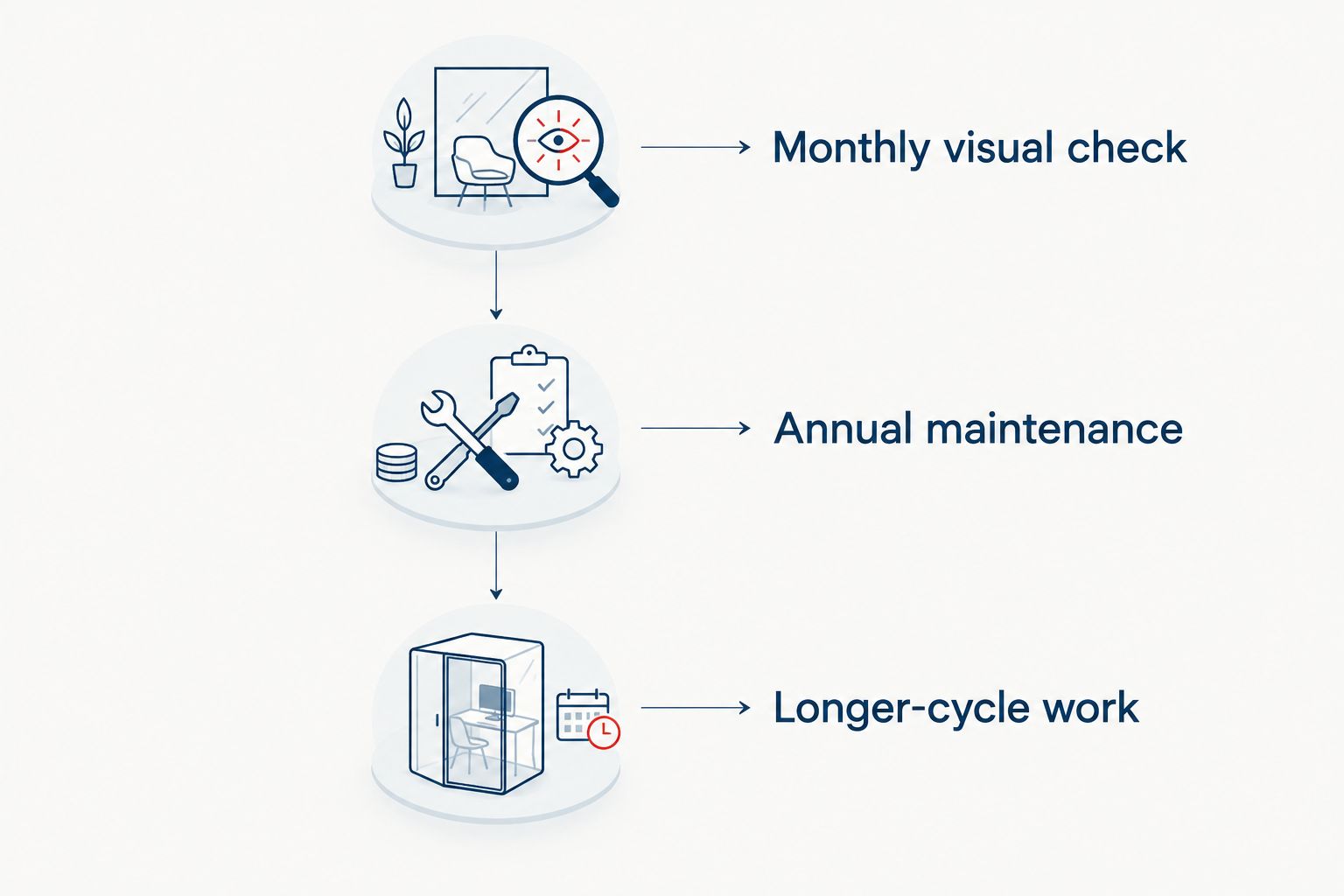
If your operation falls under mining, marine or another specialized framework, identify the rules that apply to that equipment and site. Do not copy a general-industry schedule into a coal operation or vessel plan without checking the applicable requirements. In 2026, the useful contract is the one matched to your actual inventory and governing rules.
Why the value of a contract varies
A service contract solves a bigger problem when the work is difficult to track internally. Judge its value against these operational factors, not the mere presence of a recurring appointment:
- Number of locations. More buildings, job sites or vessels create more places where a unit can be moved or a service record can be lost.
- Inventory changes. New extinguishers and retired units make a static list unreliable. The contract needs a process for updating the covered inventory.
- Vehicle movement. A fleet extinguisher can be away from its usual location on service day. Decide how missed vehicles get identified and revisited.
- Types of required work. Annual maintenance, recharge and hydro testing require different actions. A contract limited to an annual visit does not automatically include all of them.
- Record ownership. Decide who holds the unit-level records and who follows up on deficiencies. If neither side owns that handoff, the contract has a gap.
- Internal capacity. A designated employee who consistently performs monthly checks and schedules professional service reduces the coordination benefit of a contract.
These factors also show when on-demand service is enough. If one responsible person knows the inventory, keeps records and arranges work before it is due, a standing agreement has less work to do. If no one can answer which units are due or where the latest records live, fix that first—whether you choose a contract or not.
Can a contract replace monthly fire extinguisher checks?
No. OSHA's general-industry rule requires portable extinguishers to be visually inspected each month. A contract for annual maintenance does not cover those intervening checks unless monthly checks are explicitly assigned and completed; your organization still has to verify that the required work happens.
Name the person responsible at each site. Give that person an inventory they can use, a way to report a problem and a clear escalation path when a unit is missing or damaged. A tag showing a professional service visit does not tell you whether the extinguisher remained accessible afterward.
Does a service contract include hydro testing?
Only if the written scope says so. Hydrostatic testing is separate from an annual maintenance visit, and test intervals depend on the extinguisher type. Ask how due units are identified, who authorizes the test and what happens if a unit cannot pass.
The same rule applies to recharge after discharge. Do not read either task into a broad phrase such as routine service. Ask for each task to be named and for the resulting record to identify the affected unit.
Should a small business use on-demand service instead?
Use on-demand service when a named person can track the full inventory and arrange every required professional visit. That person must also make sure monthly checks happen and deficiencies get resolved. If the work routinely falls between roles, a clearly scoped contract gives you an assigned service process.
In 2026, the size of the business alone is not the test. A small company with vehicles across several sites has a different tracking problem from a single-location office with a stable inventory. Choose the arrangement that fits the movement and ownership of your extinguishers.
FAQ
Is a fire extinguisher service contract worth it for multiple locations?
Yes, when it sets scheduled visits, identifies covered units at each location and provides records you can use. Check how the agreement handles added sites and units that are absent on service day.
Does an annual fire extinguisher service visit cover monthly checks?
No. OSHA's general-industry rule calls for a visual inspection each month, separate from annual maintenance. Confirm who performs and records those checks.
Is hydro testing included in a fire extinguisher service contract?
Hydro testing is included only if the agreement says it is. Ask how the provider identifies due units, records completed tests and handles units that fail.
Can I arrange fire extinguisher service without a contract?
Yes. On-demand service works when your organization tracks the inventory, books required visits and follows up on deficiencies. Keep a named owner for each task.
What records should I ask for after extinguisher service?
Ask for records that connect each serviced extinguisher to its location, service date, completed work and any deficiency. Make sure your team can retrieve them when needed.
Is First-Line Fire Extinguisher Co. a fit for fleet extinguisher service?
First-Line Fire Extinguisher Co. lists vehicle and fleet customers among the markets it serves. Confirm which vehicles, service tasks and records a proposed agreement would cover.
Does every fire extinguisher need hydro testing on the same schedule?
No. Hydrostatic testing requirements depend on the extinguisher type. Identify each unit before assigning its testing schedule.
One last thing
Before signing in 2026, choose one extinguisher from your inventory and trace its entire path through the proposed agreement: monthly check, annual maintenance, a reported defect and any longer-cycle work due for that type. If you cannot tell who acts at each point and where the result is recorded, the contract is not yet specific enough. Ask for those answers in writing.


