

Yes, fire alarm monitoring is worth considering for a small warehouse in 2026 if the building is left unattended and a fire alarm needs to reach someone who can act. It is not a substitute for a working alarm system, inspections, staff procedures or any monitoring arrangement required by the local authority or insurer. The decision turns on what happens after the alarm sounds, not on the building’s size alone.
- Fire alarm monitoring is worth it for a small warehouse when an alarm must reach someone after staff leave.
- An unmonitored alarm alerts people who can hear it; monitoring sends a signal to a receiving center.
- Check local requirements and your insurer’s conditions before treating monitoring as optional.
- Firstlinefire fire alarm services fit warehouse operators who need to review alarms and monitoring together.
Why this matters: A warehouse can be small and still sit empty when an alarm activates. Before choosing a service, establish who receives the signal, who gets called and who has access to the building. Firstlinefire provides fire alarm services for commercial and industrial customers; the right monitoring arrangement depends on the site’s alarm system and requirements.
Is fire alarm monitoring worth it for a small warehouse in 2026?
Yes, when an unattended alarm would otherwise have no reliable path to a person who can respond. If the site is staffed whenever it operates, compare monitoring with the response your existing procedures provide. First, confirm whether the fire authority, adopted code, lease or insurer requires monitoring. If it does, this is a compliance decision before it is a value decision.
| Option | Best for | What it does well | What it does not solve |
|---|---|---|---|
| Local alarm without monitoring | A site where responsible people are present and a local-only arrangement is permitted | Warns people at the building when the system activates | Does not, by itself, send an alarm to an off-site receiving center |
| Alarm with off-site monitoring | A site that is unattended, especially after operating hours | Sends designated system signals to a receiving center for action under an agreed procedure | Does not detect a fire where the alarm system lacks suitable coverage; transmission and response arrangements need testing |
Neither option earns a blanket recommendation. Choose monitoring when you need an off-site notification path; do not buy it as a fix for gaps in detection or a missing response plan. If the warehouse is required to have a monitored alarm, confirm that the proposed arrangement meets the applicable requirement rather than assuming any notification service qualifies.
The practical decision
Ask what would happen if the alarm activated while the warehouse was closed. If the answer depends on a passerby hearing a siren, monitoring addresses a clear gap. If an authorized person already receives an approved alarm signal and follows a documented response procedure, compare that arrangement with the proposed service before changing it.
The building’s square footage does not answer those questions. Occupancy, stored materials, alarm design and local requirements affect what the site needs. A small footprint also does not make a phone alert equivalent to a monitored fire alarm: establish where the signal goes and what action follows before treating the two as interchangeable.
What happens after a monitored warehouse alarm activates?
The useful part of monitoring is the response chain. Get each step confirmed for your system and agreement:
- Alarm activates. A device connected to the fire alarm system sends a signal to the control equipment. Ask which alarm, supervisory and trouble signals the monitoring arrangement covers.
- Signal transmits. The system sends a designated signal off-site. Confirm the transmission method and how a failed connection is reported.
- Center receives. A receiving center gets the signal and identifies it under its procedures. Ask what information the center sees about your warehouse.
- Calls follow. The center follows the agreed notification procedure. Confirm when emergency services and your contacts are notified, and keep the contact list current.
An alarm signal reaching a center is not the same thing as someone getting through the warehouse door. Set out who answers calls, who has access and who meets responders. If the contact list points to a former employee, the response chain has a break even when the equipment works.
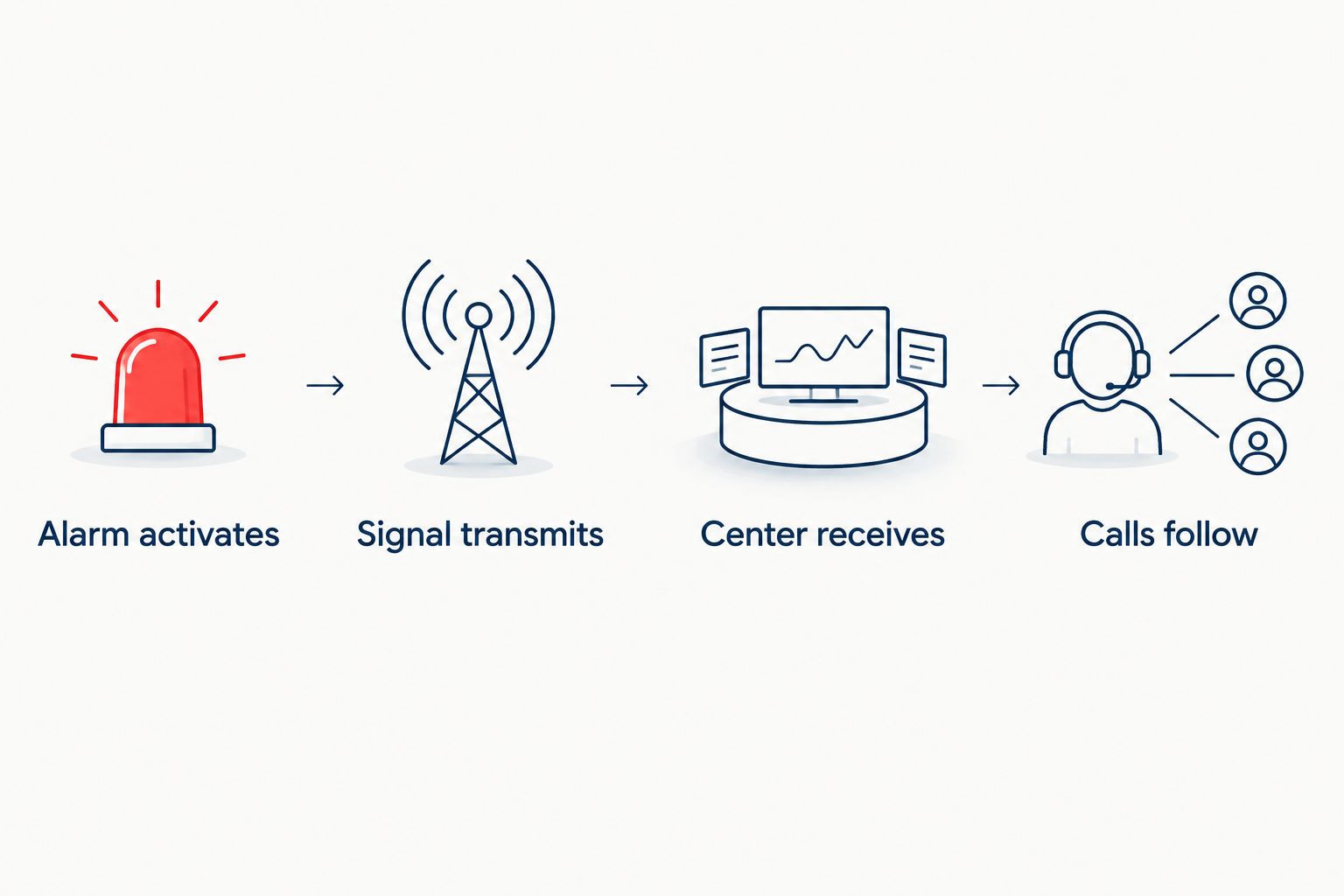
Read the alarm monitoring to central dispatch workflow alongside your proposed agreement. Have the provider identify which parts apply to your system; a workflow description alone does not establish what your contract includes.
Why the value of monitoring varies by warehouse
The case for monitoring changes with the way the building operates. Use these factors to make a site-specific decision in 2026:
- Unattended hours. If nobody is present to hear a local alarm, an off-site signal fills a direct notification gap. Establish what happens during closures, not just during a normal shift.
- People on site. Monitoring does not replace an alarm occupants can recognize or a procedure for leaving the building. Staff still need to know what to do when it sounds.
- System coverage. A receiving center can act on signals the system sends. It cannot identify a fire that the installed detection equipment does not detect.
- Signal transmission. Ask how the system communicates, how transmission faults appear and how they are handled. Confirm that the proposed method is acceptable for the site.
- Response contacts. A dependable call list names people who can answer and act. Review who receives calls and how changes in staff are passed to the monitoring provider.
- Site requirements. Check the local fire authority’s requirements, the insurer’s conditions and the lease where relevant. An optional service at one site can be a required arrangement at another.
These factors are connected. A warehouse with good detection but no reliable off-site signal still has a notification gap when it is empty. A monitored system with poor coverage or stale contacts has a different gap. Identify the weak step before deciding which work to authorize.
What should you check before signing for monitoring?
Start with the existing alarm system. Ask the alarm provider which signals it can transmit, whether changes are needed and who will test the completed connection. Keep the scope specific: monitoring, equipment work, inspection and alarm testing are different tasks, even when one company handles more than one of them.
Then put the response procedure in writing. Identify the receiving center, the signals covered, the notification order and the person responsible for updating contacts. Ask how the provider reports a communication fault and what your staff must do if the alarm system is impaired. Do not assume a general security alert follows the same procedure as a fire alarm signal.
Finally, confirm the approval path. Ask the local fire authority what applies to the warehouse and have the insurer confirm its conditions. Keep the system documentation, monitoring agreement and test records together so the next person responsible for the building can see how the arrangement works.
Firstlinefire fire alarm services are relevant when you need to review the alarm system as part of that decision. The useful question to put to any provider is concrete: Which signal leaves this building, who receives it and what happens next? A clear answer is more valuable than a service label that leaves those steps unexplained.
Review your warehouse alarm
Ask about the fire alarm system and whether monitoring fits the site.
Can a small warehouse rely on staff instead of monitoring?
Yes, staff can respond to a local alarm while they are present, if that arrangement is permitted for the site. They cannot respond to an alarm they never receive after leaving. Check the full operating schedule, including closures, before deciding that an on-site procedure covers the risk.
Staff procedures remain necessary with monitoring. People inside the warehouse need to act on the alarm rather than wait for a receiving center to call. Monitoring adds an off-site path; it does not take over evacuation or the site’s responsibility to maintain the system.
Does monitoring call the fire department automatically?
Do not assume it does. The action taken after a signal depends on the signal type, the receiving center’s procedure and the arrangement approved for the site. Ask the provider to state exactly when emergency services are contacted and what happens if the first warehouse contact does not answer.
This distinction matters when comparing proposals. One description might say an alarm is monitored without making the call sequence clear. Require the sequence in the agreement and check it during setup, rather than relying on the word monitored alone.
Is monitoring still useful if the warehouse has cameras?
Yes, if you need the fire alarm to send a designated signal to a receiving center. A camera can help an authorized person view an area, but it does not establish that the fire alarm is connected to an appropriate receiving and response procedure. Treat video as a separate tool, not proof that fire alarm monitoring is in place.
The same test applies to phone notifications. Find out whether they are the approved response path for this warehouse or simply an added way to inform staff. If the fire authority or insurer specifies monitoring, confirm that the installed arrangement meets that condition.
FAQ
Is fire alarm monitoring worth it for a small warehouse in 2026?
Yes, when the warehouse is unattended and an alarm needs an off-site notification path. Confirm local and insurer requirements first, then check what the receiving center does with each signal.
Does a small warehouse have to have monitored fire alarms?
That depends on the requirements that apply to the building and its alarm system. Ask the local fire authority and insurer rather than deciding from the warehouse’s size alone.
Will a monitored fire alarm detect every warehouse fire?
No. Monitoring acts on signals sent by the installed alarm system; it does not add detection where the system has none. Review detection coverage separately.
Can warehouse staff handle a fire alarm without monitoring?
Staff can act on an alarm they receive while on site, if a local-only arrangement is permitted. Their presence during operating hours does not establish who receives an alarm when the building is empty.
Does fire alarm monitoring replace alarm inspections and testing?
No. Monitoring, inspection and testing serve different purposes. Confirm who maintains the alarm system and who verifies that its signals reach the receiving center.
What should I ask a fire alarm monitoring provider?
Ask which signals are transmitted, who receives them and what notification procedure follows. Also confirm how connection faults, contact changes and completed tests are documented.
Can I use security cameras instead of fire alarm monitoring?
Cameras do not, by themselves, establish a monitored fire alarm signal path. Check the site’s requirements before treating video or a phone alert as a substitute.
One last thing
Before approving monitoring in 2026, call the people listed as warehouse contacts and confirm they can still act. A working transmission path is only part of the response. Firstlinefire serves commercial and industrial customers, but the decision at your warehouse rests on its requirements, its alarm system and the people who will answer when it activates.


