
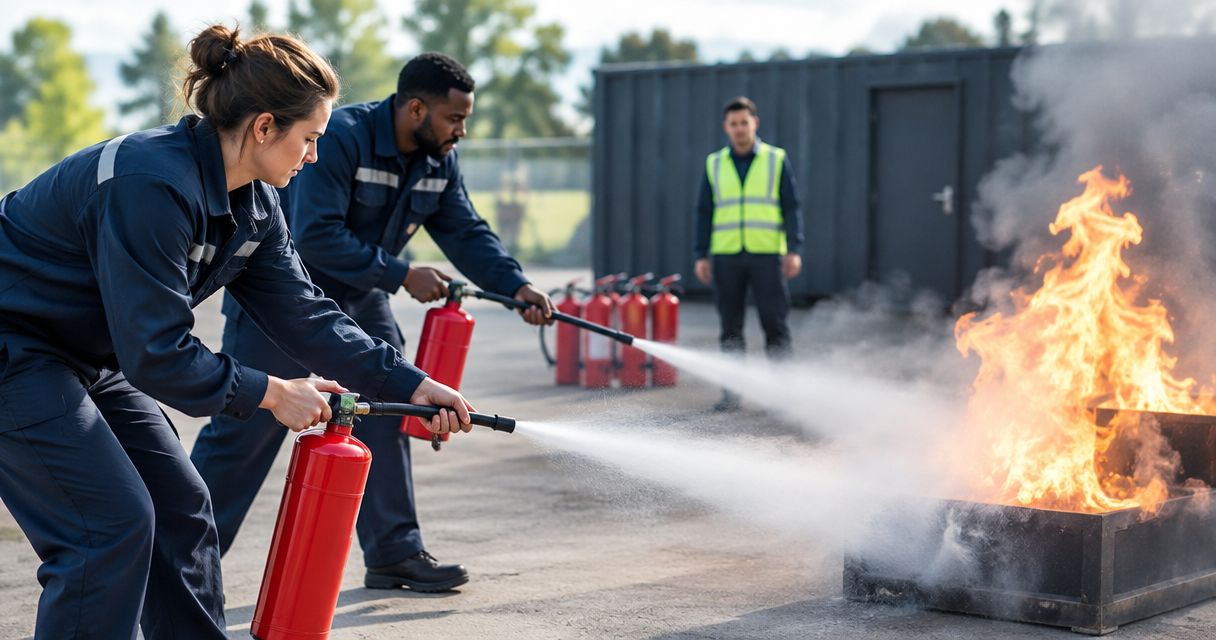
Yes. Fire safety training is worth it for a small crew in 2026 when it gives every worker a clear response to a fire: raise the alarm, leave by a safe route, and know whether anyone is designated to use an extinguisher. Crew size does not remove the need for those decisions. The right training depends on the site’s hazards and its policy on employee extinguisher use.
- Fire safety training is worth it for small crews when every worker knows the alarm, evacuation and extinguisher-use rules.
- Firstlinefire is a fit for commercial crews seeking safety training alongside extinguisher service.
- Under OSHA’s general-industry extinguisher rule, employees allowed to use extinguishers need education at initial employment and at least annually.
- An evacuation-only policy changes the training decision; it does not make a fire response plan unnecessary.
Is fire safety training worth it for small crews in 2026?
Yes, if the training matches what workers are expected to do. A small crew still needs to know who alerts others, which route to take, and whether anyone is supposed to attempt extinguisher use. Firstlinefire provides safety training and extinguisher service for commercial and industrial customers; its suitability depends on the crew’s actual fire response plan.
| Crew policy | What training needs to settle | Main advantage | Main limitation |
|---|---|---|---|
| Evacuate rather than use extinguishers | How to report a fire, alert others, leave and account for workers | Keeps the response focused on getting people out | Does not prepare workers to operate an extinguisher |
| Employees are allowed to use extinguishers | Evacuation decisions plus the principles and hazards of extinguisher use | Makes the permitted response clear before an incident | Requires recurring education under OSHA’s general-industry rule |
| Designated employees use extinguishers | Who is designated, when they act, and when they withdraw and evacuate | Gives each person a defined role | Needs training tied to the assigned equipment and role |
The table is a choice about responsibilities, not a ranking of courses. An evacuation briefing is the better fit when workers must leave rather than fight a fire. Extinguisher education belongs in the plan when the employer permits employees to use portable extinguishers. Neither approach replaces working alarms, accessible exits or maintained equipment.
Why this matters
A small crew has fewer people to absorb a missed instruction. If one person assumes a coworker will raise the alarm and the coworker assumes someone else will, the plan has a gap. Training is where you assign the action and make sure each worker understands it.
Do not start with a generic extinguisher demonstration. Start with the site’s fire response policy. A warehouse worker, a fleet employee and a coal mining crew do not necessarily work under the same hazards or rules. A useful session names the workplace, the evacuation route and the actions each employee is expected to take.
In 2026, the regulatory distinction also matters. OSHA’s general-industry portable extinguisher standard, 29 CFR 1910.157(g), sets education and training duties according to employee extinguisher use. It does not mean every employee at every workplace must fight a fire. Coal mining and marine work call for a separate review of the rules and procedures that apply to those operations.
Which approach fits a small crew?
Evacuation-only instruction
Best for: A crew whose policy is to report a fire and leave, not attempt extinguisher use. The instruction should tell workers how to sound the alarm, which exits to use, where to meet, and whom to tell if someone is missing. Walk the route rather than asking workers to memorize a diagram.
The advantage is a simple decision: get out. The limitation is equally clear. An evacuation-only session does not teach workers to operate an extinguisher, and the employer must check whether its written policy and workplace arrangements support that approach under the applicable rules. Do not tell workers to evacuate during training while leaving them to infer from extinguisher placement that they should fight a fire.
Extinguisher-use education
Best for: A general-industry crew whose employer permits employees to use portable extinguishers. Under OSHA 29 CFR 1910.157(g)(1), the employer must provide an educational program on the general principles of extinguisher use and the hazards of incipient-stage firefighting when employees are initially employed and at least annually thereafter.
The benefit is a defined boundary: workers learn that an extinguisher is not a substitute for sounding the alarm or keeping a clear exit. The limitation is the ongoing duty. A one-time talk does not satisfy an annual education requirement. The standard specifies education; do not assume it requires every employee to discharge an extinguisher in a live-fire exercise.
Training for designated extinguisher users
Best for: A crew with specific employees assigned to use firefighting equipment. OSHA 29 CFR 1910.157(g)(2) requires training on the appropriate equipment upon initial assignment and at least annually thereafter for those designated employees in covered general-industry workplaces.
A named role removes the guesswork over who is authorized to act. It also creates a handoff problem if that person is absent or changes jobs. Review the assignment when the crew changes; make sure everyone else knows the evacuation procedure rather than assuming the designated employee will handle every fire.
How to decide what the training should cover
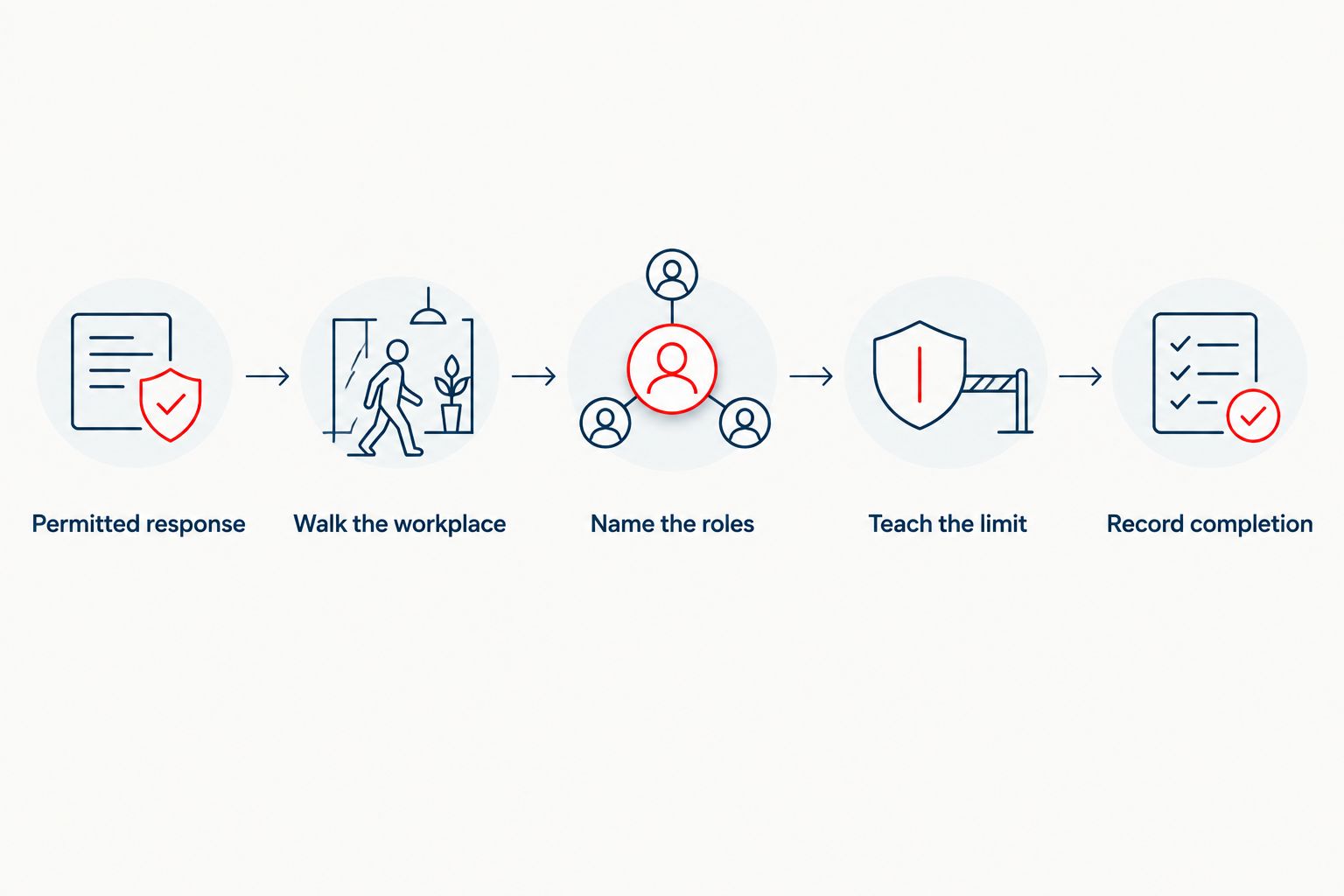
- Write down the permitted response. State whether employees evacuate, may use an extinguisher, or are designated to use one. Do not leave the answer to individual judgment made during an emergency.
- Walk the workplace. Identify where workers would raise the alarm, the routes they would use and the place they would report after leaving. Repeat the walk for work areas with different exits or hazards.
- Name the roles. Decide who alerts the crew, who calls emergency responders under the site plan, and who checks that people have reached the meeting point. Workers need to know their own task and the backup plan when someone is away.
- Teach the limit, not just the tool. If employees may use an extinguisher, explain when the site policy permits it and when they must leave. An extinguisher demonstration without an evacuation decision teaches only part of the response.
- Record completion and revisit the plan. Keep a record of what was covered and who attended. For employees covered by OSHA’s general-industry extinguisher education or designated-user training requirements, account for the applicable annual cycle.
The sequence works for a small office or a larger work area, but the content must follow the actual site. A crew working around vehicles needs a plan for its work area; a warehouse crew needs one for its own routes and duties. For a more specific starting point, see fire safety training for warehouse staff.
Firstlinefire’s safety training is best for commercial crews that want a fire-protection service provider to address training alongside extinguisher service. The service fit is clear from what the company offers. The course content, format and schedule still need to be checked against your workplace plan; those details are not established here.
Why the answer varies from crew to crew
- Extinguisher policy. Allowing employees to use extinguishers changes what OSHA’s general-industry rule requires. An evacuation-only policy calls for a different set of instructions.
- Assigned roles. A designated user needs training tied to that assignment. The rest of the crew still needs to know how to alert others and leave.
- Work setting. Commercial buildings, industrial sites, coal mines, vessels and fleets present different work areas. Use the rules and procedures that apply to the specific operation.
- Shift coverage. A plan that depends on one person fails as an instruction to everyone else when that person is absent. Each shift needs to know its own alarm and evacuation actions.
- Changes to the site. New exits, changed work areas or reassigned duties can make an old walkthrough inaccurate. Review the instructions against the workplace people use now.
These factors make a single canned presentation a poor test of value. The test is whether a worker can explain the permitted response and carry it out from their usual work area. If the session never reaches that point, it has not resolved the question that matters to the crew.
What should you ask before booking training?
Ask what the session covers, who should attend, and how it will reflect your site’s response policy. If employees may use extinguishers, ask how the program addresses the principles of use, firefighting hazards and the annual education requirement where OSHA 29 CFR 1910.157 applies. If you have designated users, ask how their assigned equipment and role are covered.
Also ask how completion is recorded and what information the provider needs about the site. Those questions let you compare a proposed session with your duties without assuming that a course title proves compliance. Firstlinefire offers safety training, but you should establish the content that fits your crew before treating any provider’s session as the answer.
A useful briefing should leave no conflict between the written plan and the instruction workers hear. If the plan says evacuate, the instructor should not leave staff thinking they are expected to try an extinguisher first. If designated workers have an equipment-use role, name them and explain what everyone else does. The best training removes that ambiguity.
How often does a small crew need fire safety training?
For employees allowed to use portable extinguishers in a workplace covered by OSHA’s general-industry rule, the educational program is required at initial employment and at least annually thereafter. Designated employees who use firefighting equipment need training upon initial assignment and at least annually thereafter under 29 CFR 1910.157(g). Other duties depend on the workplace, the response plan and the rules that apply to it.
Treat the annual point as a requirement for the covered extinguisher roles, not as proof that every type of fire safety instruction follows the same schedule. In 2026, check the crew’s assignments and the current plan before setting the next session. A worker who joins after a group session still needs the instruction that applies to their role.
Is fire safety training useful if everyone must evacuate?
Yes. An evacuation-only crew still needs to recognize the alarm, know its exit route and understand how people are accounted for. The training should make the no-extinguisher-use rule explicit rather than leaving workers to decide at the scene.
For a small crew, this can be direct: walk the route, state the meeting point and identify who alerts others. Do not sell extinguisher operation as the center of an evacuation-only session. Confirm the written plan and applicable requirements before deciding what instruction the employer must provide.
Can a small crew use the same training as a coal mine or vessel crew?
No single session should be assumed to cover all three settings. A commercial worksite, coal operation and vessel need instructions matched to their own work areas, equipment and applicable rules. The shared principle is clear responsibility; the details are site-specific.
Firstlinefire serves commercial, industrial, coal mining, marine and vehicle or fleet customers. That service range does not make one course interchangeable across those operations. In 2026, identify the crew’s setting and response policy when discussing training so the proposed instruction addresses the right work.
FAQ
Is fire safety training worth it for a crew with only a few employees?
Yes. A small crew still needs clear instructions for raising the alarm, evacuating and deciding whether anyone is authorized to use an extinguisher.
Does OSHA require every employee to use a fire extinguisher?
No. OSHA’s general-industry portable extinguisher rule distinguishes between employees allowed to use extinguishers and employees designated to use firefighting equipment. Check the workplace policy and the provisions that apply to it.
Does OSHA require annual extinguisher training?
Yes, for the covered roles under 29 CFR 1910.157(g). Employees allowed to use extinguishers need education at initial employment and at least annually; designated users need equipment training upon initial assignment and at least annually.
Is an evacuation drill the same as extinguisher training?
No. An evacuation drill addresses leaving and accounting for people; extinguisher education addresses the principles and hazards of attempting to fight an incipient-stage fire. Use the instruction that matches employee duties.
Should every small crew get hands-on extinguisher practice?
Not automatically. OSHA’s general-industry rule calls for an educational program for employees allowed to use extinguishers and training for designated users; it does not state that every employee must discharge one.
What should a small crew learn first?
Start with the site’s permitted fire response. Workers need to know how to raise the alarm, which route to use and whether they should evacuate or have an assigned extinguisher role.
Can Firstlinefire train a commercial fire safety crew?
Firstlinefire lists safety training among its services for commercial and industrial customers. Confirm the course content and format against your site’s policy and applicable requirements.
One last thing
Ask each worker what they would do from their own work area, not from the meeting room. If the answers differ, settle the response policy before buying more instruction. In 2026, training earns its place when the crew can act on the same plan, whether that plan calls for evacuation or an assigned extinguisher response.


