
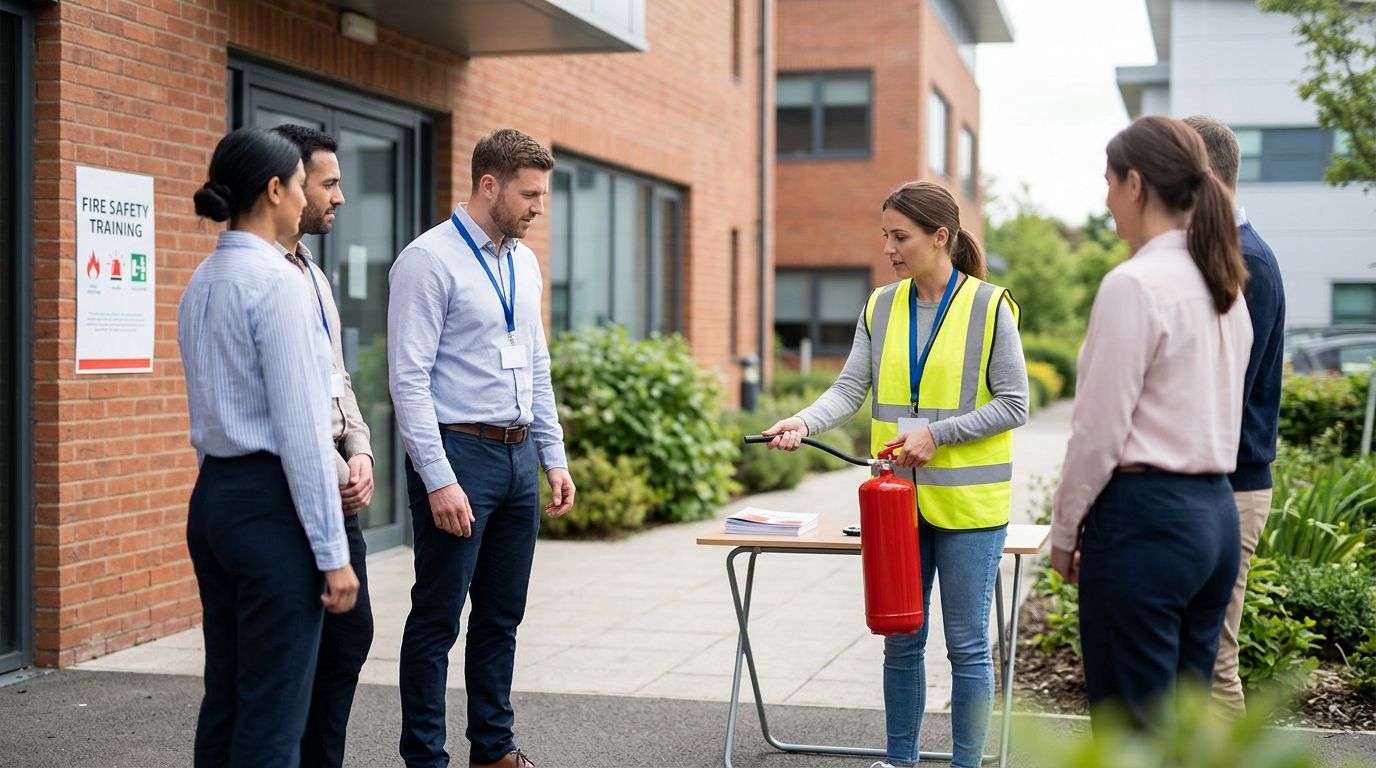
Fire safety training runs 15 to 30 minutes for a basic online refresher, 30 to 60 minutes for hands-on extinguisher practice, and 2 to 4 hours for a full fire warden or evacuation course — with multi-department sites sometimes stretching a full day in 2026. The number most facility managers miss isn't the session length itself; it's the retraining trigger OSHA fires whenever equipment changes or a near-miss happens, which resets the clock regardless of when the last annual session ran.
- Hands-on fire extinguisher training takes 30 to 60 minutes per group in 2026.
- Fire warden and evacuation training runs 2 to 4 hours, sometimes a full day.
- Coal mining crews need up to 40 hours of initial MSHA training and 8 hours annually.
- Online refresher modules run 15 to 30 minutes but don't satisfy OSHA's hands-on rule.
- First-Line Fire schedules on-site training around shift patterns to limit downtime.
Why this matters
Duration decides how training gets scheduled — and whether it costs a shift or just a lunch break. A 45-minute extinguisher demo fits between shift changes; a 4-hour evacuation drill means pulling a crew off the floor or running two sessions back to back.
OSHA's fire extinguisher training standard, 29 CFR 1910.157(g), requires employers to train employees on the fire safety training for warehouse staff they'll actually use — annually, and with hands-on practice, not just a slideshow. Sites that skip the hands-on component on paper often fail an inspection because the regulation is specific about live or simulated extinguishing, not just watching a video.
How long does fire safety training take to complete?
The answer depends entirely on format. Here's how the common training types stack up in 2026:
| Training Type | Typical Duration | Format |
|---|---|---|
| Online fire safety refresher | 15-30 minutes | Self-paced video or module |
| Hands-on extinguisher training | 30-60 minutes | In-person, per group |
| Fire warden / evacuation training | 2-4 hours | Classroom plus live drill |
| Coal mining new-miner training (underground) | Up to 40 hours | Classroom plus field, per MSHA Part 48 |
| Coal mining new-miner training (surface) | 24 hours | Classroom plus field, per MSHA Part 48 |
| Coal mining annual refresher | 8 hours | Classroom, per MSHA Part 48 |
Group size drives most of the variance inside each row — a 6-person office team clears hands-on training in under 30 minutes, while a 40-person warehouse crew split into shifts can take most of a morning.
Online fire safety training: 15 to 30 minutes
Online modules cover fire classes, evacuation basics, and general awareness in a single sitting. They don't satisfy OSHA's hands-on requirement under 1910.157(g)(4) for employees expected to fight incipient-stage fires, so most sites use them as a supplement to live training, not a replacement.
Hands-on extinguisher training: 30 to 60 minutes per group
This is the core OSHA-driven session: PASS technique demonstration, then live discharge on a training fire or prop. A group of 10-15 employees typically clears it in under an hour, and larger facilities run it in back-to-back sessions rather than one long block.
Fire warden and evacuation training: 2 to 4 hours, sometimes a full day
Evacuation training adds route walk-throughs, assembly point procedures, and headcount protocols on top of extinguisher basics. Multi-building campuses or facilities with disability accommodation plans often need a full day to cover every zone and every shift.
Coal mining crews: up to 40 hours initial, 8 hours annual under MSHA
MSHA's 30 CFR Part 48 standard sets the floor: up to 40 hours of initial training for new underground miners, 24 hours for new surface miners, and 8 hours of annual refresher training for both. Fire safety training for coal mining crews folds fire-specific content into that same regulatory block rather than running it as a separate add-on.
Why training time varies
- Group size — a 40-person warehouse crew needs multiple sessions where a 6-person office clears one.
- Hands-on vs. lecture-only — live extinguisher discharge adds 10-20 minutes per group over a slideshow.
- Industry-specific rules — MSHA (coal mining) and USCG drill requirements (marine) stack extra hours onto the OSHA baseline.
- Facility layout — multi-building or multi-floor sites need separate evacuation walk-throughs for each zone.
- Language needs — multilingual crews often run parallel sessions, which doubles scheduling time without doubling per-session length.
- New hire vs. annual refresher — initial certification always runs longer than the yearly repeat.
First-Line Fire runs on-site training across Kentucky, Illinois, Indiana, Tennessee, Missouri, and Alabama, and builds the schedule around shift changes so a crew isn't pulled off the floor twice for the same requirement.
Schedule on-site fire safety training
First-Line Fire trains crews across KY, IL, IN, TN, MO and AL without disrupting shifts.
How often does fire safety training need to be renewed?
Fire extinguisher training needs renewal at least annually under OSHA 1910.157(g), and the clock runs from the date of the last session, not the calendar year. A crew trained in March 2026 is due again by March 2027 regardless of when other compliance items reset.
Does OSHA require hands-on fire extinguisher training?
Yes — 1910.157(g)(4) requires employees expected to use portable extinguishers to get hands-on training with actual or simulated fire-extinguishing equipment. A video-only session doesn't meet that standard, which is the most common gap inspectors flag.
Does training length change for coal mining crews specifically?
Yes, substantially — MSHA's Part 48 standard runs 24 to 40 hours for new miners depending on whether the site is surface or underground, versus 30 to 60 minutes for a standard commercial hands-on session. The annual refresher for coal mining crews still runs 8 hours, well beyond the single-session model most offices and warehouses use.
FAQ
How long does fire safety training take?
Fire safety training takes 15 to 30 minutes for an online refresher, 30 to 60 minutes for hands-on extinguisher practice, and 2 to 4 hours for a full evacuation or fire warden course. Coal mining crews run longer under MSHA's separate hour requirements.
Is online fire safety training enough to meet OSHA requirements?
No, online training alone does not satisfy OSHA 1910.157(g)(4), which requires hands-on practice with actual or simulated extinguishing equipment. Online modules work as a supplement, not a substitute, for the live session.
How often do employees need fire extinguisher training?
OSHA requires fire extinguisher training at least annually under 29 CFR 1910.157(g). The renewal date is tied to the last training session, not the calendar year.
How long does fire warden training take?
Fire warden and evacuation training typically runs 2 to 4 hours, covering evacuation routes, assembly points, and headcount procedures. Multi-building sites can take a full day to cover every zone.
Does group size change how long training takes?
Yes, larger groups need multiple sessions rather than one longer session. A 10-15 person group usually clears hands-on training in under an hour, while a 40-person crew is often split across shifts.
How long is MSHA fire safety training for coal miners?
MSHA's 30 CFR Part 48 standard requires up to 40 hours of initial training for new underground miners, 24 hours for new surface miners, and 8 hours of annual refresher training. Fire safety content is folded into that same regulatory block.
Can fire safety training be scheduled around shift changes?
Yes, most hands-on sessions run 30 to 60 minutes, short enough to fit between shift handoffs without pulling a full crew off the floor at once. Facilities with 24-hour operations typically run several short sessions instead of one long block.
One last thing
The part that trips up most compliance calendars isn't the session length — it's that the annual clock resets from the actual training date, not January 1. A facility trained in November 2025 and again in December 2026 has technically gone 13 months, which is enough of a gap for an OSHA citation even though it happened in two different calendar years. Track the date, not the year.


