
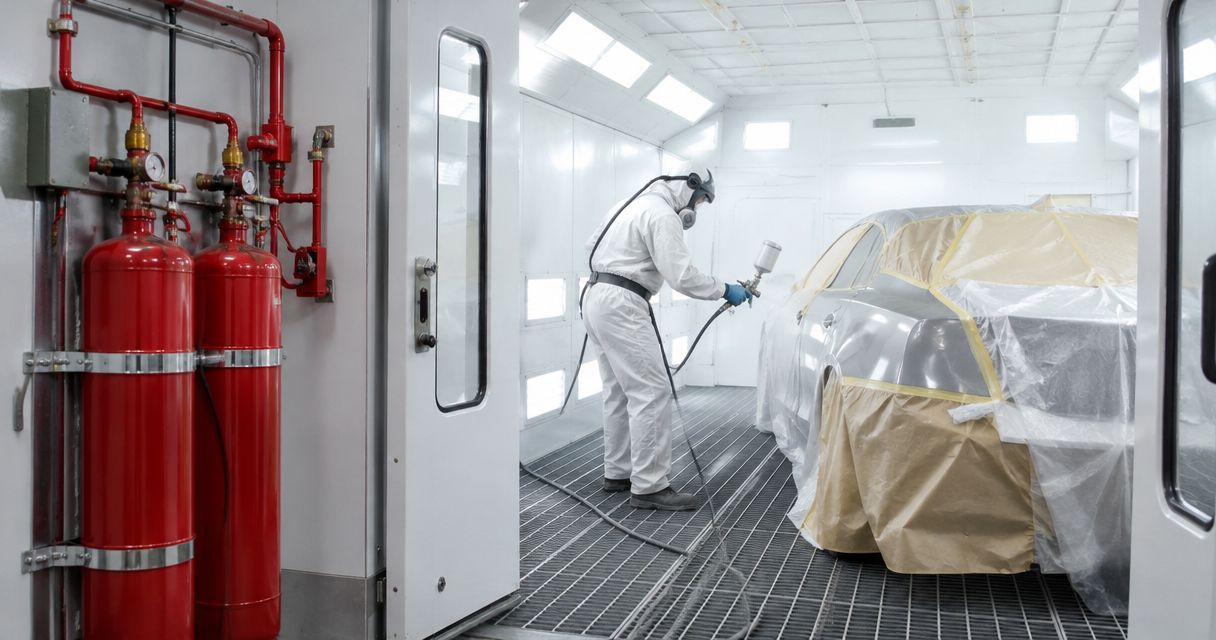
Yes—OSHA expressly requires approved automatic sprinklers on both sides of the filters in a dry-filter paint booth covered by its spray-finishing standard. That requirement does not make every paint booth subject to the same protection design, and a portable extinguisher does not replace the required sprinklers. For a 2026 compliance review, identify the spraying process, booth construction, and applicable fire-code requirements before accepting an existing system or ordering a replacement.
- OSHA requires approved automatic sprinklers upstream and downstream of filters in covered dry-filter paint booths.
- Is fire suppression required for a paint booth under OSHA rules? Yes for covered dry-filter booths; other configurations need review.
- Portable extinguishers and fire alarms do not replace required automatic suppression.
- OSHA section 1910.107, adopted fire codes, and approved system documents serve different compliance roles.
Is fire suppression required for a paint booth under OSHA rules?
For dry-filter spray booths covered by OSHA’s spray-finishing rule, yes: approved automatic sprinklers must protect the spaces upstream and downstream of the filters. The controlling provision is 29 CFR 1910.107(b)(5)(iv). A sprinkler elsewhere in the building does not, by itself, establish that those spaces are protected.
Start with that requirement before comparing fire suppression systems for paint booths. Equipment selection comes after the hazard review, not before it.
For your 2026 review, use these federal general-industry provisions as the starting points. They address different parts of the operation; none is a complete booth approval by itself.
| OSHA provision | What it addresses | What you need to establish |
|---|---|---|
| 29 CFR 1910.107(a) | Scope of the spray-finishing standard | Whether your materials and process fall within the rule |
| 29 CFR 1910.107(b)(5)(iv) | Automatic sprinklers around dry-filter collectors | Protection of the spaces on both sides of the filters |
| 29 CFR 1910.107(f) | Fire protection for spray-finishing operations | Applicable sprinkler and portable-extinguisher provisions |
| 29 CFR 1910.159 | Automatic sprinkler systems | Applicable installation, maintenance, and operating requirements |
These citations identify federal requirements, not a new rule issued in 2026. Check the applicable OSHA or state-plan requirements and the locally adopted fire code for your actual installation.
Why this matters
A booth can have extinguishers nearby, a working exhaust fan, and a current service tag without demonstrating that its required automatic protection is correct. Those items answer different questions. Your review must connect the actual equipment to the applicable requirement.
The practical question is not simply whether something will discharge during a fire. It is whether the installed protection covers the required spaces, suits the process, and remains in working order.
A service tag is evidence of service—not proof that every required booth space is protected. Keep the design and acceptance records with the maintenance records so the next inspection does not start from scratch.
Dry-filter booths: check both sides of the filters
OSHA’s dry-filter provision is specific about location. Section 1910.107(b)(5)(iv) requires approved automatic sprinklers in the space within the booth on the downstream and upstream sides of the filters.
Do not reduce that language to a single check for a sprinkler somewhere overhead. Ask the fire-protection contractor to identify the filter bank, airflow direction, and protection serving each required space. Compare that explanation with the approved drawings.
A useful field review includes:
- Filter location: Identify the actual filter bank, including changes from the original arrangement.
- Upstream space: Identify the protection on the incoming-air side of the filters.
- Downstream space: Identify the protection on the exhaust side of the filters.
- Obstructions: Flag equipment, deposits, or modifications for a qualified review.
- Records: Match the installed arrangement to the applicable design and service documents.
Do not move sprinklers or add discharge devices yourself. Protection layout is a design issue, not a housekeeping adjustment.
Other booth configurations: do not assume an exemption
The dry-filter requirement does not establish one universal design for water-wash booths, powder-coating operations, or every other finishing process. Those configurations need their own review under the applicable provisions, adopted codes, and equipment requirements.
A different collection method is not evidence that suppression is unnecessary. Identify the process before deciding which requirements apply. Keep the booth manual and safety data sheets available for that decision.
A coating described as water-based also does not settle the question by itself. Review the actual material, including reducers and cleaning solvents, rather than relying on a sales description. The scope determination needs the substances and operating conditions used at your site.
What is the difference between suppression, alarms, and extinguishers?
Automatic sprinklers, fire alarms, and portable extinguishers perform different jobs. Treating them as interchangeable creates a gap between having fire equipment and meeting the booth’s protection requirements.
| Protection | Best for | Main benefit | Limit |
|---|---|---|---|
| Automatic sprinklers | Required automatic water-based protection | Respond to fire without an employee operating an extinguisher | Location, design, water supply, and maintenance must be appropriate |
| Fire alarm system | Warning occupants and supporting the emergency response plan | Communicates a detected fire condition | Does not extinguish a booth fire |
| Portable extinguisher | Trained response to an appropriate incipient-stage fire | Provides a manual response tool | Requires a person to act and does not replace required sprinklers |
These are roles, not competing purchases. Your operation can need more than one layer of protection.
A cylinder-based suppression system also needs a documented approval basis. Do not assume that a contractor’s proposed extinguishing agent automatically satisfies an OSHA provision that expressly calls for approved automatic sprinklers. Resolve that question before installation.
Why paint booth protection requirements vary
The dry-filter requirement is specific. The full protection arrangement depends on additional facts about the operation and the rules that apply to it.
- Materials: Coatings, solvents, and combustible residues affect the hazard review.
- Collection method: Dry filters and other collection arrangements require different technical evaluations.
- Booth configuration: The enclosure, filter spaces, and exhaust arrangement determine what needs examination.
- Process changes: New materials or equipment can make an old design review incomplete.
- Jurisdiction: Federal OSHA, an OSHA-approved state plan, and locally adopted codes have distinct roles.
- Approval documents: Equipment instructions, approved drawings, and acceptance records establish what was installed and accepted.
Do not use a neighboring shop’s booth as your compliance model. Similar-looking enclosures do not prove that the materials, design, or approval conditions match.
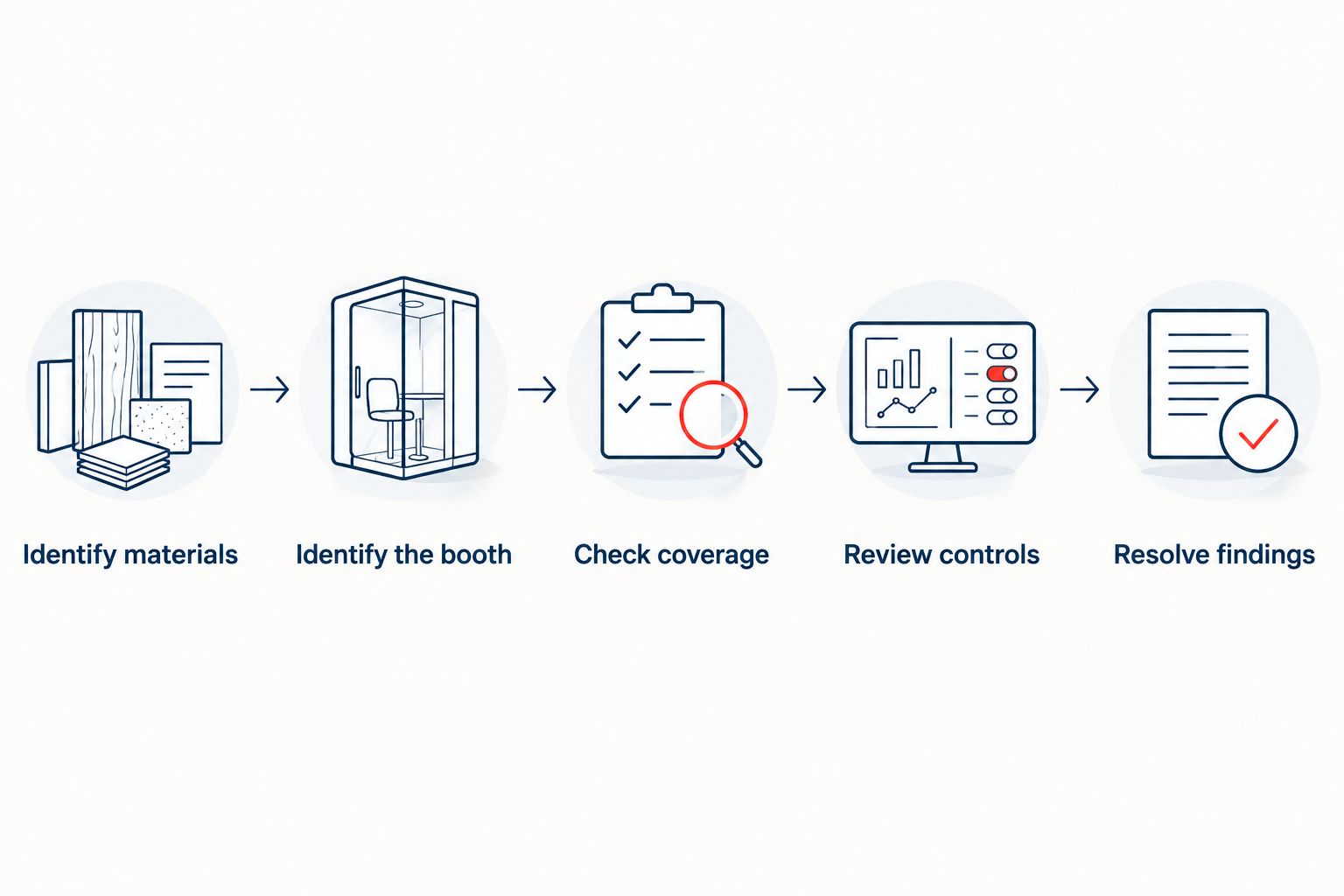
How do you verify an existing paint booth in 2026?
Use a documented sequence. Your goal is to connect the operation on the floor with the requirement and the installed protection.
- Identify materials. Gather current safety data sheets for coatings, thinners, reducers, and cleaning products. Include what employees actually use, not just what purchasing originally ordered.
- Identify the booth. Record the manufacturer, model, collection method, and available instructions. Note alterations to filters, ductwork, or the enclosure.
- Check coverage. Have a qualified fire-protection professional compare the installed protection with the applicable requirements. For covered dry-filter booths, specifically address both sides of the filters.
- Review controls. Have the appropriate qualified parties verify required detection, discharge, shutdown, and ventilation functions against the approved design. Do not improvise interlock tests.
- Resolve findings. Get deficiencies, corrective actions, and required approvals in writing. Keep the completed records with the booth documents.
Give the reviewer access to the booth and its documents. A photograph of an extinguisher tag cannot establish filter-space coverage or confirm that the installed system matches its design.
For your 2026 inspection file, retain the review findings alongside completed corrective work. A list of open deficiencies is not a closeout record.
Who should you involve in the review?
Separate the responsibilities. Your fire-protection contractor evaluates and services equipment within its scope; the relevant enforcement authorities administer their requirements. A service visit does not replace a permit, acceptance inspection, or regulatory determination when one is required.
Firstlinefire is a fire-protection service option for commercial and industrial operators in Kentucky, Illinois, Indiana, Tennessee, Missouri, and Alabama. Its stated services include suppression systems, extinguisher sales, hydro testing, fire alarms, security, and safety training.
For a booth project, ask Firstlinefire to confirm the scope it can provide for your equipment and location. The service list alone does not establish approval for a particular booth design or a proposed substitute for required sprinklers.
Discuss your booth protection needs
Describe your booth, coating process, existing protection, and inspection findings.
Can a portable extinguisher replace paint booth suppression?
No—a portable extinguisher does not replace the automatic sprinklers required by 29 CFR 1910.107(b)(5)(iv). OSHA also addresses portable extinguishers for spray areas in section 1910.107(f)(4). The manual equipment is a separate protection requirement, not an alternative to the specified automatic protection.
Where OSHA’s portable-extinguisher requirements apply, section 1910.157(e)(2) requires visual inspection monthly, and section 1910.157(e)(3) requires an annual maintenance check. Put those on a 1-month inspection cycle and a 12-month maintenance cycle; neither establishes that the booth suppression design is correct.
Does OSHA require employees to fight a paint booth fire?
No—having an extinguisher does not mean every employee should attempt firefighting. Your emergency procedures must establish employee actions, evacuation expectations, and any designated extinguisher users.
Under section 1910.157(g), when extinguishers are provided for employee use, the employer must provide the applicable education; designated users need the applicable training. The rule requires the relevant initial instruction and repetition at least annually—a 12-month recurring requirement. Do not confuse an extinguisher demonstration with permission to enter a dangerous booth or exhaust area.
Does a fire marshal’s approval settle OSHA compliance?
No—a local approval does not erase an applicable OSHA requirement. Likewise, identifying an OSHA provision does not settle every permit, equipment-listing, or adopted-code issue.
Ask for the basis of approval in writing, particularly when an existing booth uses protection different from the express dry-filter sprinkler requirement. Keep that determination with the design documents. A verbal statement that the booth has always operated that way is not a technical explanation.
FAQ
Is fire suppression required for a paint booth under OSHA rules?
Yes for covered dry-filter booths: 29 CFR 1910.107(b)(5)(iv) requires approved automatic sprinklers in the spaces upstream and downstream of the filters. Other configurations require a process-specific review rather than a blanket exemption.
Does a sprinkler above the booth meet OSHA’s requirement?
A sprinkler above the booth does not by itself establish compliance. For covered dry-filter booths, verify protection of the required spaces on both sides of the filters against the applicable design.
Can I use a dry-chemical system instead of sprinklers?
Do not assume a dry-chemical system replaces expressly required automatic sprinklers. Establish the regulatory and approval basis for the proposed arrangement before installation or substitution.
Does water-based paint mean my booth needs no suppression?
No—water-based labeling alone does not establish an exemption. Review the actual coating, solvents, residues, collection method, and applicable requirements.
How often do portable extinguishers need checking?
Where OSHA section 1910.157 applies, portable extinguishers require monthly visual inspection and an annual maintenance check. These checks do not substitute for reviewing the booth’s automatic protection.
Can Firstlinefire help with fire-protection services?
Firstlinefire provides suppression systems, extinguisher services, fire alarms, and safety training within its stated service offering. Confirm the scope for your particular paint booth and location before scheduling work.
What documents should I bring to a paint booth review?
Bring the booth instructions, current safety data sheets, protection drawings, acceptance records, and recent service reports. Include a written account of material, filter, ductwork, or equipment changes.
One last thing
Check what changed after the booth was installed. A replacement filter arrangement, altered duct, or different coating is a reason to revisit the existing protection review—not proof that the original approval still covers the operation.
For your 2026 action list, put unresolved coverage questions ahead of cosmetic paperwork fixes. Ask the reviewer to show which protection serves each required filter space. That question gets you closer to an answer than asking whether the tag is current.


