

Neither leasing nor buying fire extinguishers is automatically cheaper for a business in 2026; the cheaper choice is the one with the lower total obligation over the same operating period. Include inspection, maintenance, recharge, testing, replacement, and contract exit terms—not just the equipment payment. Compare matching equipment and service coverage before choosing either option.
- Is it cheaper to lease or buy fire extinguishers? Compare total obligations, not equipment payments alone.
- Buying gives you ownership; inspection, maintenance, and replacement still need a budget.
- Leasing requires a written breakdown of included services, exclusions, renewal terms, and return obligations.
- Firstlinefire provides fire extinguisher sales and hydro testing; compare those services against each proposal’s scope.
Why this matters
An equipment-only purchase and a lease with maintenance are different scopes. Comparing their payment lines tells you little. Put the same extinguishers, service tasks, and operating period on both sides first.
Firstlinefire provides fire extinguisher sales, hydro testing, and other fire-protection services. Keep the equipment decision separate from the service decision: owning extinguishers does not mean your staff must perform technical maintenance, and leasing does not establish what maintenance is included.
Is it cheaper to lease or buy fire extinguishers for a business?
The answer comes from matched written proposals, not the words lease or purchase. Your 2026 comparison should account for every obligation through the date you expect to stop using the equipment.
| Decision point | Buy fire extinguishers | Lease fire extinguishers |
|---|---|---|
| Best for | Businesses that want ownership and control over service arrangements | Businesses that prefer a defined equipment-use agreement and accept its terms |
| Main benefit | You own the equipment under the purchase terms | Equipment use and specified services can sit under one agreement |
| Main drawback | You must arrange and fund services not included in the purchase | Payment, renewal, return, and exit obligations depend on the contract |
| Maintenance | Include separately unless the proposal expressly includes it | Verify each included task; do not assume complete coverage |
| Equipment changes | You control replacement decisions, subject to safety requirements | Check approval, exchange, and equipment-change provisions |
| End of arrangement | Equipment remains yours, subject to any financing terms | Return, renewal, or ownership transfer follows the written agreement |
Choose buying only after adding service obligations. Choose leasing only after reading the exclusions. Neither ownership nor a recurring payment proves that a proposal covers your actual fire hazards.
Use the same comparison period
Compare both options through the same end date. A purchase evaluated over your expected occupancy cannot be fairly compared with only the opening portion of a lease.
Include any obligation that survives that date. If a lease continues after you leave the building, those remaining obligations belong in the comparison. If you expect to keep owned equipment after moving, assess whether it suits the next location before treating it as a useful asset.
Use matching equipment and coverage
Require both proposals to identify extinguisher types, ratings, quantities, locations, and condition. Do not compare different protection plans as if the only difference were ownership.
Also separate existing equipment from new equipment. A proposal that retains serviceable extinguishers has a different scope from one that replaces the entire inventory. Ask the provider to explain each proposed replacement.
Buying fire extinguishers: best for ownership and service control
Buying puts the equipment under your ownership, subject to the purchase or financing agreement. You can then arrange service separately, rather than assuming equipment ownership and maintenance must come from the same contract.
The benefit is control. The drawback is responsibility: someone at your business must maintain the inventory, arrange required work, and keep records accessible. A completed purchase does not close those tasks.
Buying deserves close consideration when:
- You expect to keep using the same site and equipment.
- You want equipment ownership separate from service arrangements.
- You already have a clear process for scheduling inspections and maintenance.
- You can evaluate replacement recommendations against an accurate inventory.
Before signing a 2026 purchase proposal, ask which installation and service tasks it includes. Mounting, identification, inspection documentation, and later maintenance should not be left to assumptions.
Best for: businesses that want ownership and can assign clear responsibility for upkeep. Main limitation: the purchase alone does not provide ongoing service coverage.
Leasing fire extinguishers: best for a defined equipment-use arrangement
Leasing gives you the right to use equipment under an agreement. The contract determines the term, services, exclusions, and what happens when the arrangement ends.
Its value depends on the written scope. A lease that lists maintenance tasks is different from an equipment-use agreement that leaves those tasks to you. Treat the word included as the start of a question, not the answer.
Read the provisions covering:
- Routine inspection and maintenance responsibilities.
- Recharge after use or loss of pressure.
- Hydrostatic testing and replacement during testing.
- Lost, damaged, stolen, or condemned equipment.
- Equipment additions and changes in site use.
- Renewal, cancellation, return, and ownership transfer.
Do not assume a lease transfers ownership at the end. Also check who removes the equipment and how you will maintain required protection if the agreement ends before a replacement arrangement begins.
Best for: businesses that prefer a defined equipment-use agreement and understand its full term. Main limitation: services and exit rights extend only as far as the contract states.
Why the lease-versus-buy result varies
The result changes when the equipment, service scope, or contract changes. These are the factors to put beside each proposal:
- Operating period. Use your expected occupancy or project period, then account for obligations that extend beyond it.
- Equipment requirements. Match extinguisher types, ratings, quantities, and placement before comparing totals.
- Existing equipment condition. Record what can remain in service and what requires maintenance, testing, or replacement.
- Service inclusions. Identify inspections, maintenance, recharge, testing, documentation, and replacement separately.
- Contract restrictions. Check renewal, cancellation, return, relocation, and ownership provisions.
- Responsibility for exceptions. Establish who handles discharge, damage, missing units, and temporary replacement protection.
A proposal with a shorter service list is not equivalent to one with a longer list. Resolve scope differences before deciding which total is lower.
How to compare proposals before you sign
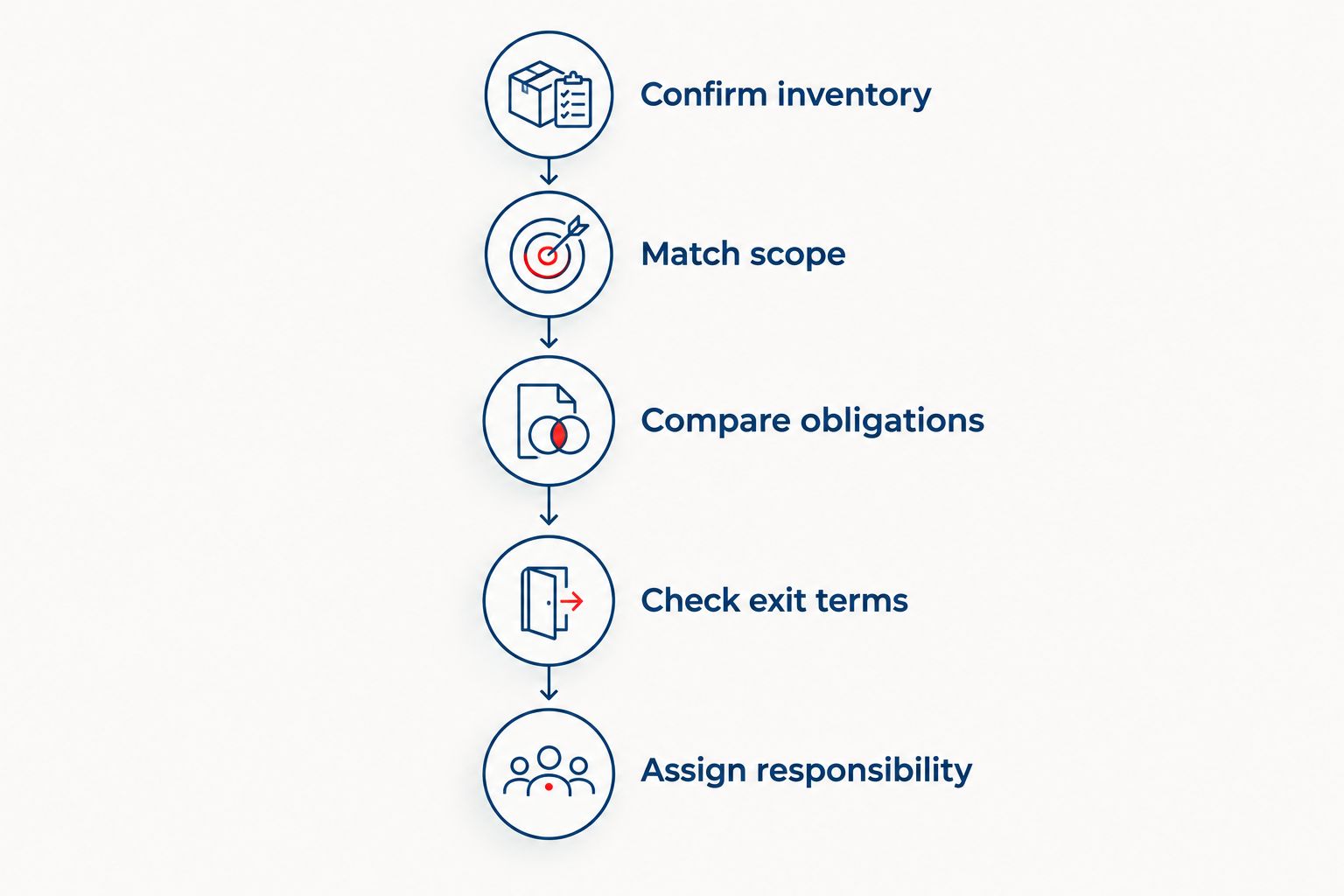
Use this sequence for a 2026 decision. Keep the inventory and both proposals together so every assumption is visible.
- Confirm inventory. List each extinguisher’s location, type, rating, condition, and available service history. Have a qualified provider assess suitability rather than choosing equipment by payment alone.
- Match scope. Ask both providers to quote the same equipment requirements and identify every service task. Mark each task as included, excluded, or your responsibility.
- Compare obligations. Use the same end date. Account for required payments, separately arranged services, and any obligations remaining after that date.
- Check exit terms. Read cancellation, renewal, return, removal, and ownership-transfer provisions. Establish how required protection continues during a change of provider.
- Assign responsibility. Name the person who checks equipment, schedules service, reports discharge or damage, and keeps records. Confirm the provider’s responsibilities in writing.
The last step matters as much as the arithmetic. A contract does not inspect an extinguisher; an assigned person and a scheduled service process do.
Ask each provider to return a corrected proposal if responsibilities remain unclear. Verbal assurances do not resolve a written exclusion. Keep the final scope with the equipment inventory and service records.
Does leasing remove inspection and maintenance duties?
Leasing does not by itself remove an employer’s fire-extinguisher duties. A service agreement can assign work to a provider, but you still need to know that the required work is completed.
For workplaces covered by OSHA’s portable fire-extinguisher rule, the 2026 requirements in 29 CFR 1910.157(e) distinguish several tasks:
- Visual inspection: OSHA requires monthly visual inspection. Use a 1-month check cycle to keep this task separate from annual maintenance.
- Annual maintenance: OSHA requires an annual maintenance check, a 12-month requirement that is not replaced by a visual check.
- Specified internal maintenance: Stored-pressure dry-chemical extinguishers requiring a 12-year hydrostatic test must be emptied and receive applicable maintenance every 6 years, subject to the rule’s exceptions.
These intervals are not a universal service schedule for every extinguisher. Equipment type and applicable requirements determine the work. Marine, mining, and other operations also need their own applicable requirements checked.
For either financing choice, ask who performs each task, who receives the record, and who follows up on defects. Use an extinguisher service records workflow to keep completed work separate from work still due.
Can I buy extinguishers and pay a company to service them?
Yes. Buying equipment and hiring a service provider are separate decisions. You do not need to choose a lease simply because your staff cannot perform technical maintenance.
Firstlinefire is best for businesses seeking fire extinguisher sales and hydro testing from one provider. Those services fit an ownership comparison; leasing terms require a separate written proposal rather than an assumption about what the company offers.
When requesting service, provide your inventory and available records. Ask the provider to distinguish routine maintenance from recharge, hydro testing, and replacement, and to explain which tasks apply to each extinguisher.
Discuss your extinguisher service needs
Review extinguisher sales, hydro testing, and service needs for your business.
What happens if I close, move, or change the site?
A move or closure does not automatically end a lease. The agreement controls termination, return, and remaining obligations, so read those provisions before committing.
Owned extinguishers also need review before relocation. Equipment suited to the old location is not automatically the right equipment for a new hazard or layout. Have the new location assessed before moving units into service.
For a 2026 relocation plan, record the protection needed at both sites during the transition. Decide who handles removal, transport, installation, and service records. Do not let the ownership decision leave either operating site without required protection.
FAQ
Is it cheaper to lease or buy fire extinguishers for my business?
The cheaper choice is the one with the lower total obligation for matching equipment and service over the same operating period. Include maintenance, recharge, testing, replacement, and contract exit obligations before choosing.
Does a fire extinguisher lease include annual maintenance?
A fire extinguisher lease includes annual maintenance only when the agreement says it does. Ask for a task-by-task list of inclusions, exclusions, and your responsibilities.
Can I own extinguishers and hire someone else to inspect them?
Yes, you can own extinguishers and arrange inspection and maintenance separately. Confirm the provider’s qualifications and the service scope before authorizing work.
Do leased fire extinguishers still need monthly checks?
Yes, leasing does not remove monthly visual inspection requirements where OSHA’s portable fire-extinguisher rule applies. Identify who completes the checks and reports defects.
Do I own leased extinguishers when the agreement ends?
You own leased extinguishers at the end only if the agreement provides for ownership transfer. Otherwise, follow its return, renewal, or other end-of-term provisions.
Who replaces a leased extinguisher after it is used?
The lease determines responsibility for recharge or replacement after use. Check whether discharge, damage, missing equipment, and temporary replacement protection receive different treatment.
What should I send a provider for a lease-versus-buy comparison?
Send the equipment inventory, available service records, site-use details, and expected operating period. Request matching equipment and service scopes so the proposals can be compared fairly.
One last thing
The most useful sentence in either proposal names who does the work. If a service task has no assigned owner, a payment schedule will not fix that gap.
Before signing, mark every required task with a responsible person or provider and a due date. Ask Firstlinefire to review your fire extinguisher service needs, then judge each proposal against that written scope—not its opening payment line.


