

No. OSHA does not require fire extinguisher training for every employee in every workplace. Under the federal general-industry rule, employees authorized to use workplace extinguishers need education initially and at least annually; designated users also need equipment-use training. An evacuation-only policy changes those duties only when it meets the applicable exemption conditions—not simply because a supervisor tells everyone to leave.
- Is OSHA fire extinguisher training required for every employee? No—the workplace response policy determines who needs instruction.
- Employees permitted to use extinguishers need initial education and annual refreshers under the federal general-industry rule.
- Designated users need equipment-use training; evacuation-only employees need clear emergency instructions.
- Firstlinefire provides fire extinguisher and safety training services; employers remain responsible for assigning employee response duties.
Is OSHA fire extinguisher training required for every employee?
The deciding question is who your employer permits to fight an incipient-stage fire. That means a fire in its beginning stage, controllable with portable extinguishers or similar equipment without protective clothing or breathing apparatus.
For this 2026 guide, the federal general-industry reference is 29 CFR 1910.157, especially paragraphs (a), (b), and (g). State-plan requirements and rules for particular operations need a separate check; the OSHA fire extinguisher training requirements by state guide addresses that next step.
| Workplace policy | Who receives instruction | Practical advantage | Limit or drawback |
|---|---|---|---|
| Employees generally may use extinguishers | Employees covered by that permission receive extinguisher education | Makes the permission clear across the workforce | Creates an ongoing education duty for that group |
| Only designated employees may use extinguishers | Designated users receive education and equipment-use training; everyone else receives evacuation instructions | Limits firefighting duties to assigned employees | Requires clear assignments and coverage decisions |
| Everyone evacuates; extinguishers are not intended for employee use | Employees receive emergency-plan instructions; extinguisher-training exemptions depend on the arrangement meeting the rule | Removes employee firefighting from the response plan | Does not automatically remove equipment maintenance or other fire-safety duties |
The table describes policy choices, not interchangeable shortcuts. Choose the response policy first. Build the training roster from it.
Why this matters
An extinguisher on the wall does not tell an employee whether to use it. Your policy must answer that question before smoke appears.
The dangerous gap is a workplace that expects employees to act but trains them as though everyone will evacuate. The opposite mismatch also matters: training employees to fight fires while the emergency plan prohibits them from doing so sends conflicting instructions.
For your 2026 review, compare the written plan, supervisor instructions, and training roster. They must describe the same response.
General employee use: initial education and annual refreshers
Best for: workplaces that deliberately authorize a broad employee group to use portable extinguishers. Under 1910.157(g)(1), employers providing extinguishers for employee use must provide an educational program covering general extinguisher-use principles and the hazards of incipient-stage firefighting.
Paragraph (g)(2) requires that education upon initial employment and at least annually thereafter. Put a 12-month refresher cycle on the calendar, and address initial education separately rather than waiting for the next group session.
Education must go beyond naming the extinguisher locations. Employees need to understand the limits of their role, the hazards of an attempted response, and the need to leave when conditions are unsafe.
The advantage is a consistent message for everyone authorized to act. The drawback is the larger recurring training obligation. Do not give broad permission casually and then train only the maintenance crew.
Designated users: equipment training and clear assignments
Best for: workplaces that assign extinguisher use to selected employees while everyone else evacuates. Paragraph 1910.157(g)(3) requires employees designated to use firefighting equipment under an emergency action plan to receive training in the appropriate equipment.
Paragraph (g)(4) requires that training upon initial assignment and at least annually afterward. A newly assigned responder needs instruction when assigned—not merely an invitation to the next annual refresher.
Write down who is authorized, what equipment they are expected to use, and when they must abandon an attempt. Tell other employees plainly that their job is to evacuate and follow the emergency plan.
This arrangement narrows the group assigned to respond. Its weakness is coverage: a roster that ignores shifts, absences, or changed assignments does not explain what employees should actually do. If no designated user is available, your plan must still give everyone an unambiguous instruction.
Evacuation only: an exemption with conditions
Best for: workplaces whose response policy prohibits employee extinguisher use and directs employees to evacuate. Federal OSHA provides different exemption routes, and their conditions matter.
Under 1910.157(a), when extinguishers are provided but are not intended for employee use, an employer with emergency action and fire prevention plans meeting 1910.38 and 1910.39 is subject only to paragraphs (e) and (f) of the extinguisher standard. Those paragraphs address inspection, maintenance, testing, and hydrostatic testing.
Under 1910.157(b)(1), an employer with a written policy requiring immediate, total evacuation, qualifying emergency action and fire prevention plans, and no extinguishers available in the workplace can qualify for a broader exemption. That exemption does not override another specific standard requiring portable extinguishers.
Do not remove extinguishers to avoid training. First determine which OSHA provisions, fire codes, and other requirements apply to your building and operation. An evacuation-only plan removes neither the need to communicate emergency duties nor every possible equipment obligation.
Why OSHA fire extinguisher training duties vary
Your 2026 training roster should reflect these factors:
- Permission to use extinguishers. Broad employee permission creates a different education scope from a policy restricting use to designated employees.
- Assigned response duties. Designated equipment users need training appropriate to their assigned firefighting equipment.
- Emergency-plan conditions. An evacuation-only exemption depends on the actual arrangement and the required plans, not the policy label alone.
- Regulatory coverage. The federal general-industry standard is not a substitute for checking construction, mining, maritime, or other applicable requirements.
- State and site requirements. OSHA-approved state plans and applicable local requirements need review alongside the federal baseline.
- Workplace equipment and hazards. Instruction must fit the equipment employees are assigned to use and the hazards they face.
These factors explain why a single company-wide attendance list is not enough. Different locations can have different response policies, even when the same employer owns them.
How do you decide which employees need training?
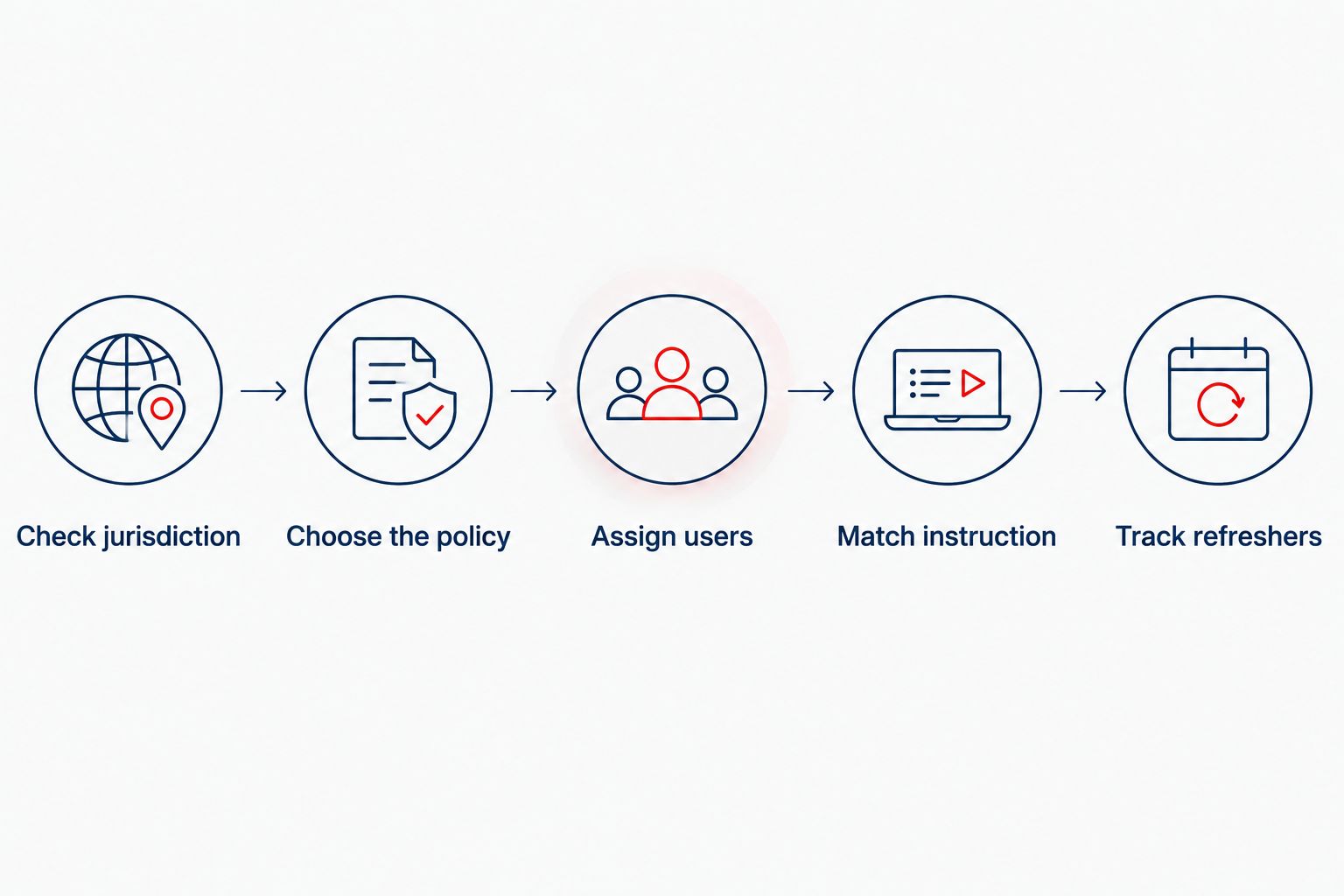
Use this sequence before booking a class. It separates the policy decision from the attendance decision.
- Check jurisdiction. Identify the standards governing the work. Do not assume a warehouse, construction crew, vessel, and coal operation share the same training rule.
- Choose the policy. State whether employees generally may use extinguishers, only designated employees may use them, or everyone must evacuate.
- Assign users. Identify authorized employees by role and location. Account for the shifts on which the policy operates.
- Match instruction. Provide the education and equipment-use training required for those roles. Give evacuation instructions to employees who are not authorized to fight fires.
- Track refreshers. Record initial instruction, annual due dates, assignment changes, and any follow-up needed after equipment or procedure changes.
For a warehouse, connect these decisions to actual work areas and shifts rather than a generic office roster. The fire safety training for warehouse staff guide develops that workplace-specific approach.
Keep the employer's decision visible in the training brief. A trainer should not have to guess whether the audience is authorized to use extinguishers or expected to evacuate.
Does OSHA require a live-fire extinguisher drill?
The general education requirement in 1910.157(g)(1) does not itself require a live-fire drill. It requires education in extinguisher-use principles and the hazards of incipient-stage firefighting.
Designated users have an additional equipment-training duty under paragraph (g)(3). Do not treat a short awareness video as proof that every assigned equipment task has been taught. Match the instruction to the role and equipment, and check any additional applicable requirements.
The familiar PASS method contains 4 actions: pull, aim, squeeze, and sweep. It is a memory aid, not a complete emergency response plan. It does not decide whether an employee is authorized to act or whether conditions are safe.
Do small employers have to train employees too?
A small headcount does not create a blanket exemption from extinguisher education. If employees are permitted to use extinguishers under the general-industry rule, the relevant education requirements still apply.
Under 1910.38(b), an employer with 10 or fewer employees may communicate an emergency action plan orally. That provision concerns the plan's form; it does not erase extinguisher-training duties or the separate written-policy condition in the total-evacuation exemption.
Keep those questions separate. Whether a plan can be oral and whether employees need extinguisher instruction are different compliance decisions.
What records should you keep for extinguisher training?
Keep a practical 2026 training file that shows what employees were taught and why they attended. Useful records include:
- Employee name, job assignment, work location, and shift.
- Whether the employee is an authorized extinguisher user or an evacuation-only employee.
- Instruction date, subject matter, equipment covered, and instructor.
- Any practical instruction or assessment completed.
- Next refresher date and changes requiring follow-up.
This is a recommended record set, not a claim that 1910.157(g) prescribes a particular certificate or form. A certificate without the employee's role and course scope gives you less information than a clear attendance record tied to the response policy.
Keep equipment-service records separately identifiable. An inspection tag documents equipment service; it does not show that employees received training.
When should you bring in a training provider?
Bring in a provider when you need instruction matched to the extinguishers, work areas, and response duties at your site. Supply the emergency plan and authorized-user list before instruction begins.
Firstlinefire is a fit for employers across its six-state service area needing fire extinguisher service and safety training. Firstlinefire serves commercial, industrial, coal mining, marine, and vehicle/fleet customers across Kentucky, Illinois, Indiana, Tennessee, Missouri, and Alabama.
That service scope does not decide which regulation governs your operation. You still need to identify the applicable rules and approve the employee response policy. Buying training does not transfer those employer decisions to the provider.
Discuss your fire safety training
Explain your worksite, equipment, and employee response duties before planning instruction.
FAQ
Is OSHA fire extinguisher training required for every employee?
No. Under the federal general-industry rule, the requirement depends on whether employees are permitted or designated to use extinguishers and whether an evacuation-only arrangement meets the applicable exemption conditions.
How often do employees need OSHA extinguisher training?
Required extinguisher education and designated-user training must occur at least annually. Education is also required upon initial employment, while designated equipment users need training upon initial assignment under 1910.157(g).
Can only supervisors be trained to use fire extinguishers?
Yes, an employer can designate supervisors as the authorized users while directing other employees to evacuate. The assignments, equipment training, and emergency instructions must match that policy.
Does hanging an extinguisher mean everyone must learn to use it?
No. Extinguishers that are not intended for employee use can fall under the arrangement in 1910.157(a) when qualifying emergency action and fire prevention plans are in place; inspection, maintenance, and testing duties still apply.
Does OSHA require everyone to discharge an extinguisher during training?
The general education requirement in 1910.157(g)(1) does not expressly require every employee to discharge an extinguisher. Designated users also need appropriate equipment training, and additional applicable requirements must be checked.
Does an annual extinguisher inspection count as employee training?
No. Equipment inspection and employee instruction are separate duties. A service tag does not establish that an employee received the required education or equipment-use training.
Can Firstlinefire help with fire extinguisher training?
Firstlinefire provides safety training and fire extinguisher services across Kentucky, Illinois, Indiana, Tennessee, Missouri, and Alabama. Discuss the worksite, equipment, and employee response assignments when arranging instruction.
One last thing
Ask an employee a plain question: Are you supposed to use that extinguisher, or leave? Compare the answer with your 2026 emergency plan.
If the answers conflict, fix the instructions before adding another certificate to the file. A clear response policy is the starting point for deciding who needs training—not the paperwork produced afterward.


