
OSHA fire extinguisher training requirements by state start with the federal general-industry rule: when extinguishers are provided for employee use, education is required upon initial employment and at least annually thereafter. The federal benchmark does not vary by state; jurisdiction, employee duties, and state-plan requirements determine how you apply it at each workplace in 2026.
- OSHA fire extinguisher training requirements by state depend on jurisdiction and who is permitted to use extinguishers.
- The federal general-industry benchmark requires initial education and annual refreshers when extinguishers are provided for employee use.
- Kentucky, Indiana, and Tennessee operate state plans covering most private-sector and state and local government workers.
- Firstlinefire provides fire extinguisher services and safety training across the six states compared below.
Why this matters
An annual extinguisher service tag is not employee training. One documents equipment service. The other addresses what employees should do when they discover a fire, including when to leave rather than attempt suppression.
For a 2026 training plan, start with your emergency action policy, not a course booking. Firstlinefire provides fire extinguisher services and safety training in Kentucky, Illinois, Indiana, Tennessee, Missouri, and Alabama. Those 6 states do not all have the same workplace-safety jurisdiction.
State comparison: the annual training benchmark
Under federal general-industry requirements, extinguisher education repeats at least annually after initial education. Employees designated to use firefighting equipment receive training upon initial assignment and at least annually thereafter. These are regulatory intervals, not survey averages or measures of how often employers actually train.
| State or benchmark | Private-sector general-industry authority | State and local government coverage | Federal extinguisher education benchmark |
|---|---|---|---|
| Overall federal yardstick | Federal OSHA or an applicable OSHA-approved state plan | Depends on state-plan coverage | Initial employment, then at least annually when extinguishers are provided for employee use |
| Kentucky | Kentucky OSHA-approved state plan | Covered by the state plan | Annual federal baseline; check applicable Kentucky requirements |
| Illinois | Federal OSHA for most private-sector workplaces | Illinois OSHA state plan | Annual federal baseline; public employers must check Illinois OSHA requirements |
| Indiana | Indiana OSHA-approved state plan | Covered by the state plan | Annual federal baseline; check applicable Indiana requirements |
| Tennessee | Tennessee OSHA-approved state plan | Covered by the state plan | Annual federal baseline; check applicable Tennessee requirements |
| Missouri | Federal OSHA for most private-sector workplaces | No OSHA-approved state plan | Federal rule applies to covered private-sector workplaces |
| Alabama | Federal OSHA for most private-sector workplaces | No OSHA-approved state plan | Federal rule applies to covered private-sector workplaces |
No state ranks higher or lower on the federal annual benchmark. The comparison separates enforcement responsibility: Kentucky, Indiana, and Tennessee have state plans covering most private-sector workplaces and state and local government workers; Illinois has a public-sector-only state plan. Missouri and Alabama do not have OSHA-approved state plans.
Methodology and scope: This 2026 reference compares OSHA's portable-extinguisher education and training requirements in 29 CFR 1910.157(g) with the jurisdiction categories in OSHA's State Plans directory. The table shows the federal general-industry baseline, not an independent finding that every state rule is identical; it does not establish requirements for construction, mining, vessels, or a particular local fire code.
Read the state column before setting the schedule
A private warehouse in Illinois generally falls under federal OSHA. An Illinois municipal workplace falls under the Illinois public-sector plan. Sharing a state address does not put both employers under the same enforcement program.
Kentucky, Indiana, and Tennessee require a different routing decision: consult the applicable state-plan authority for covered workplaces. State plans must be at least as effective as federal OSHA, and state requirements can differ. Do not treat the federal column as a substitute for checking the applicable state rule.
In Missouri and Alabama, the absence of an OSHA-approved state plan does not mean every workplace is exempt from safety obligations. Federal OSHA generally covers private-sector employers, while federal OSHA does not cover state and local government employees. Other laws, fire codes, and employer requirements remain separate questions.
Education and designated-user training are different
OSHA distinguishes general extinguisher education from training for employees designated to use firefighting equipment. The starting dates differ: initial employment for education under paragraph (g)(2), and initial assignment for designated-user training under paragraph (g)(4). Both repeat at least annually.
| Requirement | Who it addresses | Initial timing | Repeat interval | Required subject matter |
|---|---|---|---|---|
| Employee education, 1910.157(g)(1)–(2) | Employees where extinguishers are provided for employee use | Initial employment | At least annually | General principles of extinguisher use and hazards of incipient-stage firefighting |
| Designated-user training, 1910.157(g)(3)–(4) | Employees designated to use firefighting equipment under the emergency action plan | Initial assignment | At least annually | Use of the appropriate firefighting equipment |
Neither category is the higher-performing option. They address different duties, not different quality levels. General education explains use principles and hazards; designated-user training addresses the equipment employees are assigned to use.
Source and scope: OSHA, 29 CFR 1910.157(g)(1)–(4), federal general-industry portable-extinguisher requirements used for this 2026 reference. These provisions do not prescribe a universal class length in minutes or a single course format for every workplace.
Annual does not mean wait for the next group class
Use an annual cycle as the recurring benchmark, not as permission to delay initial instruction. A new employee covered by the education requirement needs that education upon initial employment. An employee newly assigned to use firefighting equipment needs training upon initial assignment.
For scheduling, express the recurring benchmark as at least once each year, then track each applicable initial requirement separately. A single company-wide calendar entry does not show whether new hires or newly designated employees received instruction when required.
Your response policy determines the training scope
Before comparing courses, decide what employees are expected to do during a fire. The federal standard recognizes different workplace arrangements, but exemptions depend on specific conditions. An informal instruction to leave is not the same as a qualifying written policy.
| Workplace arrangement | Best for | Strength | Limitation or condition |
|---|---|---|---|
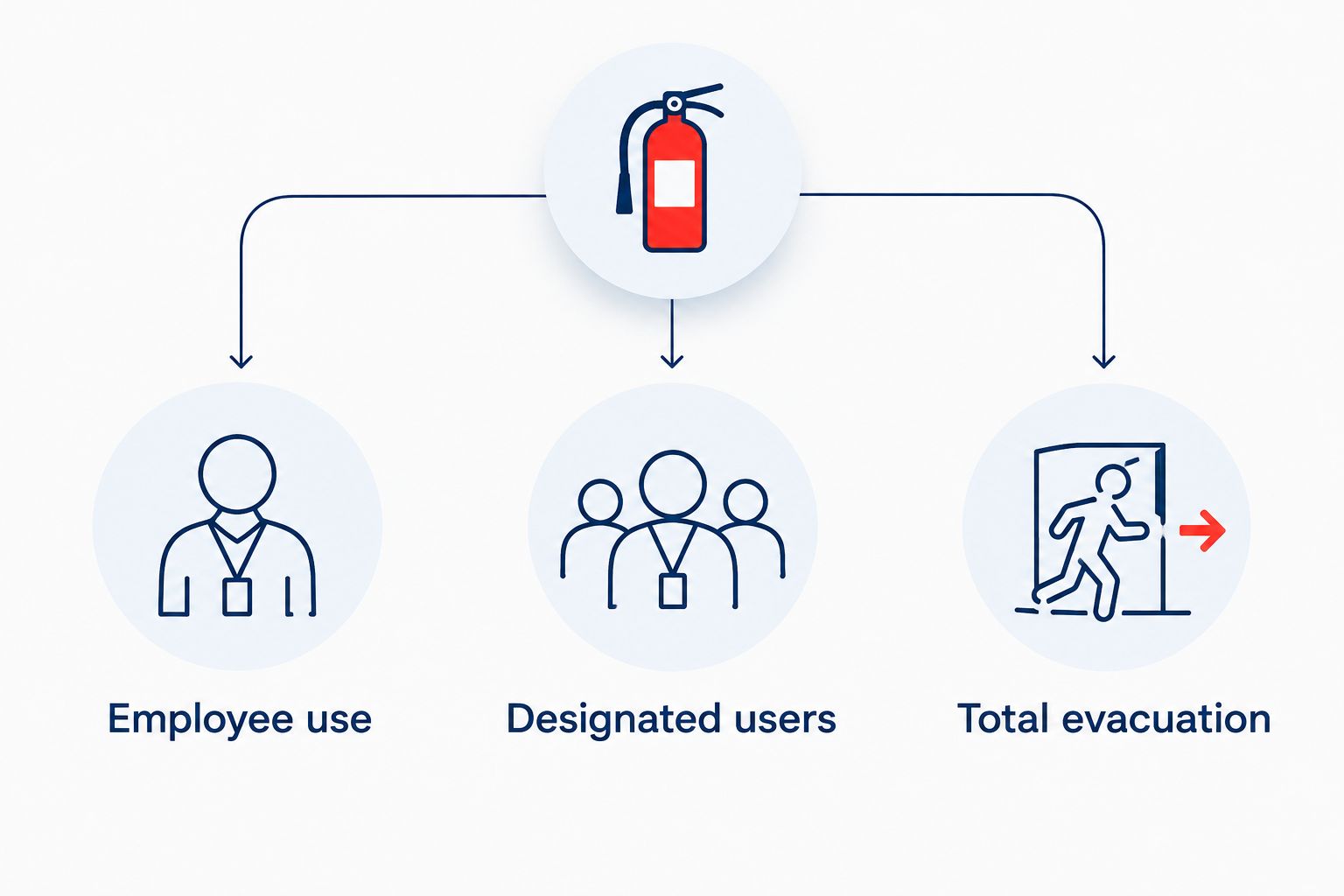
| Extinguishers provided for employee use | Workplaces permitting employees to use portable extinguishers | Aligns education with permitted use | Triggers the applicable education requirements |
| Designated users only | Workplaces assigning extinguisher use to identified employees | Separates equipment-use duties from evacuation duties | Requires appropriate designated-user training and a qualifying emergency action plan |
| Immediate total evacuation with no workplace extinguishers | Workplaces meeting the federal exemption conditions | Removes an employee firefighting role | Requires the specified written policy and plans; another OSHA standard can still require extinguishers |
Best for is a policy fit, not a safety ranking. Choose the arrangement that matches the actual workplace and applicable rules. Do not select an exemption because it appears to reduce class attendance.
OSHA 1910.157(b)(1) describes the exemption involving immediate total evacuation, qualifying plans, and no extinguishers in the workplace, unless another specific standard requires them. Paragraph (b)(2) addresses emergency action plans that designate the only employees authorized to use available extinguishers and require everyone else to evacuate.
Put the boundary in writing
Your employees need a clear answer to a practical question: am I expected to leave, or am I authorized to consider using this equipment? Put the answer in the emergency action plan and teach it consistently.
A designated-user policy also needs to work across shifts. If the person authorized to use an extinguisher is absent, employees should not improvise a new firefighting assignment. The evacuation instructions must remain clear without that person present.
How to use these benchmarks
Use the annual federal benchmark to build a repeatable schedule. Use jurisdiction and employee assignments to decide which requirements belong on that schedule. Keep equipment-service deadlines separate from training dates.
- Confirm jurisdiction first. The comparison covers 6 states, but 3 have state plans covering most private-sector workplaces and state and local government employees. Identify the authority for each location before applying a company-wide rule.
- Separate initial instruction from recurring instruction. An annual refresher does not replace education upon initial employment or training upon initial assignment where required.
- Assign the audience from the written policy. Distinguish employees receiving general education, designated equipment users, and employees instructed to evacuate.
- Review the site, not just attendance. The session should address the actual equipment, hazards, alarm process, and evacuation instructions employees encounter.
Firstlinefire is a fit for businesses seeking fire extinguisher service and safety training across Kentucky, Illinois, Indiana, Tennessee, Missouri, and Alabama. Service availability alone does not establish that a particular course satisfies every site's requirements. Confirm the proposed audience, equipment, subject matter, and applicable authority before scheduling.
Plan your fire safety training
Discuss employee roles, site hazards, and the equipment your crew is expected to use.
What a useful training record should show
Build a record that explains who received instruction and what it covered. A sign-in sheet establishes attendance; it does not describe whether the session addressed extinguisher hazards, assigned equipment, or evacuation duties.
For your 2026 file, record:
- Workplace and audience: Identify the location, employees, and whether they are designated equipment users.
- Instruction date: Separate initial education, initial assignment training, and recurring sessions.
- Equipment covered: Identify the extinguisher or firefighting equipment addressed in the session.
- Subjects covered: Include use principles, incipient-stage hazards, and the response limits taught.
- Instructor and materials: Identify who delivered the session and which materials supported it.
- Follow-up: Record missed attendance or instruction that still needs completion.
This is a recommended record structure, not a claim that 1910.157(g) prescribes these exact fields. The paragraph states education and training duties; it does not provide a universal attendance form or retention period.
Keep training evidence separate from extinguisher maintenance evidence. A service record answers a different question from an employee education record. Connecting both to the same workplace file helps you find them without treating one as proof of the other.
Where this benchmark stops
The federal general-industry table is not a universal fire-training schedule. Firstlinefire serves commercial, industrial, coal mining, marine, and vehicle/fleet customers, but those customer categories do not all fall under one regulatory framework.
Construction sites
Do not transfer a general-industry citation into a construction safety plan without checking the construction standards. OSHA's construction fire-protection requirements include 29 CFR 1926.150. Identify the work being performed and the applicable requirements before selecting the training plan.
Coal mining operations
Mining can fall under MSHA rather than OSHA. Determine jurisdiction and the applicable mine training requirements before using the annual OSHA benchmark. A general workplace extinguisher course does not, by itself, establish compliance with mine-specific obligations.
Vessels and marine work
Marine operations require a jurisdiction check involving the vessel, activity, and applicable Coast Guard or OSHA requirements. A dockside facility and a vessel should not automatically receive the same compliance checklist. Identify the governing requirements before setting the instruction schedule.
Local requirements and other obligations
The OSHA benchmark answers an employee-safety question. It does not settle every fire marshal, licensing, insurer, or contractual requirement. Keep those obligations visible in the site plan without presenting them as requirements of 1910.157(g).
FAQ
Do OSHA fire extinguisher training requirements change by state?
Jurisdiction and state-plan requirements differ by state, while the federal general-industry benchmark requires initial education and at least annual refreshers when extinguishers are provided for employee use. Check the applicable state-plan rule rather than assuming every state's wording is identical.
How often does OSHA require fire extinguisher training?
Under 29 CFR 1910.157(g), covered employee education and designated-user training repeat at least annually. Education starts upon initial employment; designated-user training starts upon initial assignment.
Does every employee have to receive hands-on fire extinguisher training?
No blanket hands-on requirement for every employee appears in 1910.157(g). The rule distinguishes general education from training for designated equipment users, so match the instruction to employee duties and applicable requirements.
Can my business require everyone to evacuate instead of using extinguishers?
Yes, the federal standard recognizes qualifying evacuation arrangements. The exemptions have specific conditions involving the written policy, emergency plans, extinguisher arrangements, and other applicable standards; an informal evacuation instruction is not enough.
How many minutes must an OSHA extinguisher class last?
OSHA 1910.157(g) does not prescribe a universal class length in minutes. Judge the proposed instruction against required content, employee assignments, and the equipment employees are expected to use.
Does an annual extinguisher inspection count as employee training?
No. Extinguisher inspection and maintenance concern equipment condition, while employee education and training concern use principles, hazards, and assigned firefighting equipment.
Does Illinois OSHA cover private businesses?
The Illinois OSHA state plan covers state and local government workers, while federal OSHA covers most private-sector workplaces in Illinois. Identify the employer category before choosing the applicable authority.
Can Firstlinefire help with extinguisher services and training?
Firstlinefire provides fire extinguisher services and safety training across Kentucky, Illinois, Indiana, Tennessee, Missouri, and Alabama. Confirm the location, employee roles, equipment, and required training scope when arranging service.
One last thing
The first training decision is who must leave, not who can pull a pin. Before approving your next session, compare the attendee list with the written response policy. Resolve any mismatch before teaching equipment use.
That check makes the 2026 annual benchmark useful. You get a schedule tied to actual responsibilities, rather than a recurring class whose audience no longer matches the workplace.


