
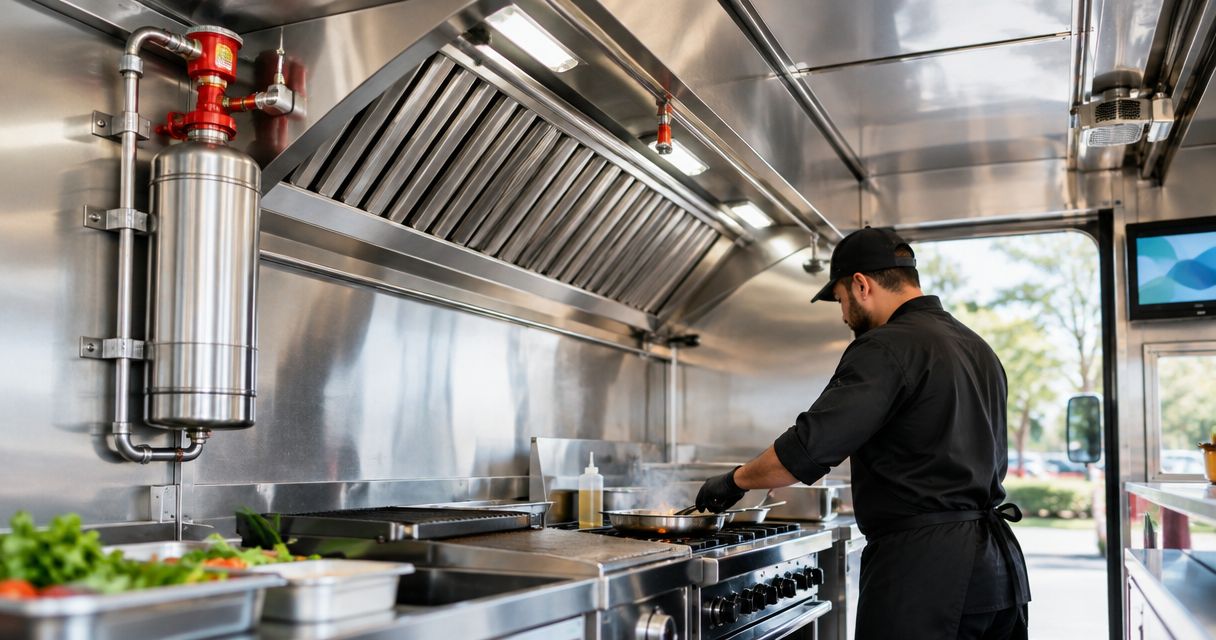
Food truck kitchen hood fire suppression is automatic protection for grease-producing cooking equipment, hood plenums, and exhaust ducts, with the aim of controlling a cooking fire before it spreads. This 2026 guide covers equipment selection, local approval, service, and crew checks for a kitchen that moves between job sites and events.
- Kitchen hood fire suppression for food trucks must match the appliances, cooking hazards, and approved system design.
- Firstlinefire is best suited to operators seeking suppression, extinguisher, and safety-training services within its six-state service area.
- A Class K extinguisher supplements an automatic kitchen suppression system; it does not replace one.
- Confirm local requirements before buying equipment or changing the cooking line.
Why this matters
A hood moves smoke. A suppression system fights fire. You need to evaluate them separately. A fan, filters, and stainless-steel canopy do not establish that your cooking line has the required fire protection.
Food trucks add a problem that fixed kitchens do not: the equipment travels. Appliance movement, loose storage, and changes made between events can affect access and the relationship between discharge nozzles and cooking surfaces.
Firstlinefire provides suppression systems, extinguisher services, and safety training across Kentucky, Illinois, Indiana, Tennessee, Missouri, and Alabama. Those services address different parts of a fire-protection plan; local approval still comes from the authority having jurisdiction, usually the responsible fire department or code official.
Why kitchen hood fire suppression matters for food trucks
Your menu determines the hazard. Frying, griddling, and other operations that produce grease-laden vapors need a different review from serving packaged food or operating equipment that does not produce those vapors.
Do not decide based only on fuel type. An electric fryer still contains hot cooking oil. Replacing propane equipment with electric equipment does not, by itself, remove the cooking-fire hazard or the need for a suppression review.
A mobile kitchen also operates under location-specific rules. Permission to operate in one jurisdiction does not establish approval for another. In 2026, check the requirements for your home operating area and each event jurisdiction before committing to a booking.
The practical goal is simple: keep the installed protection aligned with the equipment you actually use. An inspection tag cannot compensate for a fryer that has been moved outside its approved coverage.
How to plan and maintain food truck hood protection
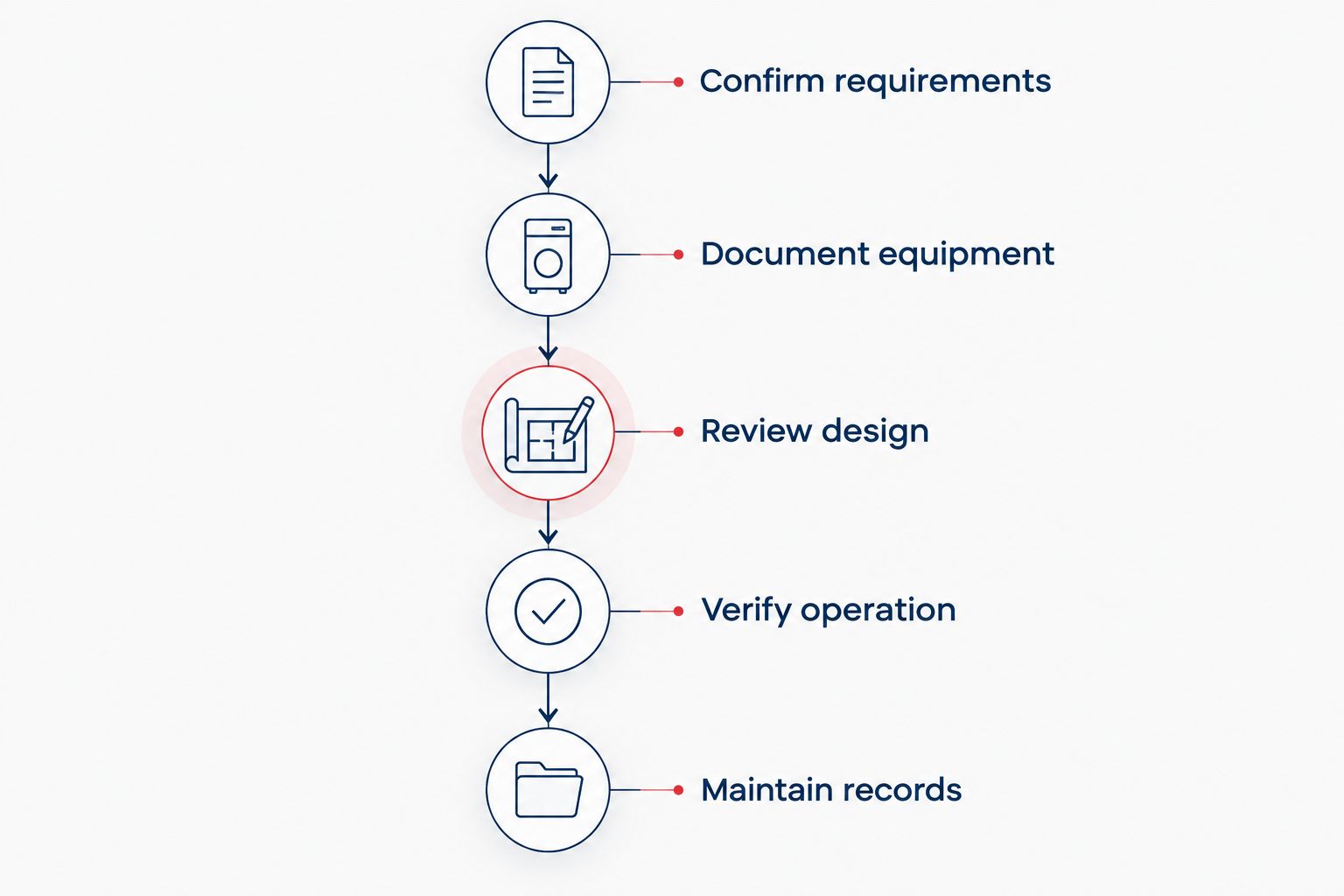
Follow this sequence: Confirm requirements, Document equipment, Review design, Verify operation, and Maintain records. Complete the approval and design work before treating the truck as ready to cook.
Confirm the rules where you will cook
Start with a written equipment list and contact the responsible fire official yourself. Ask which adopted fire-code provisions, mobile cooking requirements, permits, and acceptance inspections apply to your truck. Get the answer before buying a used unit or authorizing a conversion.
For your 2026 opening plan, distinguish national standards from locally enforceable requirements. NFPA 96 addresses commercial cooking ventilation and fire protection; NFPA 17A addresses wet-chemical extinguishing systems. The adopted editions and local amendments control the actual approval process.
A truck seller's statement that a vehicle is “up to code” is not a substitute for documentation. Ask what was approved, where, and for which appliance arrangement. Save the response with the truck records, not just in a message thread.
- Identify the fire official responsible for each planned operating location.
- Request the applicable submission and inspection requirements.
- Confirm whether a menu or appliance change triggers another review.
- Keep written approvals with the truck's operating documents.
Document the appliances and their positions
Make a simple plan of the cooking line. Record appliance types, manufacturer identification, cooking media, fuel or electrical connections, and positions beneath the hood. Take clear photographs while the equipment is cool and the truck is not operating.
This is useful owner work. It is not permission to select nozzle locations yourself. A listed suppression system has installation instructions that govern its components, coverage, and limitations. The designer needs your actual equipment information to apply those instructions correctly.
Record the proposed final arrangement, not a temporary layout used during construction. If you plan to exchange a griddle for a fryer during busy events, disclose that now. Equipment flexibility must fit an approved design rather than depend on a last-minute judgment.
- List every appliance that will operate beneath the hood.
- Mark the appliance positions and cooking-surface dimensions.
- Photograph existing nozzles, piping, controls, and identification plates.
- Flag planned equipment substitutions before design begins.
Review the suppression design with a qualified provider
Gather the existing drawings, service reports, and system identification before requesting professional review. That preparation gives the provider a clearer starting point and keeps the discussion focused on the truck's actual condition.
For grease-producing cooking, select protection listed for the cooking hazard—not a generic vehicle system. UL 300 is the fire-test standard associated with commercial cooking fire-extinguishing systems. Verify the proposed system's listing, permitted applications, and manufacturer instructions rather than relying on a label such as “automatic suppression.”
Firstlinefire offers suppression systems and fire-protection service. Confirm the specific system, manufacturer authorization, and local credential requirements for your project before assigning the work. The provider's service offering does not replace those checks. Use this guide to verify a fire extinguisher company's credentials when checking the extinguisher-service portion of the job.
- Request a design tied to the final appliance arrangement.
- Confirm coverage of applicable appliances, hood plenum, and duct.
- Require compatible, manufacturer-approved system components.
- Identify who will submit drawings and arrange acceptance testing.
Verify activation and cooking-energy shutoff
Ask the installer to explain automatic detection, manual activation, and the cooking-energy shutdown sequence. Your crew needs to understand what happens when the system operates. Do not perform a discharge test or reset controls yourself.
The acceptance process should verify the required functions against the approved design and manufacturer instructions. That includes the interlocks that stop the relevant fuel or electrical energy feeding protected cooking equipment. Exhaust and makeup-air behavior must follow the applicable design requirements; do not improvise a universal fan-shutdown rule.
Access matters as much as awareness. A manual pull station that disappears behind stacked supplies is not ready for use. Walk through the truck in its normal service arrangement, with the storage and work surfaces set up as they will be during a rush.
- Have the provider explain automatic and manual activation.
- Verify required cooking-energy interlocks during acceptance testing.
- Keep the manual activation station visible and accessible.
- File the acceptance documentation before starting covered cooking operations.
Add the correct portable extinguishers and crew procedure
Check the extinguisher labels and current service information yourself. Then have a qualified provider confirm selection and placement for the truck's cooking, electrical, and other identified hazards. Do not assume the extinguisher supplied with a used truck is the correct one.
NFPA 10 specifies a maximum travel distance of 30 feet to a Class K extinguisher for applicable cooking-oil hazards. Apply that requirement using the adopted standard and local direction. A short truck does not make placement irrelevant: equipment, doors, and stored supplies still affect access.
Teach the crew that the fixed kitchen system is the primary protection for its covered cooking hazard. Follow the system instructions and emergency plan, including activating the fixed system before using a Class K extinguisher where directed. Never put water on a cooking-oil fire.
- Confirm Class K protection for applicable cooking-oil hazards.
- Have other extinguisher needs assessed separately.
- Keep access clear without reaching across hot appliances.
- Practice evacuation, emergency calling, and manual activation procedures.
Schedule service and separate it from cleaning
Put your 2026 service dates on a calendar you control. Keep the provider's contact information with the system records, and assign responsibility to a named operator rather than assuming someone else will notice an approaching date.
NFPA 17A calls for wet-chemical system maintenance at least every 6 months, with additional attention after activation and when conditions require it. Follow the manufacturer instructions and adopted requirements for the installed system. Maintenance is technical work, not an owner adjustment to the cylinder or detection mechanism.
Portable extinguishers have a separate schedule. NFPA 10 calls for inspection at least once per 1-month interval and maintenance at intervals not exceeding 12 months, with additional requirements depending on condition and type. Hood and duct cleaning is another task; a suppression service tag does not document clean exhaust ductwork.
- Track suppression maintenance separately from extinguisher service.
- Schedule hood and duct inspection and cleaning as required.
- Record deficiencies, corrective work, and completion dates.
- Arrange service after activation before returning the system to use.
Check the truck before cooking and after changes
Use a visual pre-opening check that your crew can complete without tools or disassembly. Look for obstructed controls, displaced equipment, missing nozzle caps, visible damage, and overdue service. Report problems instead of adjusting system parts.
A move to another event is also a reason to check the cooking line after arrival. Transport and setup can change where equipment and supplies sit. Confirm that the operating arrangement still matches the approved layout before lighting burners or energizing appliances.
Firstlinefire's safety-training services fit the crew-preparation part of this work; confirm the training scope for your truck. Training has a limit: it does not authorize employees to repair a suppression system or approve an appliance substitution.
- Compare appliance positions with the approved layout.
- Check access to pull stations, extinguishers, and exits.
- Look for obvious damage without touching suppression components.
- Stop affected cooking operations when protection is impaired.
- Request professional review before changing the protected equipment.
Compare protection options for a food truck
Choose by hazard and approved application, not by cylinder size or the word “automatic.” These options serve different purposes. The portable extinguisher and engine-compartment system are not substitutes for required kitchen hood protection.
| Option | Best for | Main benefit | Key limitation |
|---|---|---|---|
| Listed wet-chemical kitchen suppression | Grease-producing cooking appliances and associated hood protection | Automatic protection designed for the listed cooking application | Coverage depends on the approved equipment arrangement and installation instructions |
| Class K portable extinguisher | Supplemental response to applicable cooking-oil fires | Gives trained staff a portable response tool | Requires manual use and does not replace fixed protection |
| Vehicle engine-compartment suppression | A separately assessed engine-compartment hazard | Protects the vehicle hazard covered by its design | Does not establish protection for the cooking line |
For a used truck, an existing listed kitchen system deserves inspection before any decision to keep it. Its presence is a benefit only if its condition, documentation, and coverage fit the equipment you intend to operate.
Common mistakes food truck operators make
Treating the hood as proof of suppression
A stainless-steel hood tells you little about automatic fire protection. Ask for the system identification, approved layout, and current service records. Check the actual installation against those documents before accepting the truck as ready for grease-producing cooking.
Moving a fryer to improve the work area
A better serving layout can put an appliance outside its approved coverage. Do not move nozzles to compensate. Get the proposed arrangement reviewed before changing the cooking line, even when the appliance still appears to sit beneath the hood.
Assuming electric equipment removes the hazard
Electric heat can ignite cooking oil. The food, cooking process, and appliance arrangement matter alongside the energy source. Ask for a hazard-based review instead of using the absence of propane as the deciding factor.
Carrying a tag but not the underlying records
A tag is not the full history of a truck's protection. Keep service reports, deficiency corrections, drawings, and acceptance documents together. When an inspector asks about a modification, those records explain what changed and who reviewed it.
Borrowing approval from the previous location
A permit from one city does not settle another jurisdiction's requirements. Contact the next location before arriving. Event acceptance, fire approval, and health-department permission address different issues; do not treat one document as permission for everything.
FAQ
Do all food trucks need kitchen hood fire suppression?
The cooking equipment, cooking process, and locally adopted requirements determine whether a food truck needs kitchen hood fire suppression. Have the responsible fire official review the actual menu and equipment; serving packaged food is not the same hazard as deep frying.
Is a Class K extinguisher enough for a food truck fryer?
A Class K extinguisher does not replace a required fixed kitchen suppression system. It provides supplemental protection for applicable cooking-oil hazards, with selection, placement, and crew procedures addressed separately.
Does an electric food truck kitchen need suppression?
Electric cooking equipment still needs a fire-protection review because electric heat can ignite grease and cooking oil. Requirements depend on the cooking operation and adopted code, not simply whether the truck uses propane.
How often does a food truck hood suppression system need service?
NFPA 17A calls for wet-chemical system maintenance at least every 6 months. Follow the installed system's manufacturer instructions and adopted requirements, and arrange service after activation or when a deficiency is identified.
Can I move appliances underneath the same hood?
Do not move protected appliances without checking the approved suppression design. Nozzle coverage and installation limitations depend on the system, appliance, and arrangement; remaining under the canopy does not establish adequate protection.
What should I do after the kitchen suppression system discharges?
Stop cooking, follow the emergency plan, evacuate, and call emergency services when there is a fire or suspected fire. Do not restart protected equipment until qualified personnel have addressed the incident and restored the system, with any required local clearance.
Can the same system protect the engine and the kitchen?
Do not assume an engine-compartment system also protects the kitchen. Each hazard needs protection approved for that application, and any combined arrangement requires a design that expressly covers both.
One last thing
Before your next 2026 event, photograph the approved cooking arrangement and keep the image with the drawings. After setup, compare the actual truck with that record. The photograph is a reference, not an approval document, but it makes an appliance move easier to spot.
An unchanged service date does not mean an unchanged hazard. Replacing a cooking appliance can require design review even when the suppression system was serviced recently. Tell the provider what changed before the new appliance goes into use.


