
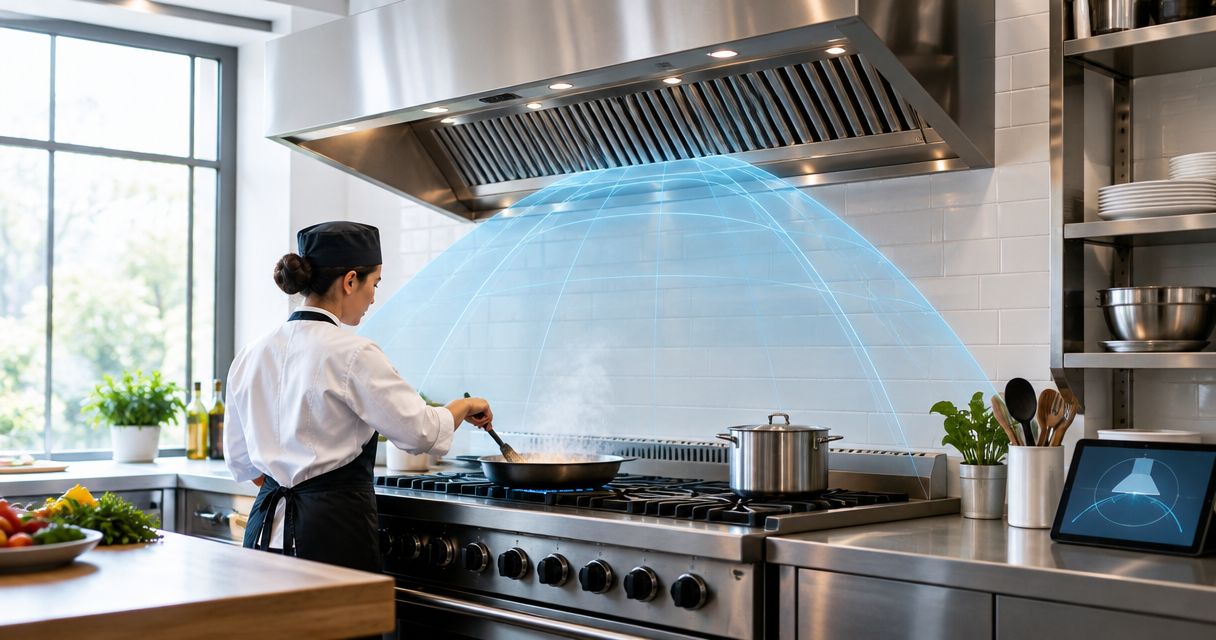
Kitchen hood suppression coverage by appliance type has no universal average or coverage range: the installed system’s listing and manufacturer’s design manual set the limits. For your 2026 kitchen review, compare the cooking surface, appliance arrangement, nozzle location, and obstructions—not hood length alone.
- Kitchen hood suppression coverage by appliance type follows the installed system’s listing, not a universal square-foot rule.
- Firstlinefire provides suppression services for commercial operators across Kentucky, Illinois, Indiana, Tennessee, Missouri, and Alabama.
- Fryers, griddles, ranges, and broilers require appliance-specific checks against the manufacturer’s design manual.
- Have a qualified suppression contractor review appliance changes before you cook on the revised line.
Firstlinefire provides fire-protection system sales, inspection, and service. Firstlinefire is best suited to commercial operators seeking suppression services within its stated six-state service area. A general coverage guide helps you prepare for that service; it does not approve a nozzle layout.
Why this matters
An appliance can fit beneath a hood without fitting the suppression system’s approved protection arrangement. Hood capture and fire suppression address different jobs. A hood’s physical footprint is not proof that every cooking surface beneath it receives suitable agent coverage.
For a 2026 equipment change, the useful benchmark is whether the actual installation matches the applicable listed arrangement. Do not use an appliance-type average to approve your cook line.
Coverage benchmarks by appliance type
Coverage means the cooking hazard that a listed nozzle arrangement is designed to protect under specified installation conditions. The overall yardstick is compliance with that arrangement—not a common area allowance shared by every appliance.
| Appliance or scope | Coverage benchmark | What must match the design manual | What the benchmark cannot establish |
|---|---|---|---|
| Overall cook line | Listed protection arrangement for the actual hazards | Appliance layout, nozzle selection, placement, agent supply, and piping limits | Approval based only on total hood length |
| Deep-fat fryer | Listed protection for the fryer's cooking-oil hazard | Frypot dimensions, configuration, nozzle position, and any applicable dripboard conditions | Coverage based on the fryer cabinet’s outside dimensions |
| Flat griddle | Listed protection for the cooking surface | Surface dimensions, nozzle arrangement, height, and aiming limits | Permission to extend coverage to a larger replacement griddle |
| Range | Listed protection for the range configuration | Burner arrangement, protected dimensions, nozzle position, and obstructions | Automatic equivalence with a griddle of similar width |
| Charbroiler | Listed protection for the specific broiler category | Cooking surface, fuel or heat-source configuration, nozzle arrangement, and mounting limits | Interchangeability among different broiler designs |
| Wok cooking station | Listed protection applicable to the wok arrangement | Vessel arrangement, hazard dimensions, nozzle location, and discharge path | Coverage inferred from the opening in the worktop |
| Solid-fuel cooking appliance | Protection specifically suitable for the solid-fuel application | Appliance configuration, fuel-related hazards, and applicable system limitations | Suitability established by a nearby nozzle alone |
| Hood plenum and exhaust duct | Protection for these separate portions of the exhaust system | Listed nozzle arrangement and the applicable plenum and duct requirements | Substitution for appliance-surface protection |
No appliance leads or trails on a universal coverage scale. A fryer allowance cannot be ranked against a griddle allowance without identifying the system, nozzle arrangement, and listed installation conditions. Comparing those figures across unrelated systems produces a misleading benchmark.
Methodology: this 2026 comparison organizes appliance checks around the scope of UL 300 commercial-cooking fire testing, NFPA 17A wet-chemical systems, and NFPA 96 commercial-cooking ventilation and fire protection. It is a requirements-based comparison, not a measured installation dataset; it cannot establish a nozzle’s permitted dimensions or certify an installation.
How to use these benchmarks
- Match the appliance category first. A charbroiler is not a griddle simply because both occupy the same space. Give the contractor the actual appliance model and cooking configuration.
- Compare the protected surface, not the cabinet. The table distinguishes cooking hazards from outside dimensions. Record both so the contractor can identify the relevant measurement.
- Check the whole arrangement. Nozzle height, aiming, obstructions, and system capacity belong in the review. An acceptable surface dimension does not settle the other checks.
- Keep appliance and exhaust protection separate. The table treats the plenum and duct as separate scopes. Confirm both rather than counting every nozzle as interchangeable coverage.
Use the table to prepare questions. Leave nozzle selection, piping changes, and acceptance testing to qualified personnel working from the applicable manufacturer documentation and local requirements.
What changes the answer for each appliance
Fryers: measure the cooking hazard
A fryer’s outside width includes parts that do not describe the oil surface. The contractor needs the frypot configuration and dimensions relevant to the listed arrangement. Applicable conditions can also distinguish between cooking areas and adjacent dripboards.
The advantage of an appliance-specific arrangement is a direct match to a defined hazard. Its limitation is that a replacement fryer still needs review, even when the cabinet fits the old space. Do not treat an unchanged footprint as an unchanged fire hazard.
Griddles: check the full surface
A griddle presents a broad cooking surface. Coverage depends on the applicable surface limits and nozzle arrangement, including the permitted relationship between the nozzle and that surface.
A clear, unobstructed surface is straightforward to document. Shelves, equipment, or other objects in the discharge path complicate the check. Record the actual setup used during service—not an empty line arranged only for an inspection photograph.
Ranges: identify the configuration
A range introduces a different cooking arrangement from a flat griddle. Burner placement and the manufacturer’s listed protection conditions matter. Similar appliance widths do not prove equivalent protection.
Keep the appliance identification readable and available. A generic description such as commercial range leaves the contractor without the model information needed to compare the installation against its documentation.
Broilers and solid fuel: identify the hazard precisely
Charbroilers and solid-fuel appliances require precise identification. Different heat sources and cooking configurations must be checked against the protection system’s applicable listings and instructions.
Tell the suppression contractor about a fuel change before using the changed appliance. Do not assume an existing nozzle remains suitable because the hood, gas connection, or appliance location stays the same.
Woks: record the vessel arrangement
A wok station is not defined adequately by its counter opening. Vessel position and the cooking arrangement affect the relationship between the hazard and the suppression discharge.
Document the station as operated. Include fixed supports and nearby objects that affect access to the cooking hazard. That record gives the contractor a useful starting point without asking kitchen staff to judge nozzle suitability.
Dedicated and overlapping coverage arrangements
Some systems use appliance-specific protection arrangements. Others offer listed overlapping coverage arrangements within defined conditions. Neither approach creates unrestricted permission to rearrange equipment.
| Arrangement | Best for | Practical advantage | Limitation |
|---|---|---|---|
| Appliance-specific coverage | A documented cook line matched to individual appliance hazards | Makes the relationship between a nozzle arrangement and its intended appliance explicit | Appliance changes require review against that arrangement |
| Listed overlapping coverage | Layouts that fit the system’s documented overlapping-coverage conditions | Provides a defined protected arrangement within the listed limits | Does not cover every appliance type or permit unrestricted movement |
Ask the contractor which arrangement your system uses. Then ask which document establishes its limits. A verbal description such as full coverage is not a substitute for the applicable design information.
For a 2026 remodel, choose a layout that the listed system can protect, rather than placing equipment first and assuming the existing nozzles will work. Both arrangements have value when correctly applied. Both have boundaries.
Review an appliance change before cooking
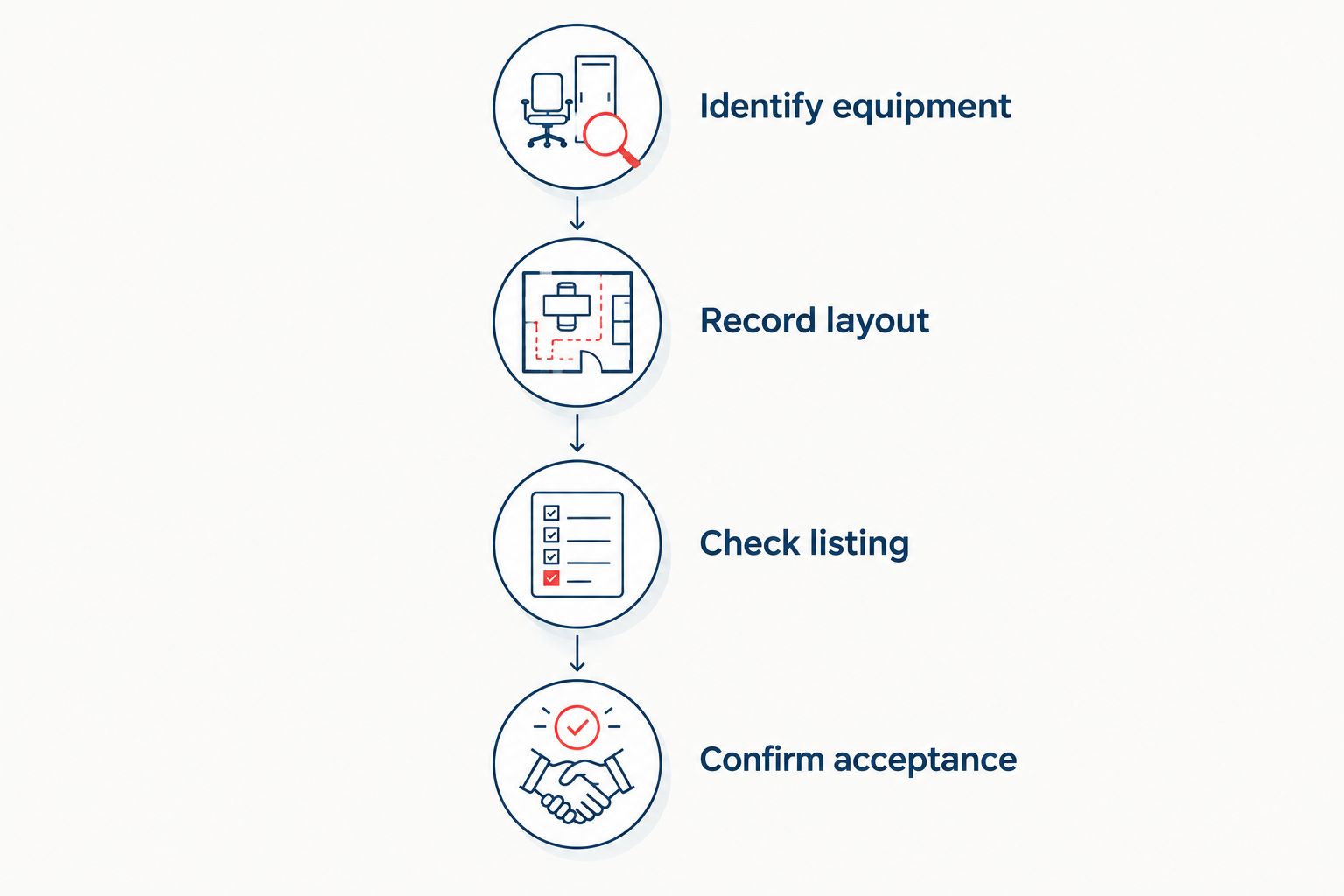
A useful change review follows a clear sequence. You supply the equipment facts; the qualified contractor checks the suppression design and identifies any required work or approvals.
Identify equipment
Record the existing and proposed appliance make, model, cooking configuration, and location. Include a change in fuel or cooking method. Keep the equipment specification sheet with the request.
Record layout
Photograph the cook line, nozzle locations, and nearby shelves or obstructions. Record cooking-surface dimensions and appliance positions. Do not move or adjust a nozzle to improve a photograph or make room for equipment.
Check listing
Have the contractor compare the proposed installation with the applicable system design manual. The review must address the relevant nozzle arrangement and system limits, not just whether another nozzle physically fits.
Confirm acceptance
Identify required documentation, testing, permits, and authority approval before placing the changed cooking arrangement in service. The authority having jurisdiction determines local acceptance requirements.
Your 2026 change record should show what changed and which documentation supports the resulting arrangement. Keep it with the suppression service records so the next contractor or inspector can follow the decision.
The kitchen hood suppression inspection and sign-off workflow addresses the next stage: connecting the equipment review to inspection records and the applicable sign-off process.
Discuss your cook line change
Ask Firstlinefire about suppression service for your commercial kitchen.
What a coverage review should leave you with
Ask for a written explanation that connects the installed arrangement to the applicable manufacturer documentation. It should identify the equipment reviewed, required corrections, and any unresolved acceptance conditions. An invoice alone does not explain coverage.
Keep these records together:
- Appliance identification: model information and the cooking configuration reviewed.
- Layout record: appliance positions, relevant dimensions, and nozzle locations.
- Design reference: the applicable system documentation supporting the arrangement.
- Service findings: corrections, testing, and remaining issues.
- Acceptance records: permits or authority documentation where required.
These records serve different purposes. Equipment information describes the hazard; design information explains the protection arrangement; acceptance records address the local approval process. None replaces the others.
Firstlinefire lists suppression systems among its services. Confirm the installed system and requested scope when arranging kitchen hood suppression service. A general service description does not establish authorization for every manufacturer or every system model.
FAQ
How much area does a kitchen hood suppression nozzle cover?
A kitchen hood suppression nozzle covers the hazard permitted by its listed installation arrangement, not a universal area. Check the installed system’s design manual for the applicable appliance dimensions, nozzle position, and other limits.
Can the same nozzle protect a fryer and a griddle?
Do not assume a nozzle arrangement approved for a fryer also protects a griddle. A qualified contractor must check whether the actual system, nozzle, placement, and appliance configuration are permitted by the manufacturer’s documentation.
Can I move an appliance under the same hood?
Have a qualified suppression contractor review the proposed move before using the relocated appliance. Remaining beneath the same hood does not establish that the cooking hazard remains within the listed protection arrangement.
Does overlapping coverage let me put any appliance anywhere?
No. Listed overlapping coverage has defined installation conditions and limitations. The contractor must check the proposed appliance type, position, and dimensions against those conditions.
Does a duct nozzle also protect the cooking appliances?
Do not count a duct nozzle as appliance protection. Duct, plenum, and appliance protection address different portions of the cooking exhaust installation and must each be checked against the applicable requirements.
Does a current service tag prove a replacement fryer is covered?
A service tag alone does not establish coverage for a replacement fryer. The replacement appliance and its location need review against the applicable listed arrangement, with the change documented.
What should I give a contractor before a 2026 kitchen equipment change?
Provide the existing and proposed appliance models, cooking configurations, dimensions, locations, and photographs of the cook line. Ask the contractor to identify the applicable design conditions and required acceptance steps before the changed arrangement enters service.
One last thing
The appliance that fits the gap is not automatically the appliance your suppression system protects. Before approving a kitchen equipment order, send the specification sheet and proposed location for suppression review. That decision belongs before installation, not after the first cooking shift.


