
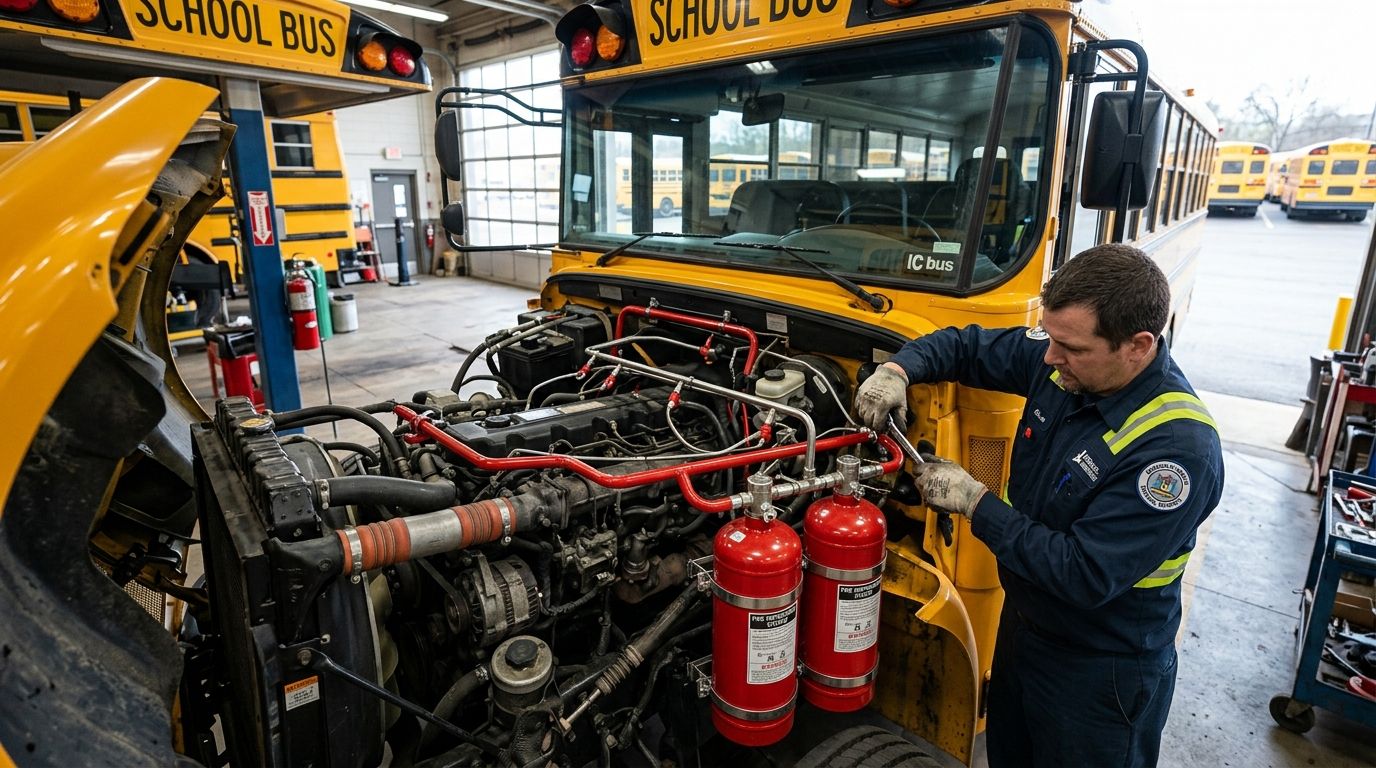
School bus fire suppression systems protect the engine compartment and passenger compartment of a bus with the goal of stopping an engine fire before it spreads into the cabin where 40-plus kids are seated. A school bus carries a different risk profile than a semi-truck or a passenger car: fixed routes, mandatory evacuation drills, state DOT oversight, and a driver whose first job during a fire is getting children off the vehicle, not fighting the fire.
- Vehicle fire suppression systems for school buses target the engine compartment, where most bus fires start before they reach the cabin.
- Automatic wet chemical or clean agent systems detect heat and discharge without driver action — critical when the driver's job is evacuation, not firefighting.
- NFPA 10 still requires a portable extinguisher on board even when an automatic system is installed; one does not replace the other.
- First-Line Fire installs and services vehicle fire suppression systems for fleet operators across Kentucky, Illinois, Indiana, Tennessee, Missouri and Alabama.
Why vehicle fire suppression matters for school bus fleets
An engine compartment fire has minutes, sometimes less, before it burns through the firewall into the passenger compartment. Drivers are trained to evacuate first, not fight fire — which means the vehicle needs to slow the fire down without waiting on a human to pull a trigger.
State pupil transportation offices and district risk managers increasingly ask fleet maintenance shops for automatic vehicle fire suppression systems for fleet trucks style protection adapted to buses, not just a handheld extinguisher bolted to the stairwell. Engine fires are hard to spot from the driver's seat, and a bus stopped on a two-lane road with kids still unbuckling doesn't have time for someone to locate, aim, and discharge a portable unit.
A system that fires automatically buys the driver the one thing that matters in that moment: time to get every seat empty.
Building out suppression coverage for a bus fleet
Assess your engine compartment risk zone
Start with where the fire actually starts, not where it's convenient to bolt on equipment.
- Turbocharger and exhaust manifold areas — the most common ignition point on diesel buses
- Fuel and hydraulic lines routed near hot surfaces
- Battery compartments, especially on buses with wheelchair lifts, cameras, or radios added after the factory build
- Wiring harnesses that have been re-routed or spliced during past repairs
- Any spot flagged for oil or fuel seepage on a prior DOT inspection
Choose the suppression agent for the compartment
The agent determines how fast the system reacts and what's left in the engine bay afterward.
- Wet chemical — cools the fire and helps prevent reflash, common choice for diesel engine compartments
- Clean agent — leaves no residue, a better fit when sensors or wiring harnesses sit close to the risk zone
- Dry chemical — broad coverage, a standard retrofit option for older buses in the fleet
- Compare agent behavior side by side before you commit a whole fleet to one type — the suppression systems ranked by agent type breakdown covers how each one performs on a live engine fire
Confirm detection and response speed
Detection speed decides whether the system catches a fire at ignition or after it has already spread.
- Linear heat detection tubing routed through the highest-risk zones, not just mounted at one point
- Automatic discharge tied to heat threshold, not manual trigger only
- A manual pull station in the cabin as backup, within driver's reach from the seat
- Response time varies by system design — see how systems stack up in the fire suppression systems ranked by response time comparison before specifying equipment for a new bus order
Verify compliance with state and NFPA requirements
A suppression system doesn't replace what a state inspector expects to see on the vehicle.
- NFPA 10 requires a portable fire extinguisher on board every school bus regardless of any automatic system installed
- State pupil transportation regulations vary — check what your state DOT requires for bus fire equipment before ordering hardware
- Keep suppression system service records separate from extinguisher inspection tags; inspectors ask for both
- Cross-reference requirements with your fire alarm coverage if the district also runs a bus garage — the same compliance logic applies to fire alarm systems for schools
Train drivers on shutdown and evacuation sequence
The system buys time. The driver still has to use it correctly.
- Know where the manual pull station is without looking
- Shut down the engine the moment a warning light or smoke is noticed, before evacuation begins if safely possible
- Evacuate from the rear door first when the fire is at the front of the bus
- Run the evacuation drill at least as often as your state requires, and rehearse it with the suppression system in mind, not around it
Schedule inspection and recharge on a fixed calendar
A suppression system that hasn't been serviced is a false sense of security parked in a bus lot.
- Visual inspection on a documented interval, tracked per vehicle, not per fleet
- Full system service and agent recharge on the manufacturer's schedule
- Extinguisher tags checked monthly per NFPA 10, hydro tested on the required interval
- Replace or service any unit that shows a damaged gauge, dented cylinder, or missing pin before the bus goes back on a route
“A bus with 40 kids on board doesn't get a second warning system — the suppression has to work the first time.”
Comparing suppression options for school bus fleets
| Option | Best for | Key limitation |
|---|---|---|
| Automatic wet chemical system | Diesel engine compartments, most common bus retrofit | Requires agent recharge after any discharge |
| Automatic clean agent system | Compartments with sensitive wiring or sensors | Typically a higher-touch install than wet chemical |
| Portable dry chemical extinguisher | Mandatory backup on every bus under NFPA 10 | Requires driver action, not automatic |
| Manual pull-station suppression | Fleets not ready for full automatic detection | Still depends on someone reaching the station in time |
Verdict: an automatic wet chemical or clean agent system paired with the NFPA 10-mandated portable extinguisher is the combination most bus fleets land on in 2026 — the automatic system buys time, the portable unit covers what the automatic system doesn't reach.
Get suppression systems specced for your fleet
First-Line Fire services vehicle fire suppression across KY, IL, IN, TN, MO and AL.
Common mistakes school bus fleets make
- Treating the portable extinguisher as the whole solution. NFPA 10 requires it, but it does nothing against a fire that's already spread past reach in the engine bay.
- Skipping agent recharge after a discharge or accidental trigger. A bus with a spent suppression cylinder looks protected and isn't.
- Routing detection tubing to one spot instead of the whole risk zone. A single-point detector misses fires that start off to the side of the compartment.
- Letting inspection tags lapse across a large fleet. One missed bus in a 40-vehicle fleet is the one a state auditor finds.
- Training drivers on evacuation but never on the suppression system itself. Drivers need to know where the manual pull station is and what the automatic discharge looks and sounds like.
FAQ
Do school buses need automatic fire suppression systems in 2026?
Requirements vary by state, but a growing number of districts specify automatic engine compartment suppression on new bus orders in 2026, on top of the portable extinguisher NFPA 10 already requires. Check your state pupil transportation office for the current mandate.
Is an automatic suppression system enough, or do buses still need a portable extinguisher?
NFPA 10 requires a portable fire extinguisher on every school bus regardless of any automatic suppression system installed. The two are complementary, not interchangeable.
What's the difference between wet chemical and clean agent suppression for a bus engine?
Wet chemical cools the fire and helps prevent reflash and is the common choice for diesel engine compartments. Clean agent leaves no residue and fits better where sensitive wiring or sensors sit close to the risk zone.
How often does a vehicle fire suppression system need service?
Service intervals follow the manufacturer's schedule for that system, with agent recharge required any time the system discharges. Portable extinguishers on the same bus follow NFPA 10's monthly visual check and annual maintenance schedule.
Where do most school bus fires start?
Most bus fires start in the engine compartment, around the turbocharger, exhaust manifold, or wiring that's been re-routed during repairs. That's why detection tubing needs to cover the whole compartment, not one point.
Can one suppression system cover a whole fleet of buses?
No — suppression systems are installed and serviced per vehicle. A fleet needs a documented inspection schedule tracked bus by bus, not a fleet-wide average.
Does adding a wheelchair lift or extra electronics change the suppression setup?
Yes. Added electrical accessories create new wiring runs and battery compartment risk that should be assessed before finalizing agent choice and detection layout.
One last thing
The detail fleets miss most in 2026 isn't the suppression system itself — it's the gap between suppression service records and extinguisher inspection tags. A state auditor checks both, separately, and a fleet that's current on one but lapsed on the other still fails the inspection.


