
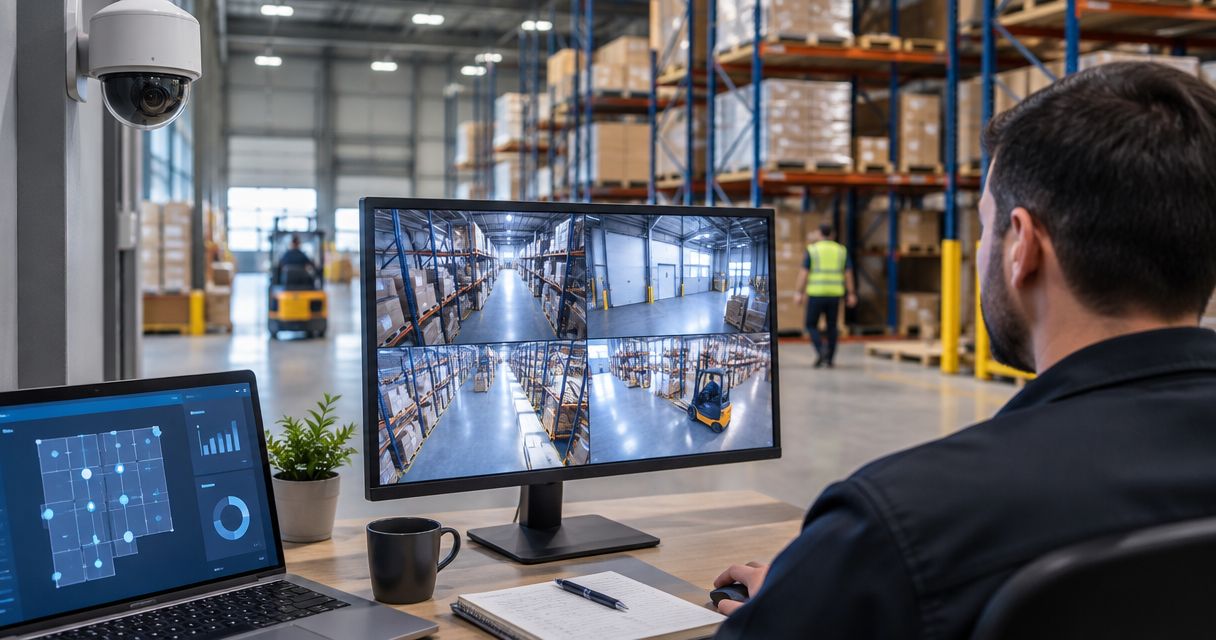
A warehouse security camera system needs a site-specific quote in 2026 because camera count, building layout, storage, wiring, and monitoring determine the final cost. The quote must also account for recurring storage or monitoring charges that are separate from installation.
- Security camera system cost warehouse estimates require a site survey in 2026; a flat national price is not reliable.
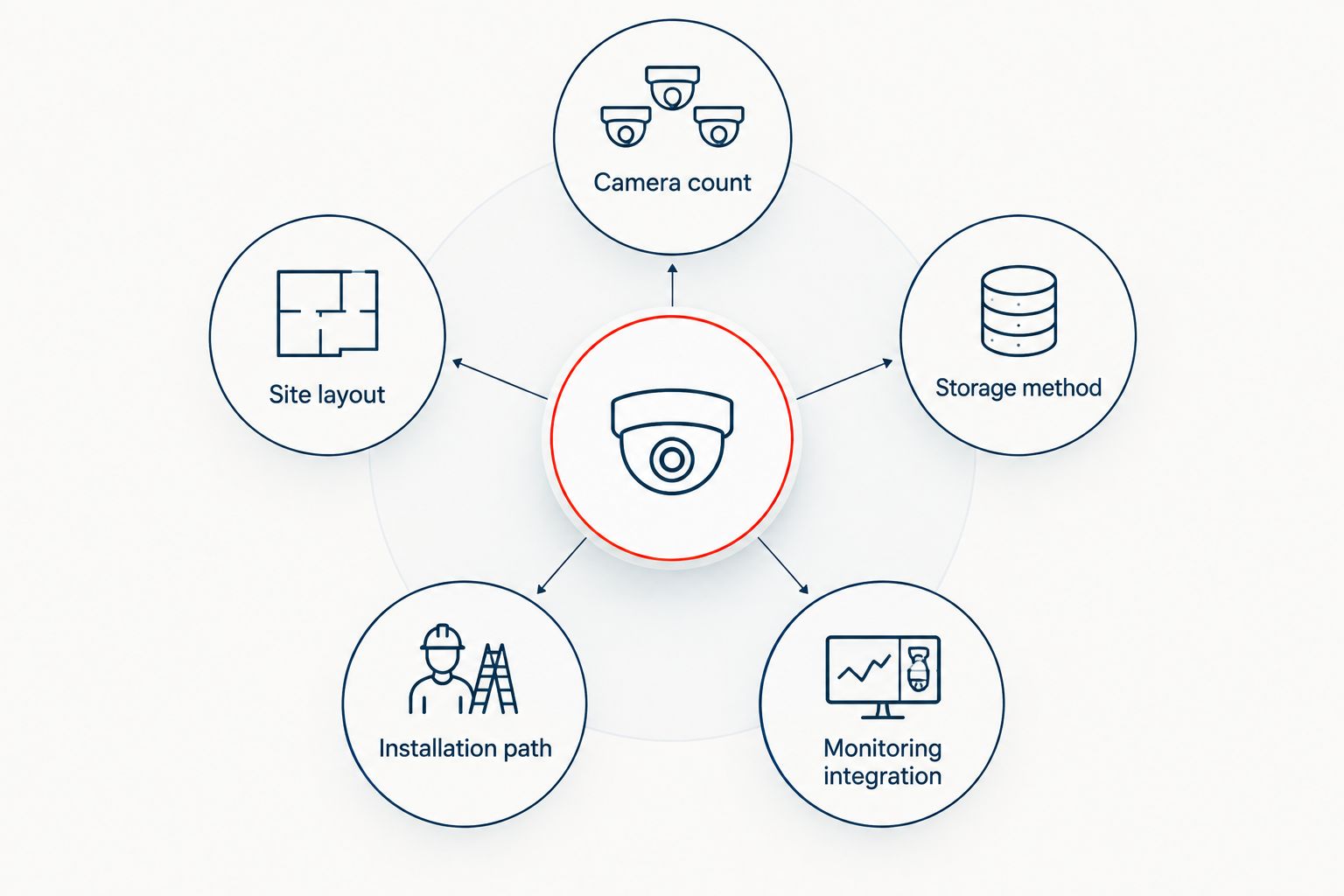
- Camera count, site layout, storage, wiring, and monitoring are the 5 main cost drivers.
- Fixed, PTZ, and thermal cameras serve different warehouse areas and carry different installation requirements.
- Cloud storage creates a recurring charge; on-site recording requires local hardware and maintenance.
- First-Line Fire Extinguisher Co. fits operators combining security cameras with fire alarms and fire-protection service.
Why this matters
Warehouse camera coverage is not one camera at the front door. Loading docks, employee entrances, racking aisles, offices, exterior yards, and perimeter gates create separate sightlines. Miss one, and the recorded footage may not show the event you need to review.
Start by comparing the functions covered by commercial security camera systems. Decide which areas need continuous recording, which need event alerts, and which need live monitoring before asking for a 2026 proposal.
First-Line Fire Extinguisher Co. is best for commercial and industrial operators that want security planning handled alongside fire alarms and fire-protection service. The company serves customers across 6 states: Kentucky, Illinois, Indiana, Tennessee, Missouri, and Alabama.
How much does a security camera system cost for a warehouse in 2026?
A defensible 2026 warehouse camera cost cannot be stated without a floor plan, camera schedule, recording plan, and installation scope. A quote should separate equipment, installation, storage, monitoring, and future service instead of presenting one unexplained total.
The first estimate should answer these questions:
- Which doors, aisles, yards, and work areas require coverage?
- Which locations need fixed, PTZ, or thermal cameras?
- Can existing network and electrical infrastructure support the system?
- Will footage be stored on-site, in the cloud, or through a mixed setup?
- Does the warehouse need live monitoring, event alerts, or record-only coverage?
| Quote component | What the installer should define | What changes the cost |
|---|---|---|
| Cameras | Type, location, field of view, and mounting point | Camera count and camera capability |
| Recording | Cloud, on-site, or mixed storage | Retention needs and recording quality |
| Network | Cabling, switches, and available connection points | Cable distance and existing infrastructure |
| Installation | Mounting, lifts, conduit, and testing | Ceiling height and access conditions |
| Monitoring | Alert handling and dispatch workflow | Record-only versus monitored response |
| Service | Inspection, maintenance, and replacement process | System size and service scope |
Do not compare proposals by the equipment total alone. One proposal may include cabling and storage while another leaves both as separate charges. Put every proposal into the same 6-part structure before deciding which one costs less.
Fixed IP cameras: best for defined sightlines
Fixed IP cameras watch one selected field of view. They fit dock doors, employee entrances, office corridors, cage areas, and aisle intersections where the viewing direction does not need to change.
The main benefit is predictability. The installer can aim the camera at a defined point and document exactly what it covers. The limitation is equally clear: a fixed camera cannot turn to follow movement outside its field of view.
Best for: doors, narrow aisles, controlled work areas, and other stable sightlines.
- Pros: Simple coverage plan, consistent framing, and straightforward review.
- Cons: Each blind spot may require another camera, cable run, and mounting point.
- Verdict: Buy for the warehouse areas where the target stays in one place.
PTZ cameras: best for open yards
Pan-tilt-zoom cameras can change direction and zoom into activity across a larger open area. They fit trailer yards, parking areas, wide loading aprons, and perimeter zones where movement does not follow one fixed path.
A PTZ camera does not watch every direction at the same time. Its value depends on presets, automated tours, event rules, or an operator who can control it. A poorly planned PTZ installation can be looking away when an event happens.
Best for: exterior yards and open areas with vehicle or pedestrian movement.
- Pros: Adjustable view and wider operational coverage from one mounting point.
- Cons: The camera can miss activity outside its current view; setup and monitoring are more involved.
- Verdict: Buy where a fixed camera cannot cover the required area, but keep fixed coverage on critical doors.
Thermal cameras: best for dark perimeter areas
Thermal cameras detect heat patterns rather than depending only on visible light. They fit dark fence lines, remote property edges, and exterior areas where ordinary video does not provide dependable detection conditions.
Thermal footage serves a different purpose from standard identification footage. It can help detect activity, but a separate visible-light camera may still be needed when the warehouse needs recognizable visual detail.
Best for: poorly lit perimeter areas where detection matters more than color detail.
- Pros: Detection does not depend on normal scene lighting.
- Cons: Added equipment scope and less conventional visual detail than a standard camera image.
- Verdict: Hold unless the site survey identifies a perimeter detection problem that standard cameras and lighting do not solve.
Why warehouse camera system costs vary
The same square footage can produce very different 2026 proposals. A mostly open building has different coverage demands from a warehouse divided by tall racks, secure cages, offices, and multiple dock banks.
- Camera count. Every required view adds equipment, mounting, cabling, configuration, and testing.
- Site layout. Racking, walls, mezzanines, machinery, and stored inventory can block sightlines.
- Camera type. Fixed, PTZ, and thermal cameras solve different problems and require different planning.
- Installation path. Long cable routes, high mounting points, conduit, and restricted work areas add labor.
- Storage method. Cloud recording creates recurring service charges; on-site recording requires local equipment.
- Monitoring integration. Event verification and central dispatch require more configuration than record-only cameras.
A 2026 quote should show these factors separately. If it does not, ask the installer to identify the camera schedule, recording method, installation assumptions, and recurring services in writing.
How a warehouse camera quote should be built
A good estimate starts with the property, not a camera catalog. Use this sequence to keep the proposal tied to actual risks and operating conditions.
1. Mark the areas that must be seen
List loading docks, shipping doors, receiving doors, employee entrances, offices, secure storage, equipment areas, exterior yards, and gates. Separate required coverage from optional coverage before discussing camera models.
2. Define the purpose of each view
A camera may need to detect movement, show a full scene, document handling activity, identify a person, or track a vehicle. One camera position does not automatically satisfy every purpose.
3. Check obstructions and lighting
Walk the intended viewing path. Racks, stacked inventory, trailers, doors, glare, shadows, and changing work zones can block or degrade a planned view. Review both operating and closed-hour conditions.
4. Choose the recording method
Decide between 2 storage paths: cloud recording and on-site recording. A mixed approach can also be used when different areas have different retention or access needs, but that adds another layer to system administration.
5. Define alert and monitoring rules
Decide whether cameras only record, send event alerts, support remote review, or connect to a monitored response process. Clear rules prevent routine warehouse movement from creating unnecessary alerts.
6. Price installation and service separately
The proposal should distinguish equipment from lifts, conduit, cabling, configuration, monitoring, storage, and maintenance. This makes competing 2026 bids easier to compare and exposes charges that would otherwise appear after approval.
Cloud storage versus on-site recording
Storage is not a minor line item. It determines where footage sits, how authorized staff reach it, and which recurring or maintenance obligations remain after installation.
| Storage option | Best for | Main advantage | Main drawback |
|---|---|---|---|
| Cloud recording | Sites prioritizing remote access and provider-managed storage | Less recording hardware kept at the warehouse | Recurring charges continue while the service is active |
| On-site recording | Sites prepared to manage local recording equipment | Direct control over local hardware | Hardware capacity, maintenance, and physical protection remain site responsibilities |
| Mixed storage | Sites with different needs across critical and general areas | Storage can be assigned by operational need | More configuration and administration |
Do not choose storage only by the initial quote. Ask how access works, who manages user permissions, what happens during a network interruption, and which charges repeat. Those answers shape the real security camera system cost for a warehouse in 2026.
Should cameras connect to fire alarm monitoring?
Cameras and fire alarms serve different functions, but the response workflow can be coordinated. A warehouse can use camera views to give authorized personnel more context while alarm events follow the required monitoring and dispatch process.
The security camera and fire alarm monitoring workflow explains where the systems can share information without treating video as a substitute for required fire detection equipment.
First-Line Fire Extinguisher Co. provides security and fire alarm services for commercial and industrial customers. That makes the company relevant when a warehouse wants fewer disconnected service relationships across cameras, alarms, and fire-protection equipment.
Discuss your warehouse camera scope
Review coverage, storage, monitoring, and fire alarm coordination with First-Line Fire.
How many cameras does a warehouse need?
A warehouse needs enough cameras to cover required views without relying on unusable distance or blocked sightlines. Count views, not square feet: each dock bank, entrance, secure area, aisle intersection, yard, and gate must be assessed on its own.
Start with critical doors and high-consequence areas. Add wider operational views after those points are covered. First-Line Fire Extinguisher Co. can then match the required views to the appropriate camera types and installation scope.
Is a monitored system better than record-only cameras?
A monitored system is better when the warehouse needs someone to receive and act on defined alerts. Record-only cameras fit sites that primarily need footage for later review and already have staff responsible for checking events.
Monitoring adds an ongoing service component. Record-only coverage reduces that component but shifts response responsibility to the warehouse. The correct 2026 choice depends on who is expected to act when activity occurs.
Can a warehouse add cameras in phases?
Yes. A warehouse can phase installation when the initial design identifies the final system architecture before the first cameras are installed. Phase 1 should cover the highest-priority doors, yards, and secure areas without creating network or recording limits that block later expansion.
Phasing can spread project work, but it does not fix a weak design. Document the planned final camera count, storage approach, cable routes, and monitoring scope before approving the first phase.
FAQ
How much does a security camera system cost for a warehouse in 2026?
A warehouse security camera system needs a site-specific quote in 2026 because camera count, layout, storage, wiring, and monitoring determine the cost. Require separate figures for equipment, installation, recurring services, and maintenance.
What is the biggest warehouse camera cost driver?
Camera count is a primary cost driver because each additional view can require equipment, mounting, cabling, configuration, and testing. Site layout and installation access determine how much work each camera adds.
What's the best security camera for a warehouse loading dock?
A fixed IP camera is usually the right starting point for a defined loading-dock view. Add PTZ coverage when the surrounding apron or trailer yard requires a wider adjustable view.
Is cloud storage better than an on-site recorder?
Cloud storage is better for sites prioritizing provider-managed storage and remote access, while on-site recording suits sites prepared to manage local hardware. Compare recurring charges, maintenance, access, and network dependence before choosing.
Do warehouse security cameras need live monitoring?
Warehouse cameras need live monitoring only when the operating plan requires someone to receive and act on defined alerts. Record-only systems fit sites that mainly need footage for later review.
Can security cameras connect to warehouse fire alarm monitoring?
Security cameras can be coordinated with a warehouse fire alarm monitoring workflow, but video does not replace required fire detection equipment. The design must keep each system's function and response rules clear.
Are thermal cameras necessary for warehouse security?
Thermal cameras are necessary only when the site has a detection problem that standard cameras and lighting do not solve. They are most relevant to dark perimeter areas, not every interior aisle or loading door.
What should a warehouse camera quote include?
A warehouse camera quote should include the camera schedule, recording method, network work, installation, monitoring, storage, testing, and service scope. It should also separate one-time work from recurring charges.
One last thing
Start the camera survey outside. Warehouses often focus first on interior aisles while trailers, gates, employee entrances, and dock approaches carry the least controlled movement. Map those views before selecting equipment.
First-Line Fire Extinguisher Co. serves commercial and industrial customers across Kentucky, Illinois, Indiana, Tennessee, Missouri, and Alabama. A warehouse camera proposal in 2026 should reflect the actual building, operating schedule, and response plan — not a generic package.


