
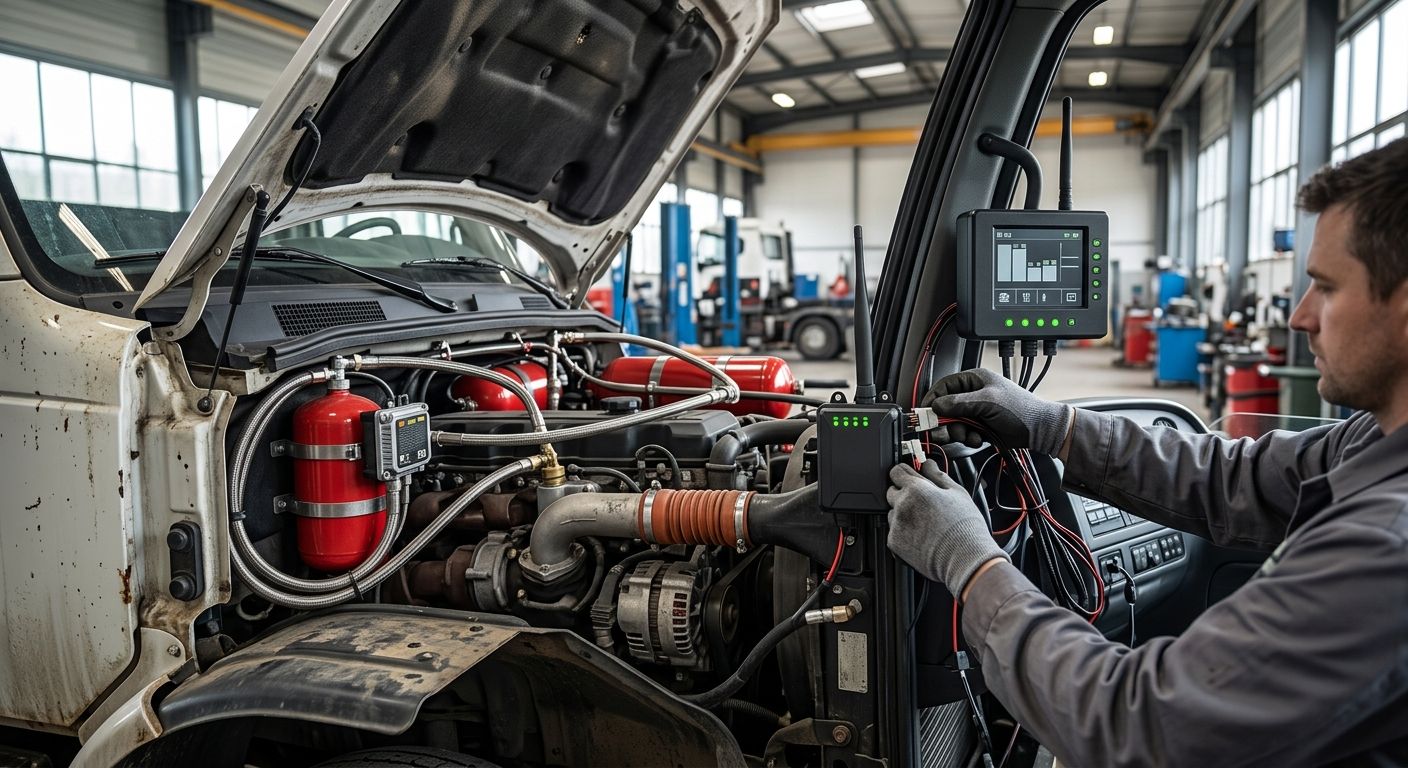
Instead of hearing about a suppression discharge from a driver's cell phone call twenty minutes after the fact, wire the system's output relay into the truck's telematics box so dispatch gets a GPS-stamped alert the second the agent releases. First-Line Fire installs and services vehicle fire suppression systems for trucking, coal mining, marine and vehicle/fleet customers across Kentucky, Illinois, Indiana, Tennessee, Missouri and Alabama, and the wiring step below works with most hardwired and CAN-bus telematics devices already running in your trucks in 2026.
- Wire the suppression panel's discharge relay to a telematics auxiliary input, never to the ignition circuit.
- Most Amerex and Ansul CHECKFIRE panels ship with a normally-open dry contact output built for exactly this connection.
- Test the circuit in the panel's diagnostic or test mode before the truck leaves the yard, never during a live discharge.
- Vehicle fire suppression systems paired with telematics turn a phone-call delay into a GPS-stamped alert dispatch sees immediately.
- 49 CFR 393.95 still requires a physical extinguisher onboard even after the suppression system is wired into telematics.
Why this matters
A suppression discharge on a highway shoulder in six states of coal seams, marine terminals and interstate freight lanes is not something you want reported secondhand. The gap between an agent firing and dispatch knowing about it is the difference between a controlled pullover and a truck burning to the frame while someone hunts for a phone signal.
Fleets running vehicle fire suppression systems for fleet trucks already have the hardware capable of this signal. The panel just needs to talk to whatever telematics box is already reporting engine hours, location and fault codes. Most fleets skip this step because nobody tells them the panel has an output terminal sitting unused.
“If the alert reaches dispatch before the driver reaches for the radio, the wiring is right.”
Before you start
- Physical access to the suppression control panel's output terminals — most Amerex and Ansul CHECKFIRE panels have a labeled auxiliary or alarm output block behind the cover plate; know which terminals are dry contact versus powered before you touch anything.
- A telematics device with a spare digital or auxiliary input — Samsara, Geotab and most fleet gateways installed since 2020 have at least one unused input pin, but confirm it before ordering parts.
- The gotcha that bites at step four: input voltage thresholds are not standardized across telematics hardware. Different fleet gateways read a closed dry contact differently, and if you crimp the wire before confirming the device's expected voltage range, you'll get a false idle signal or nothing at all. Pull the device's wiring spec sheet first, every time.
Set up your suppression system output
- Locate the alarm or auxiliary output terminal block on the suppression control panel. On Ansul CHECKFIRE panels this is typically a screw terminal marked Alarm Output or Aux Relay; on Amerex systems it's usually labeled Discharge Output.
- Confirm with a multimeter whether the output is a dry contact (no voltage, just open/closed) or a powered signal. Dry contact is the standard and the safer default for telematics wiring.
- Route an 18-22 gauge wire from the output terminal to the telematics box's harness, keeping it clear of the vehicle's fuel lines and exhaust routing.
- Put the panel into its test or diagnostic mode (check the panel's manual for the exact button sequence — this varies by manufacturer) and confirm the relay closes without an actual discharge.
Expected result: the telematics box registers a digital input change the moment you trigger test mode, with no suppression agent released and no fault codes thrown on the vehicle's dash.
Configure the telematics alert rule
- Log into the fleet telematics dashboard and find the Rules, Alerts, or Triggers section (naming varies by platform, but every major fleet gateway has one).
- Click Create Rule or New Alert.
- Set the Trigger to the digital or auxiliary input you wired in the previous section.
- Set the Condition to "input closed" or "input active," matching how your panel's relay behaves.
- Name the rule something dispatch will recognize instantly — "Suppression Discharge — Unit 214" beats a generic label when three alerts fire in one shift.
- Add Notification Actions: SMS, email, and in-app push to whoever runs the dispatch board, plus a geofence tag so the alert carries the truck's GPS coordinates.
- Save the rule and run the test-mode trigger again from the panel to confirm the notification actually lands.
Expected result: dispatch receives a location-stamped alert within the same minute the test signal fires, with the truck's ID and coordinates attached, not just a generic fault code.
Variant: automatic engine shutdown on discharge
Some fleets, particularly those hauling flammable cargo or running underground mining equipment, wire the same relay to an engine-kill circuit instead of (or alongside) the telematics alert. This shuts the engine down the moment the agent releases, cutting fuel feed to a fire already fighting for oxygen. It requires a separate relay from the alarm output and coordination with whoever maintains the vehicle's ignition system — this is not a DIY wire-splice job, and First-Line Fire's install crews handle the relay staging separately from the telematics tap so one failure does not disable the other.
Troubleshooting
- Alert never reaches dispatch, but the panel test shows the relay closing. Check for a dry contact / powered contact mismatch — this is the most common install error, and it usually means the telematics input read a voltage it wasn't expecting.
- False alerts triggered by road vibration. Add a debounce timer of a few seconds in the rule configuration so a momentary bounce doesn't register as a discharge event.
- Alert fires with no GPS coordinates attached. The telematics unit's GPS antenna may be shadowed by cab metal or a recent mount change; reposition the antenna and re-test.
- Relay stays engaged after the panel resets. Some panels require a manual reset sequence on the control head itself before the output terminal releases — check the panel's reset procedure before assuming a wiring fault.
- Rule fires on ignition-off events instead of discharge events. This almost always means the input was wired to the wrong terminal block during a previous unrelated install; re-trace the harness back to the suppression panel specifically.
Get your fleet's suppression systems wired in
First-Line Fire installs and services suppression panels across six states.
Customize your workflow
Once the discharge alert reaches dispatch reliably, expand the rule set. Fleets running mixed cargo often add a second rule tied to the vehicle's fuel shutoff, and fleets with scheduled maintenance windows tie the alert into their trucking fleet inspection schedule so a discharge automatically flags that unit for full panel recharge before it goes back on the road.
Agent type matters here too. Dry chemical, clean agent and foam-based vehicle fire suppression systems all discharge differently, and the relay timing on some panels lags behind others. The breakdown in the suppression systems ranked by agent type guide covers which agents fire fastest and which need the longest reset window before the truck can return to service.
Verdict: wiring a vehicle fire suppression system's discharge output into fleet telematics is a low-cost, high-value addition for any fleet running six-state routes or mining sites, and it should be standard on every new install in 2026.
FAQ
Can any vehicle fire suppression system connect to telematics?
Most modern panels from Amerex and Ansul include a dry contact alarm output built for exactly this connection. Older panels may lack the output terminal entirely and need a retrofit relay kit.
Does connecting suppression to telematics replace the required onboard extinguisher?
No. 49 CFR 393.95 still requires commercial vehicles to carry a rated portable extinguisher regardless of any installed suppression system. The telematics tap changes reporting speed, not compliance.
What's the best telematics platform for this integration in 2026?
Any platform with a free digital or auxiliary input and a rules engine works. Samsara and Geotab are common across the fleets First-Line Fire services, and the wiring principle is the same across platforms.
How much does it cost to wire a suppression panel into telematics?
Cost depends on how many trucks need the retrofit and whether the panel already has an output terminal versus needing a relay kit added. Ask for a quote based on your fleet size and panel models.
Will a false trigger shut down my engine?
Only if the engine-kill variant is wired in, and that setup includes a debounce timer specifically to prevent road vibration or a bounced contact from cutting fuel unnecessarily.
How fast does dispatch get notified after a discharge?
Once the rule is configured and tested, the notification fires as soon as the telematics device registers the input change, carrying the truck's location with it.
Do coal mining vehicles need a different wiring approach than highway trucks?
The wiring principle is identical, but mining equipment often pairs the telematics alert with an automatic engine shutdown given the confined-space fire risk underground.
Can I test the integration without discharging the suppression agent?
Yes. Panels have a test or diagnostic mode that closes the alarm relay without releasing agent, and that is the only safe way to confirm the telematics rule works.
One last thing
Most fleets that skip this integration aren't ignoring it on purpose — nobody ever checked whether the suppression panel already had an output terminal sitting unused behind the cover plate. It's a short check with a multimeter that turns a phone-call delay into a location-stamped alert, and in 2026 there's no good reason for a fleet running six-state routes to leave that terminal unwired.


