
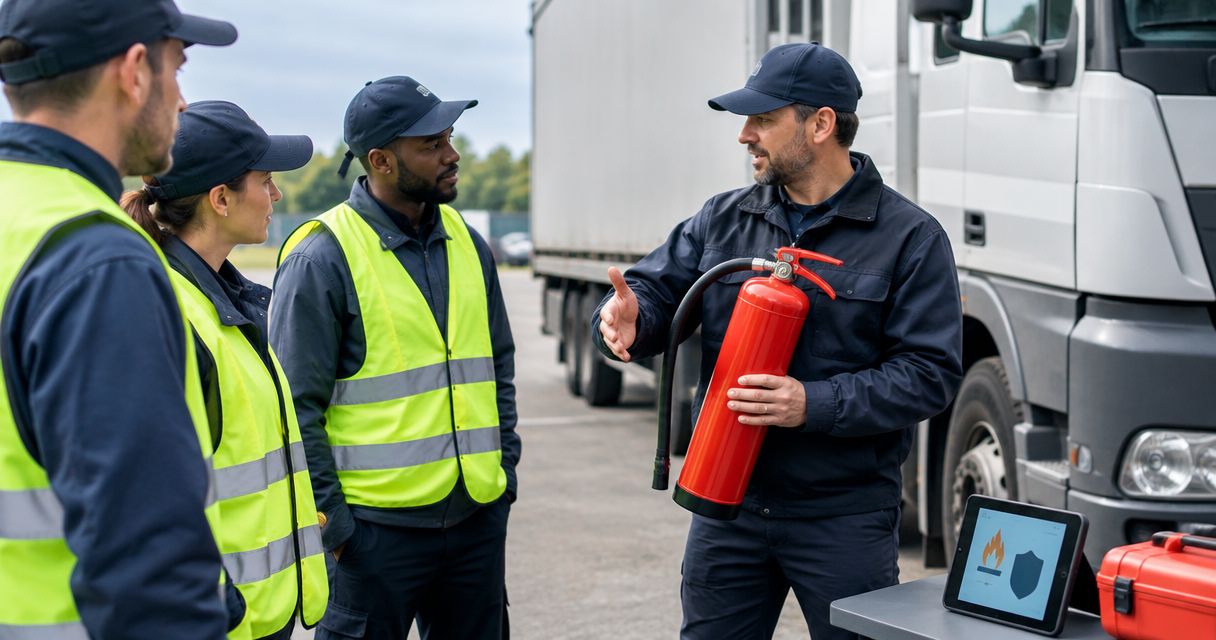
Train fleet drivers on vehicle fire suppression systems by teaching them to recognize system alerts, stop safely, evacuate, report the incident, and leave inspection and restoration to qualified personnel. In 2026, the training must match the equipment installed on each vehicle; a driver should not have to guess what an indicator or manual release does during a fire.
- How to train fleet drivers on fire suppression systems: teach alerts, safe stopping, evacuation, and defect reporting.
- Show each driver the controls on the vehicle they operate; do not treat every installed system as identical.
- First-Line Fire Extinguisher Co. fits fleets seeking suppression-system service and safety training across its stated service area.
- A suppression discharge does not make a vehicle safe to reenter or return to service.
How do you train fleet drivers on vehicle fire suppression systems?
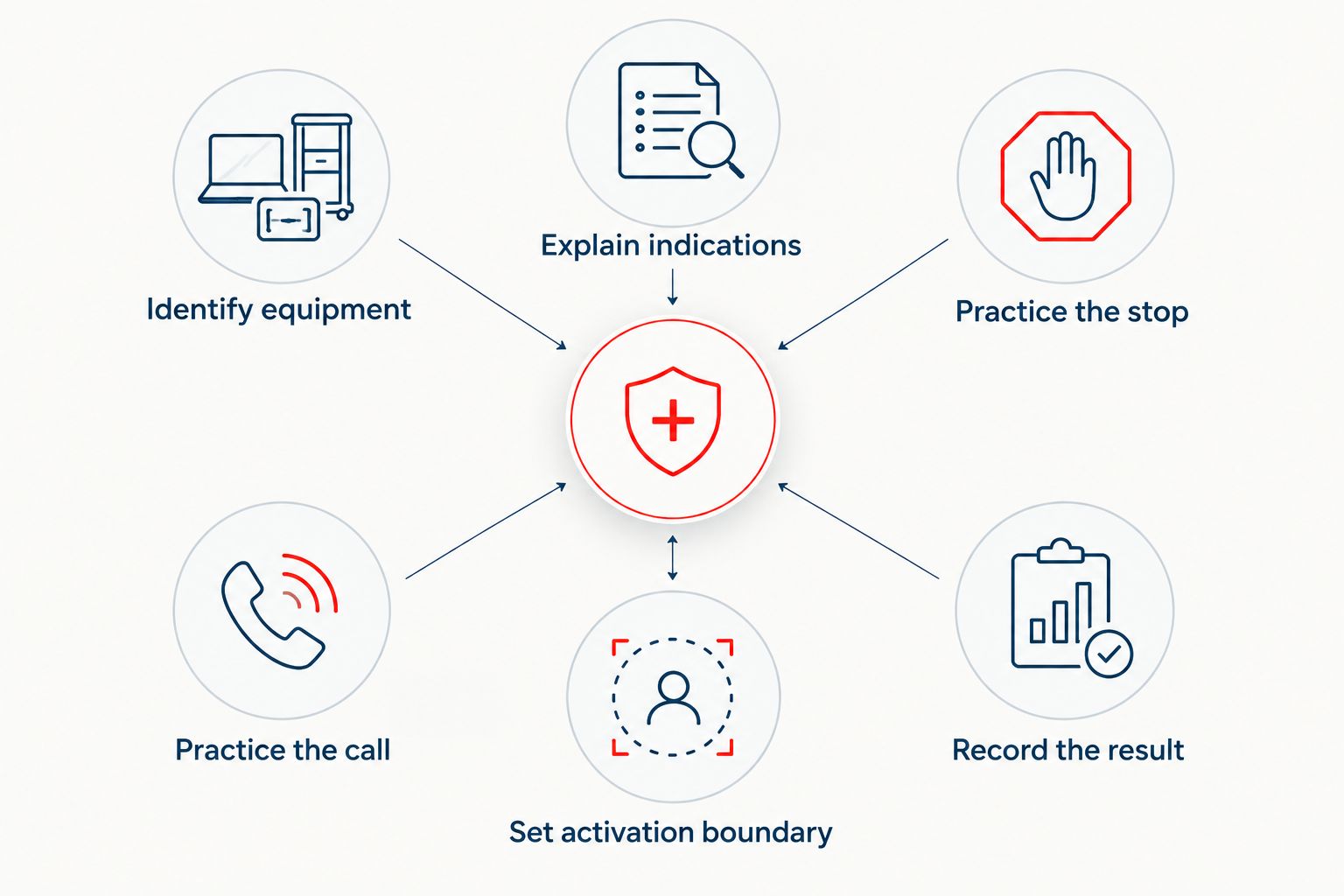
Use a vehicle-specific demonstration, a supervised response exercise, and a recorded check of what the driver can do without prompting. Teach the response as a sequence. The driver identifies an alert, brings the vehicle to a safe stop, gets people clear, calls for emergency help, and reports the vehicle and system status. Keep activation instructions tied to the installed system’s manual and the fleet’s approved procedure.
- Identify the equipment. Show the driver the system indicator, protected area, any manual release, and the vehicle’s portable extinguisher. These are separate pieces of equipment with different uses. Include the portable extinguisher in the vehicle check; 49 CFR 392.7 requires drivers subject to that rule to be satisfied that listed equipment, including fire extinguishers, is in good working order before driving. The fire extinguisher inspection guide for trucking fleets covers that separate task.
- Explain normal and fault indications. Use the installed system’s instructions to show what the driver should see before departure and what requires a report. Do not teach a generic light color or alarm pattern as if it applies to every vehicle.
- Practice the stop. Have the driver describe where they would stop without creating another hazard, how they would secure the vehicle, and how they would move passengers or coworkers away from it. A live drill does not require a real discharge.
- Practice the emergency call. The driver should be able to state the location, vehicle identification, visible signs of fire, and whether anyone remains near the vehicle. The first call during an active fire is for emergency help, not a routine maintenance ticket.
- Set the activation boundary. Demonstrate a manual release only according to the installed system’s instructions and fleet policy. A driver must not improvise at a control, open a hot compartment to investigate, or assume an automatic discharge has ended the hazard.
- Record the result. Document the vehicle or system covered, the driver trained, the instruction used, and the response practiced. Send faults and post-discharge work to the people responsible for service before the vehicle returns to duty.
These steps are the training plan, not a substitute for the equipment manufacturer’s instructions. If the fleet operates different vehicle types, repeat the controls-and-alerts portion for each installed configuration a driver will use.
Why this matters in 2026
An installed system and a portable extinguisher do different jobs. A driver who cannot tell them apart can report the wrong fault or try to use the wrong control. First-Line Fire Extinguisher Co. is best for fleet operators seeking vehicle suppression service and safety training from one provider. That fit does not replace the fleet’s duty to provide its drivers with vehicle-specific instructions.
Training also needs a clear line between driver action and technician work. Drivers can identify an alert and report what happened. They should not diagnose a fault, reset a system after discharge, or declare a fire scene safe based on an indicator. Make that boundary explicit before a vehicle leaves the yard.
The 2026 training record should answer a practical question: Which system was this driver shown? A signature against a general fire-safety presentation does not show that a driver recognizes the controls in a particular cab. Keep the vehicle or system identification with the training record so a supervisor can see where another demonstration is needed.
What should drivers learn before their first route?
Start inside the parked vehicle. Point to the indicator and any driver-operated control without activating the system. Ask the driver to find each item again. A slide deck cannot confirm that the driver can locate a control from the seat they actually use.
Next, explain what the system protects using its installed documentation. The driver needs to know where the protected area is, not a theory lesson on every suppression agent. If the vehicle carries a portable extinguisher, show where it is mounted and keep its training separate from the installed system’s activation procedure.
Finish with a spoken scenario. Give the driver a fault indication before departure, then a different scenario involving suspected fire while driving. The driver should report the first without starting the trip and describe a safe stop, evacuation, and emergency call for the second. Correct the answer on the spot, then have the driver repeat it.
A supervisor should also state who receives a defect report and who decides when a vehicle can return to service. Write those names or roles into the fleet procedure. Do not leave a driver to choose between finishing a route and acting on a system fault without instructions.
What changes between automatic and manual activation?
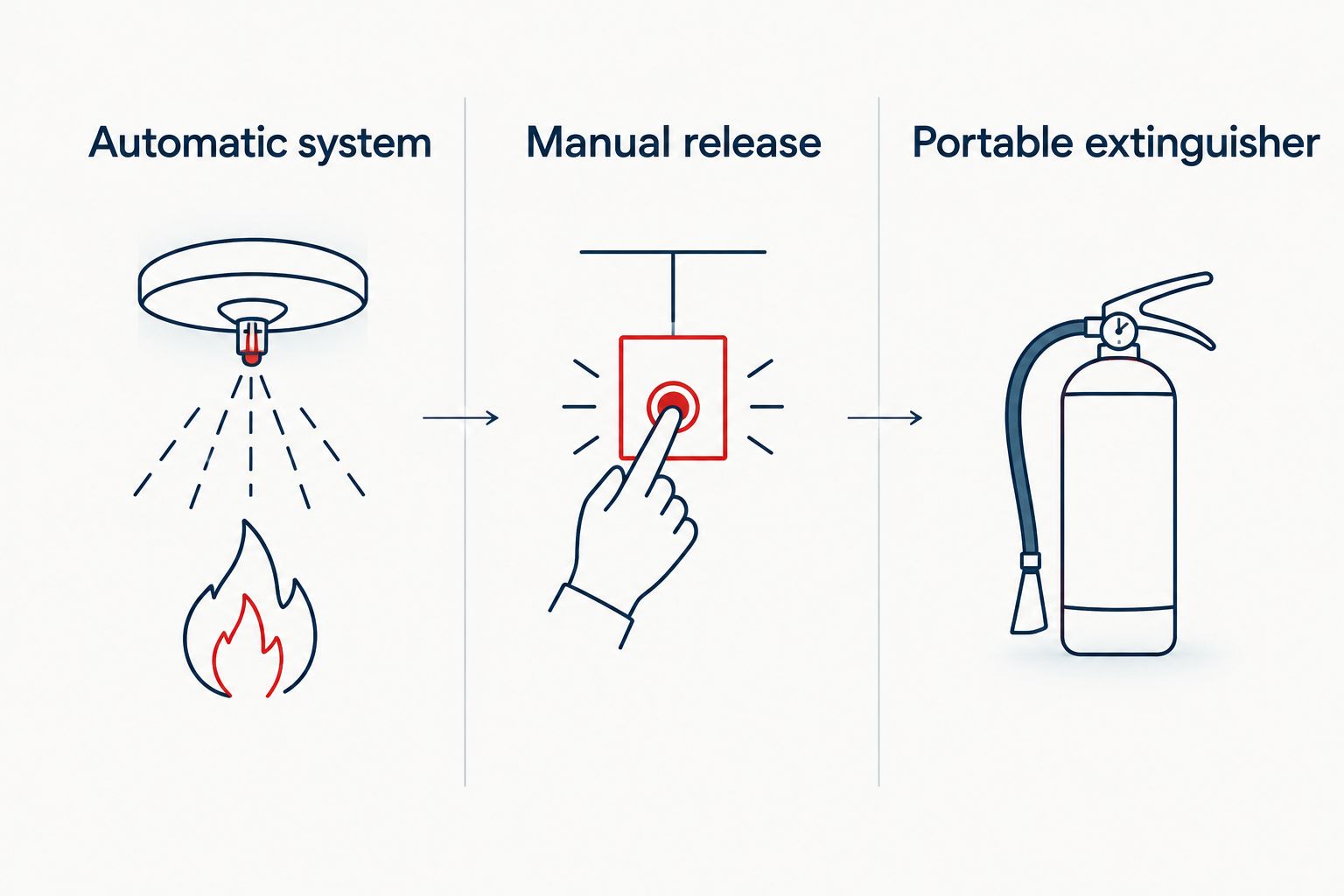
Both belong in driver training, but they call for different decisions. Automatic activation is not an instruction to stay with the vehicle. A manual release is not a general-purpose button to use without regard to the installed system’s directions.
| Situation | What the driver needs to know | What the driver must not assume |
|---|---|---|
| Automatic system indication or discharge | Stop safely, move people clear, call emergency services, and report the event. | A discharge proves the fire is out or the vehicle is safe to reenter. |
| Manual release on the installed system | Identify the control and follow the system’s instructions and fleet procedure for its use. | The same release location or activation method applies to another vehicle. |
| Portable extinguisher present | Recognize that it is separate from the installed suppression system and follow the fleet’s extinguisher training. | A portable extinguisher is a substitute for evacuation or emergency help. |
If an installed system has both automatic and manual functions, show both during the same parked-vehicle demonstration. Do not test a live release as a training exercise unless the equipment’s qualified service personnel have planned the work. Use the manufacturer’s training method for that system instead.
Why driver training varies
Use the same emergency priorities across the fleet, then change the equipment demonstration to match the vehicle. The factors that affect the lesson are concrete:
- Installed system and its instructions. Indicator meanings, manual controls, and fault procedures must come from the equipment fitted to the vehicle.
- Vehicle layout. The cab, protected area, and control locations determine what a driver must be able to find without searching.
- Driver assignment. A driver who rotates between vehicles needs an introduction to each different configuration before using it.
- People on board. Passenger and crew evacuation belongs in the response exercise when the vehicle carries other people.
- Portable extinguisher provision. If extinguishers are provided for employee use, applicable training duties must be addressed separately from installed-system instruction.
- Reporting chain. The fleet must specify who receives a fault report, an emergency report, and the vehicle after a discharge.
Do not build the lesson around the vehicle label alone. Two vehicles assigned to the same work can still have different controls. Use the installed system documentation and a walk-through at the vehicle to settle the details.
How do you check that a driver can respond?
Have the driver demonstrate and explain, rather than simply acknowledge a policy. Set the vehicle in a safe, parked condition. Point to an indicator or describe an alert, then ask the driver to work through the response without suggestions. Use a non-live demonstration of controls that follows the system’s instructions.
Check the actions individually. Can the driver find the indicator and manual control? Can they distinguish a fault before departure from a suspected fire during a route? Can they describe a safe stop, getting people clear, calling for help, and reporting the system event? A missed action calls for correction and another attempt, not a completed checkmark.
Record what was demonstrated and where. A useful record identifies the driver, training date, vehicle or installed system covered, instructor, and result. Keep a separate service report for faults or discharge. A training record shows that a person practiced a response; it does not show that equipment passed inspection.
In 2026, review the record when a driver changes vehicles or a system is changed. Teach the differences before that driver takes the vehicle out. Repeat the response exercise during the fleet’s scheduled safety training so locating controls does not depend on memory from an unrelated vehicle.
When does annual extinguisher training apply?
Under 29 CFR 1910.157(g), employers that provide portable fire extinguishers for employee use must provide education on their general principles and hazards upon initial employment and at least annually thereafter. Employees designated to use firefighting equipment need training on the appropriate equipment upon initial assignment and at least annually thereafter. Check how that standard applies to the fleet’s work and extinguisher policy; do not present those portable-extinguisher provisions as a universal training interval for every installed vehicle suppression system.
The distinction matters in a mixed fleet. A driver can have current portable-extinguisher education and still have never seen the installed suppression control in a newly assigned vehicle. Put both subjects in the plan, but record them so a supervisor can tell which one the driver completed.
Who should handle a fault or discharge after the driver reports it?
The driver reports what they observed and where the vehicle is. The fleet then keeps the vehicle from returning to duty until the fault or discharge has been assessed under its service procedure. Do not ask the driver to clear an alert merely to continue the route.
First-Line Fire Extinguisher Co. provides suppression systems and safety training services for vehicle and fleet customers. Its relevant role is system service and training support, not replacing the driver’s emergency call or the fleet’s dispatch decisions. When arranging support, give the provider the system information, vehicle identification, and driver’s report so the service question is clear.
Can a driver use a portable extinguisher after the system discharges?
A discharge does not, by itself, make extinguisher use safe. The driver’s first duties are a safe stop, getting people clear, and calling emergency services. Portable-extinguisher use depends on the employer’s training and policy, conditions at the scene, and a safe way out. A driver should never return to a vehicle or open a compartment to use an extinguisher against an unseen fire.
Keep this question in the drill because it exposes a common training gap: a driver sees that the installed system has discharged and treats it as permission to approach. The correct lesson is to reassess from a safe location and leave fire-scene decisions to emergency responders.
FAQ
How do you train fleet drivers on fire suppression systems?
Show drivers the installed controls and alerts, practice a safe stop and evacuation, and check their response on the vehicle they use. Record the system covered and correct any missed action before completing training.
Should drivers manually activate a vehicle fire suppression system?
Drivers should follow the installed system’s instructions and their fleet’s procedure for manual activation. Training must show the actual control without assuming another vehicle works the same way.
Does automatic suppression mean a driver can stay in the cab?
No. An automatic discharge does not establish that the fire is out or that the vehicle is safe; the driver should stop safely, move people clear, and call emergency services.
Is a portable extinguisher the same as an installed suppression system?
No. A portable extinguisher is separate equipment, with its own inspection and employee-training considerations. Show drivers where it is without treating it as a replacement for the installed system.
How often is portable-extinguisher education required at work?
For employers providing portable extinguishers for employee use, 29 CFR 1910.157(g) calls for education upon initial employment and at least annually thereafter. That rule does not set a blanket training interval for every installed vehicle suppression system.
What should a driver do when a suppression-system fault appears before departure?
The driver should report the indication under the fleet’s procedure before taking the vehicle out. The fleet should have the fault assessed rather than ask the driver to diagnose or clear it.
What should a fleet record after vehicle suppression training?
Record the driver, date, instructor, vehicle or system covered, actions practiced, and result. Keep equipment service findings in the service record, not solely in the driver’s training record.
One last thing
A driver can pass a general fire-safety class and still miss the manual control in a different truck. Before a 2026 vehicle reassignment, put the driver in the parked cab and ask them to find the indicator, identify the release, and describe their first response to an alert. If they cannot do that without a prompt, the vehicle-specific lesson is not finished.
For fleets operating across Kentucky, Illinois, Indiana, Tennessee, Missouri, and Alabama, First-Line Fire Extinguisher Co. offers vehicle and fleet suppression services and safety training. Keep the driver lesson tied to the installed equipment, regardless of who delivers it.


