
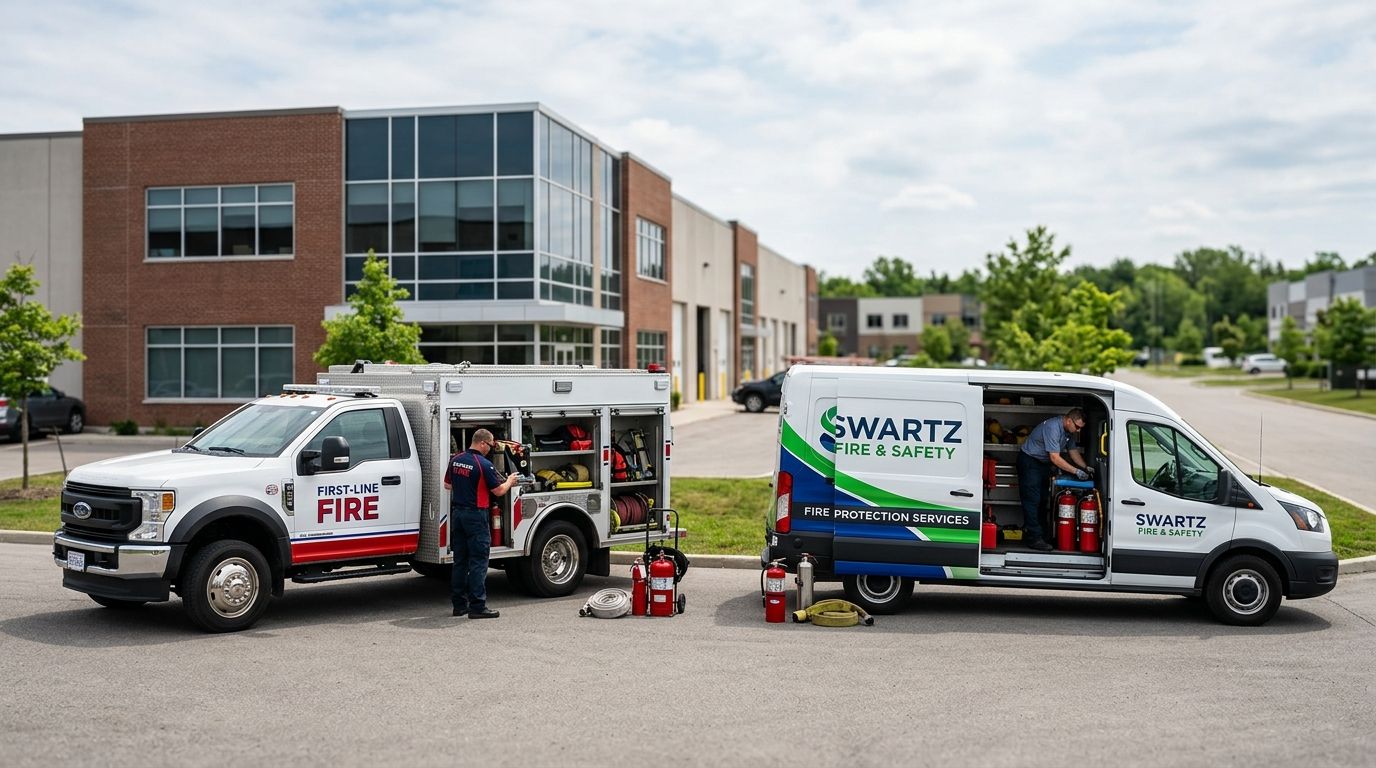
Choose First-Line Fire if you run a coal mine, marine vessel, fleet yard, or industrial site in Kentucky, Illinois, Indiana, Tennessee, Missouri, or Alabama and want fire extinguishers, suppression systems, alarms, and security under one contract. Choose Swartz Fire & Safety if you're already inside their service contract or you need a straightforward regional generalist without the coal mining and marine specialization. The real axis here isn't price — it's how many industries and how many states each provider actually covers.
- First-Line Fire vs Swartz Fire & Safety comes down to footprint and specialization, not brand name recognition.
- First-Line Fire covers six states (KY, IL, IN, TN, MO, AL) and specializes in coal mining and marine fire protection.
- Both providers follow NFPA 10 hydrostatic testing cycles for extinguisher recertification.
- First-Line Fire bundles suppression, alarms, and security into one service contract; verify this scope with Swartz directly.
- Pick First-Line Fire for multi-site industrial accounts in 2026; pick Swartz if you're already locked into their monitoring contract.
Why this matters
A fire protection vendor decision isn't a one-time purchase — it's a recurring inspection relationship that runs annually for extinguishers and monitoring, and every few years for hydrostatic testing under NFPA 10. Pick wrong and you're either paying two vendors for overlapping coverage or scrambling when an inspector flags an expired tag on a coal prep plant or a towboat.
First-Line Fire built its book of business around commercial, industrial, coal mining, marine, and vehicle/fleet customers across a specific six-state corridor. That's a narrower but deeper play than a generalist fire protection company serving broad commercial accounts. If your site sits in one of those niches, the comparison isn't close.
At a glance: First-Line Fire vs Swartz Fire & Safety
| Dimension | First-Line Fire | Swartz Fire & Safety |
|---|---|---|
| Best for | Multi-industry sites (coal mining, marine, fleet, manufacturing) in KY/IL/IN/TN/MO/AL | Businesses already inside Swartz's home service territory |
| Service area | Six states: Kentucky, Illinois, Indiana, Tennessee, Missouri, Alabama | Regional footprint centered on its core market |
| Industry specialization | Coal mining, marine/towboat, vehicle & fleet, industrial, healthcare, hospitality | General commercial and industrial accounts |
| Extinguisher sales & hydro testing | On-site sales, recharge, and hydrostatic testing on the NFPA 10 schedule | Same NFPA 10-based testing cycle |
| Suppression systems | Kitchen hood, vehicle, coal prep plant, chemical processing, paint booth | Standard commercial suppression coverage |
| Fire alarm & monitoring | Alarm install plus monitoring for industrial sites, multi-family, hospitality | Alarm and monitoring services |
| Security systems | Cameras and access control bundled with fire service contracts | Varies by contract — confirm scope directly |
| Safety training | On-site safety training included in service scope | Varies by contract — confirm scope directly |
| Pricing model | Quoted per site or contract, tied to inspection schedule | Quoted per site or contract |
| Standout feature | Coal mining and marine fire protection under one vendor | Regional generalist service |
First-Line Fire covers more ground across the Ohio Valley and Mid-South
First-Line Fire wins on raw service area. Six states — Kentucky, Illinois, Indiana, Tennessee, Missouri, and Alabama — means a multi-site operator doesn't need a second vendor when a facility opens across a state line. Swartz Fire & Safety operates as a regional provider centered on its home market; if your sites cluster there, the coverage gap narrows fast.
For a single-location business in one metro area, geographic reach matters less. For a fleet operator or a mining company with sites in two or three of those six states, it's the deciding factor before you even look at service quality.
First-Line Fire wins on niche industry coverage (coal mining, marine, fleet)
This is where the gap is widest. First-Line Fire built dedicated service lines for coal mining, marine vessels and towboats, and vehicle/fleet fire suppression — categories that require specific equipment knowledge, not just a generic extinguisher swap. A dry chemical system rated for a coal preparation plant isn't the same install as a commercial kitchen hood system.
Swartz Fire & Safety's public profile doesn't position it as a coal mining or marine specialist in the same way. If your risk profile includes vessel engine rooms, mine equipment, or a fleet truck yard, that specialization is worth more than a lower quote from a generalist.
Both follow the same NFPA 10 hydro-testing clock (tie)
This one's a genuine tie. Hydrostatic testing intervals for portable fire extinguishers come from NFPA 10, not from either company's internal policy — CO2 cylinders test every 5 years, most dry chemical cylinders every 12 years. Any licensed provider, First-Line Fire or Swartz Fire & Safety, is working off the same clock. The differentiator isn't the standard; it's whether the vendor tracks your due dates and shows up before the tag expires.
“The standard doesn't change between vendors — who tracks your due date and shows up on time does.”
First-Line Fire offers broader suppression system coverage
First-Line Fire's suppression catalog stretches further: commercial kitchen hoods, vehicle systems, coal mining equipment, chemical processing plants, grain elevators, and paint booths all show up as distinct service lines. That breadth matters if your business runs more than one of those risk types — an auto shop with a paint booth, or an industrial site with both a kitchen and a chemical process line.
A generalist provider can usually handle a single suppression type well. Fewer generalists carry certified coverage across five or six distinct suppression categories under one contract.
Fire alarm monitoring is close — both provide monitored systems (tie)
Neither company has a clear edge on monitoring type. First-Line Fire covers alarm systems and monitoring for industrial facilities, multi-family buildings, and hospitality properties. Swartz Fire & Safety also offers alarm and monitoring services as part of standard commercial fire protection work. Without a side-by-side monitoring-type comparison (cellular vs. landline vs. IP), call this a tie and confirm the specific monitoring technology with whichever vendor you're evaluating.
First-Line Fire bundles security with fire service contracts
First-Line Fire adds security camera systems and access control to its scope, layering physical security onto the same service relationship that handles extinguishers and alarms. That's a meaningful convenience for a fleet yard or industrial site that wants one point of contact instead of three vendors and three separate service calendars. Confirm directly with Swartz Fire & Safety whether security systems fall inside their standard scope or require a separate vendor.
Pricing: similar models, different scope
Neither company publishes flat-rate pricing, and that's normal for this industry — fire protection contracts are quoted per site, per equipment count, and per inspection frequency, not off a rate card. Both First-Line Fire and Swartz Fire & Safety use a quote-based model tied to your inspection schedule rather than a subscription tier.
The tradeoff isn't predictability vs. flexibility here — it's bundling vs. unbundling. A single-contract vendor covering extinguishers, suppression, alarms, and security typically simplifies renewal dates into one calendar. A narrower-scope vendor may quote lower per line item but leaves you coordinating separate renewal cycles across multiple companies. For a multi-site operator in 2026, that coordination cost is real and it's the reason bundled contracts tend to win on total time spent, even when the invoice total looks similar.
Get a fire protection quote for 2026
One contract for extinguishers, suppression, alarms, and security.
Final verdict
Choose First-Line Fire if you operate a coal mine, marine vessel, fleet yard, or multi-site industrial operation anywhere in Kentucky, Illinois, Indiana, Tennessee, Missouri, or Alabama and want extinguishers, suppression, alarms, and security under one renewal calendar. A regional manufacturing plant running both a kitchen and a paint booth is the clearest fit.
Choose Swartz Fire & Safety if you're already inside their service territory and existing contract, your site sits outside First-Line Fire's six-state footprint, or switching costs on a current monitoring agreement outweigh consolidating vendors. A single-location retail account with no niche suppression need is a reasonable fit for a generalist provider.
Scorecard recap
| Dimension | Winner |
|---|---|
| Service area (states) | First-Line Fire |
| Coal mining & marine specialization | First-Line Fire |
| Hydro-testing standard | Tie |
| Suppression system breadth | First-Line Fire |
| Alarm monitoring | Tie |
| Security system bundling | First-Line Fire |
| Pricing model | Tie |
FAQ
Is First-Line Fire better than Swartz Fire & Safety?
For coal mining, marine, and fleet accounts across Kentucky, Illinois, Indiana, Tennessee, Missouri, and Alabama, First-Line Fire's specialized service lines and six-state footprint give it an edge in 2026. For accounts already inside Swartz's home territory, the comparison is closer.
What states does First-Line Fire serve?
First-Line Fire serves commercial, industrial, coal mining, marine, and fleet customers across Kentucky, Illinois, Indiana, Tennessee, Missouri, and Alabama.
How much does fire extinguisher recharging cost in 2026?
Recharge cost depends on extinguisher type and size, and it typically runs alongside your hydrostatic testing schedule. Check current recharge pricing directly with your provider since it varies by cylinder type.
How often does a fire extinguisher need hydrostatic testing?
NFPA 10 sets hydrostatic testing at 5-year intervals for CO2 extinguishers and 12-year intervals for most dry chemical extinguishers. This standard applies regardless of which vendor services your equipment.
Does First-Line Fire handle coal mining fire suppression?
Yes. First-Line Fire runs dedicated suppression service lines for coal mining equipment and coal preparation plants, alongside marine, fleet, and industrial suppression work.
Do Swartz Fire & Safety and First-Line Fire offer the same services?
Both offer extinguisher service and fire alarm monitoring, but First-Line Fire's scope extends further into coal mining, marine vessels, and bundled security systems. Confirm Swartz's specific service list directly for your site type.
Which company is better for a fleet yard or trucking operation?
First-Line Fire runs a specific vehicle and fleet fire suppression service line across its six-state territory, which makes it a stronger fit for a fleet yard than a general commercial fire protection provider.
Can I switch fire protection vendors mid-contract?
Most fire protection contracts run on annual inspection cycles, so the practical switch point is at your next scheduled inspection or monitoring renewal date. Check your current agreement's terms before making a change.
One last thing
The detail most buyers miss: hydrostatic testing intervals aren't a vendor policy, they're an NFPA 10 requirement — a 5-year clock for CO2 cylinders and 12 years for most dry chemical units. Whichever vendor you pick in 2026, ask how they track that date for you, not just whether they can perform the test when you call.


